
 Muslim
In a landmark achievement for global telecommunications, Meta has officially unveiled "Petal," a revolutionary subsea cable system set to redefine the limits of intercontinental data transmission. Spanning 7,000 kilometers between the United States and France, Petal is the world’s first transoceanic subsea cable to achieve a capacity of one petabit per second (1 Pbps)—a staggering 1,000 terabits per second.
This infrastructure project does not merely offer an incremental upgrade; it represents a fundamental shift in submarine engineering. By successfully deploying multi-core fiber at scale, Petal effectively doubles the capacity of the most advanced subsea systems currently in operation, establishing a new gold standard for the digital backbone of the global internet.
The Main Facts: A New Benchmark for Global Traffic
The scale of Petal’s performance is difficult to comprehend in traditional networking terms. To put its 1 Pbps capacity into perspective, it would theoretically provide enough network bandwidth to allow 75% of the world’s population to stream high-quality music simultaneously.
For the average user, subsea cables are invisible, yet they are the lifeblood of the modern digital economy. Approximately 99% of all intercontinental data traffic—including every international phone call, streaming session, and business transaction—traverses these glass filaments resting on the ocean floor. Petal is designed to fortify this infrastructure, ensuring that the surging demand for reliable, low-latency connectivity is met with a future-proof foundation. By concentrating this massive volume of data into a single, highly efficient cable, Meta is reducing the material requirements, physical footprint, and carbon expenditure that would otherwise be associated with deploying multiple, less-efficient systems.
Chronology: The Evolution of Subsea Engineering
The journey to the petabit milestone is the result of decades of cumulative innovation. The history of subsea capacity is marked by distinct "step changes," each necessitated by the impending limits of physical science.
The Foundation (1980s–2000s)
The modern era of subsea communication began in the 1980s with the introduction of erbium-doped fiber amplifiers (EDFA). This technology allowed signals to travel across vast ocean distances without needing constant electrical regeneration, enabling the first true wave of high-speed connectivity.
The Coherent Revolution (2010s)
The 2010s brought about the era of "coherent optical transmission." By leveraging advanced modulation techniques, engineers were able to push significantly more data through existing fiber strands. During this period, the industry saw capacity increases of tenfold or more. However, as these systems pushed the boundaries of physics—approaching the "Shannon Limit," the theoretical maximum information transfer rate of a communications channel—it became clear that simply refining existing technology would no longer suffice.
The Pivot to Spatial Division Multiplexing (SDM)
Facing the Shannon Limit, the industry shifted toward Spatial Division Multiplexing (SDM). Instead of trying to squeeze more data into a single core, engineers focused on increasing the number of fiber pairs within a cable.
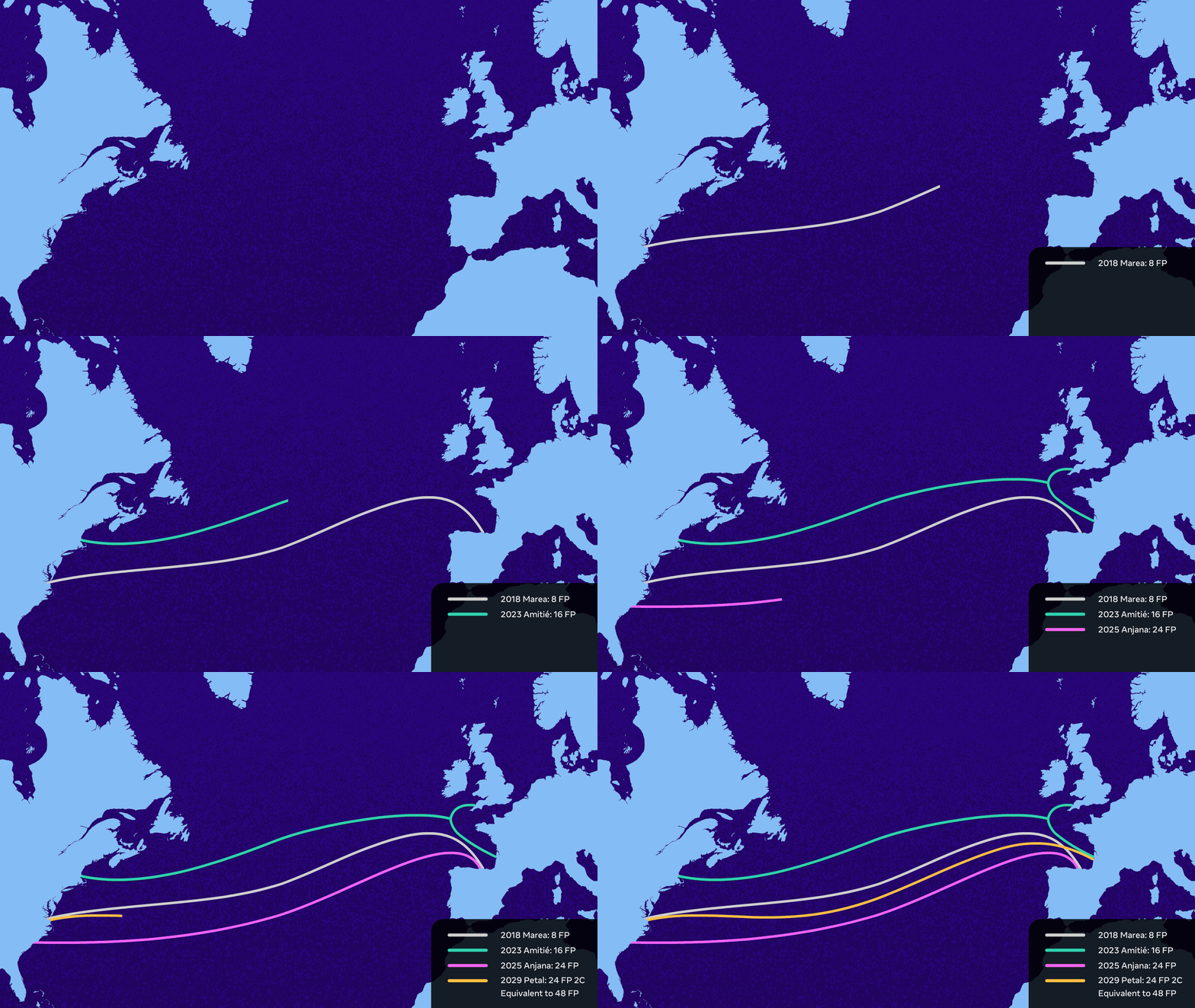
- Marea: Meta’s early investment, featuring eight fiber pairs, set an initial standard.
- Amitié: This system pushed the envelope to 16 fiber pairs.
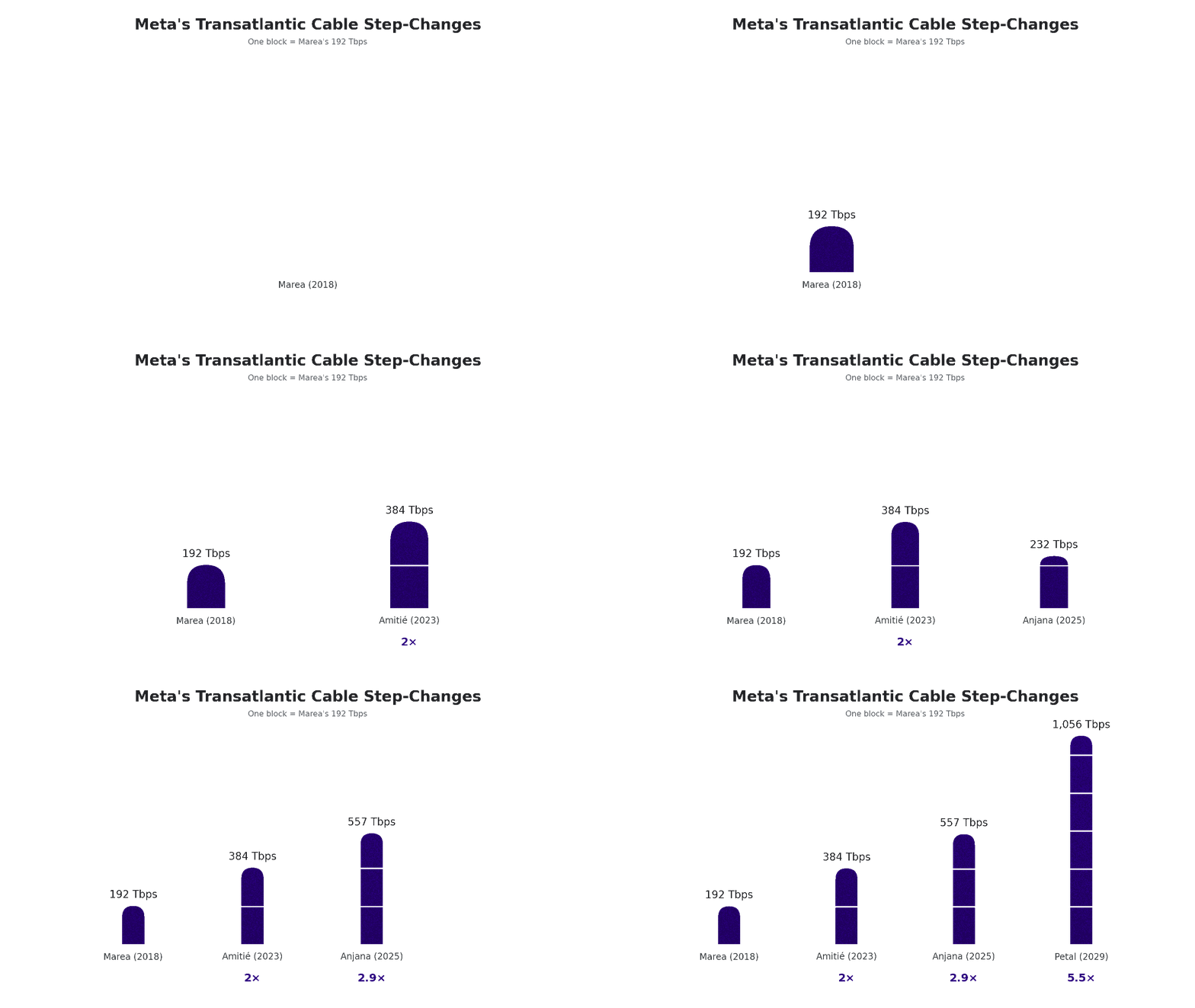
- Anjana: Recently landing in Spain, this system introduced 24 fiber pairs, achieving a breakthrough 0.5 Pbps capacity.
Petal represents the next logical step in this evolution: the adoption of 2-core fiber technology. By utilizing a 24 fiber-pair system where each fiber contains two cores, Petal achieves the equivalent of 48 fiber pairs, effectively doubling the capacity of Anjana and cementing its status as the largest single generational leap in subsea history.
Supporting Data: The Physics of Multi-Core Innovation
Transitioning to a 2-core fiber ecosystem presented significant technical hurdles. A subsea cable is subjected to immense pressure and must survive in harsh deep-sea environments for 25 years or more. Integrating two cores into a single strand of glass, roughly the thickness of a human hair (125 µm), required a complete reimagining of fiber manufacturing.
The Fiber Challenge
The two primary obstacles were attenuation (signal loss) and crosstalk (interference between the two cores). Sumitomo Electric Industries solved these issues by using ultra-pure synthetic silica in the manufacturing of the fiber preforms. By precisely controlling the refractive indexes within the cores and the surrounding medium, and by using a counter-propagating signal strategy, the engineering team achieved near-zero crosstalk. The result is a fiber strand that performs with the same reliability as single-core fiber but with double the throughput.
The Repeater Architecture
A 7,000 km cable requires approximately 100 repeaters to amplify signals across the ocean floor. Petal utilizes a sophisticated "Fan-In/Fan-Out" (FIFO) interface. This system transitions the 2-core signals into two single-core signals for the amplification process, then merges them back into the 2-core format. This allows the system to utilize proven, highly efficient amplification technology while maintaining a power-efficient architecture. Crucially, this design ensures that Petal operates within existing 18 kV power-feeding equipment limits, avoiding the need to completely redesign global subsea power infrastructure.
Official Responses and Strategic Partnerships
The realization of Petal is the result of a deep collaboration between Meta, NEC, Sumitomo Electric, and Orange.
NEC, acting as the turnkey system supplier, played a critical role in qualifying the world’s first petabit-capable system. Eduardo Mateo, Chief Strategy Officer of NEC’s Submarine Network Division, noted: "Achieving petabit-per-second capacity across a transoceanic submarine system represents a major technological milestone. This achievement reflects NEC’s sustained investment in R&D and our commitment to delivering secure, reliable global networks."
Sumitomo Electric Industries, the fiber provider, emphasized the importance of their "2C Z-PLUS ULL Fiber." Takehiko OKADA, General Manager of the Optical Fiber & Cable Division, stated: "We are thrilled that our innovative multi-core fiber will contribute to Petal. As a pioneer in ultra-low loss fiber, we are committed to supporting the global network expansion essential for a highly digital future."
Orange, the landing party in France, underscored the importance of this infrastructure for European connectivity. Jean-Louis Le Roux, EVP of Orange International Networks, remarked: "Reaching one petabit on a transatlantic link, 25 years after the terabit milestone, is a significant breakthrough. This project reinforces our commitment to Meta and demonstrates our expertise in extending connectivity to European countries, ensuring the security and resilience of our terrestrial networks."
Implications: Building for the Next Generation
The implications of Petal extend far beyond Meta’s own service requirements. By moving multi-core fiber from the experimental lab into a mainstream, scalable production environment, Meta is providing a roadmap for the rest of the telecommunications industry.
As artificial intelligence, immersive virtual reality, and high-definition global collaboration tools continue to consume bandwidth, the "Petabit Era" arrives at a critical juncture. The infrastructure laid today will dictate the possibilities of the internet for the next quarter-century. By fostering this innovation, Meta is not only securing its own capacity needs but is actively contributing to the resilience and growth of the global digital backbone.
Petal is more than just a cable; it is a proof-of-concept for the future of human connectivity, signaling that even as we approach the theoretical limits of physical transmission, the ingenuity of global engineering continues to open new doors. Through collaborative investment and a willingness to rethink the fundamental architecture of the ocean floor, the industry has ensured that the digital world will continue to expand, faster and more efficiently than ever before.

 Nila Kartika Wati
 Neng Nana
 Basiran

 Iffa Jayyana
 Raul Delapena Setiawan
 Rifan Muazin
 Asro
Asro