
 Layla Zulfa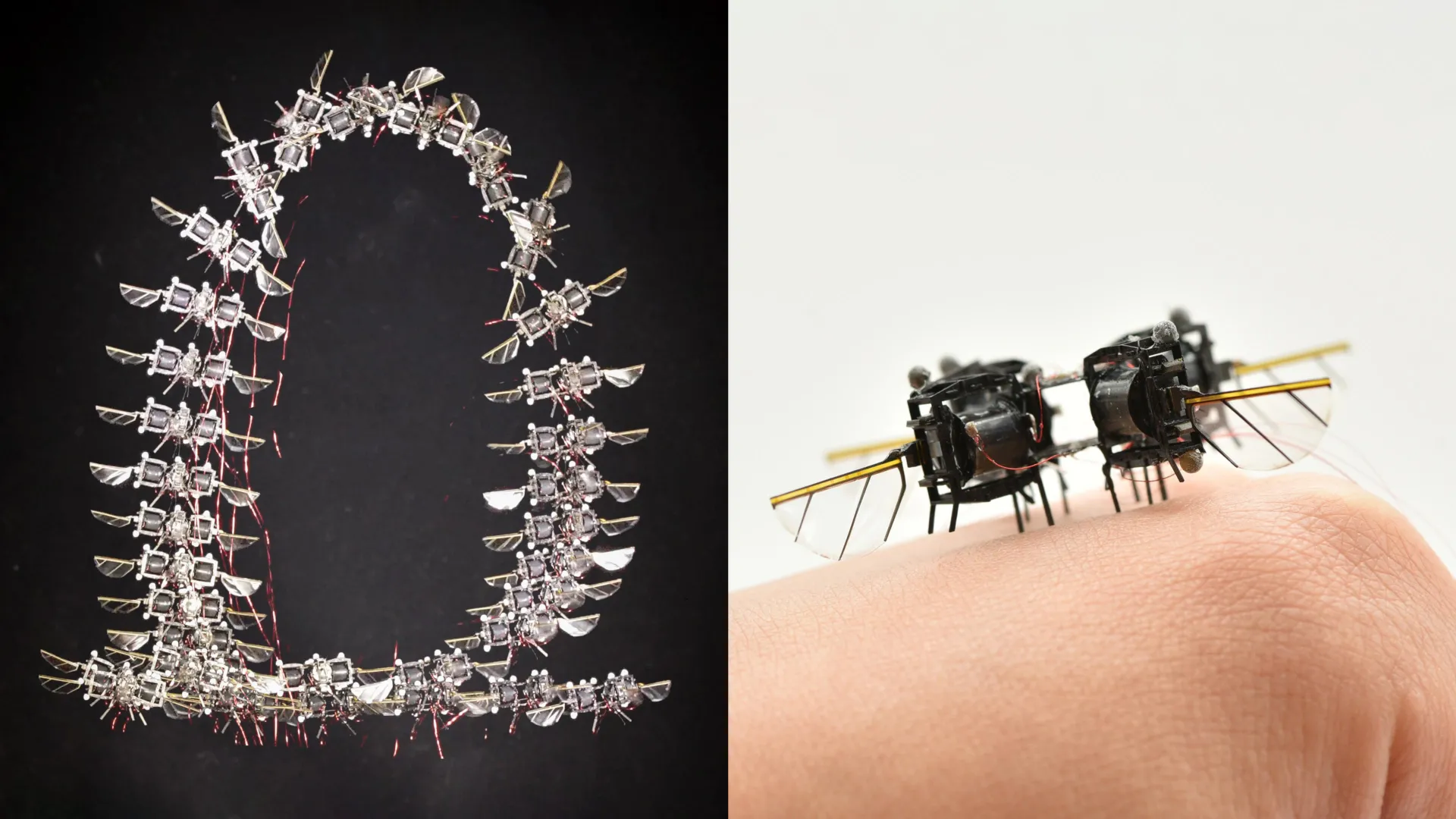
In the aftermath of a catastrophic earthquake, when time is measured in breaths and structural integrity is a memory, the first responders are often confronted by the impossible: voids too small for humans, gaps too unstable for search dogs, and debris fields too chaotic for traditional drones. For years, the vision of a "robotic swarm"—tiny, insect-scale machines capable of threading through the rubble of a collapsed building—has been the holy grail of search-and-rescue engineering.
Today, that vision has taken a massive leap toward reality. Researchers at the Massachusetts Institute of Technology (MIT) have unveiled a breakthrough in bioinspired robotics, demonstrating a microrobot capable of aerial maneuvers—including high-speed somersaults—that rival the agility of the very insects that inspired them. By pairing sophisticated artificial intelligence with soft-robotic hardware, the team has shattered previous performance limitations, marking a paradigm shift in how we perceive the utility of micro-scale flight.
The Chronology of a Breakthrough
The journey to this moment has been a five-year odyssey led by Kevin Chen, an associate professor in the Department of Electrical Engineering and Computer Science (EECS) and head of the Soft and Micro Robotics Laboratory at MIT.
For the better part of a decade, the field of microrobotics was stuck in a "slow-motion" phase. While engineers could successfully build robots the size of a microcassette and weighing less than a paperclip, these machines were largely static or sluggish. They followed rudimentary flight paths and lacked the "reflexes" to handle turbulence or complex navigation.
The initial hurdle was purely mechanical. The team first focused on building a more durable, robust chassis capable of enduring the stresses of high-speed movement. This culminated in a design featuring larger flapping wings powered by soft artificial muscles. These muscles are capable of contracting at high frequencies, producing the rapid wingbeats necessary for true flight. However, as the hardware matured, the "brain" of the robot became the bottleneck. Traditional controllers, which dictate the robot’s orientation and trajectory, were either too simple to allow for complex movement or too computationally heavy to operate in real-time on a micro-scale platform.
The turning point occurred when Chen’s team joined forces with the Laboratory for Information and Decision Systems (LIDS), led by Jonathan P. How, the Ford Professor of Engineering. Together, they developed a two-part AI-driven control system that finally allowed the robot to think as fast as it could fly.
Decoding the Anatomy of Agile Flight
The technological core of this achievement lies in the duality of its control system: a high-level "expert" planner and a low-level "policy" executor.
The Expert Planner: Model-Predictive Control
At the heart of the system is a model-predictive controller. In engineering terms, this is a mathematical powerhouse that simulates the robot’s physics in real-time. It predicts how the robot will behave over a short window of time, calculating the exact thrust and torque required to navigate a specific path. Because the aerodynamics of a tiny, fluttering machine are notoriously complex—often involving unstable vortex shedding and air-flow interference—the model-predictive controller provides the stability required to plan aggressive moves, such as a sharp 90-degree turn or a mid-air flip.
The Policy Executor: Imitation Learning
While the expert planner is brilliant, it is computationally "expensive"—it requires too much power to be housed on a tiny robot. To solve this, the team employed a technique known as "imitation learning." They used the expert planner to generate a massive library of successful flight maneuvers and then trained a "policy"—a deep-learning model—to mimic these expert moves.
This policy acts as the robot’s real-time intuition. Because the policy is a distilled, streamlined version of the expert model, it can run instantaneously on the robot’s limited hardware. The result is a system that possesses the foresight of a high-end supercomputer but the agility of a bumblebee.
Supporting Data: By the Numbers
The performance gains realized by this new control architecture are nothing short of transformative. According to the research published in Science Advances, the MIT team achieved the following metrics compared to their previous-generation robots:
- Speed: A 447 percent increase in maximum flight velocity.
- Acceleration: A 255 percent boost, allowing the robot to change speed and direction with near-instantaneous responsiveness.
- Agility Test: In a stress-test scenario, the robot successfully completed 10 consecutive somersaults in just 11 seconds.
- Spatial Accuracy: Despite deliberate wind disturbances introduced during the test, the robot remained within 4 to 5 centimeters of its intended flight path, proving its resilience against external environmental chaos.
These numbers confirm that the robot is no longer just "flying"; it is navigating. The ability to perform consecutive flips demonstrates a level of control stability that was previously thought impossible at this scale, as any minor error in a flip would typically compound and result in a catastrophic crash.
Expert Perspectives
The project is a testament to interdisciplinary collaboration. Kevin Chen emphasizes that the goal was never just to build a cool toy, but to solve a logistical nightmare for rescue operations.
"We want to be able to use these robots in scenarios that more traditional quadcopter robots would have trouble flying into," Chen explains. "Now, with our bioinspired control framework, the flight performance of our robot is comparable to insects in terms of speed, acceleration, and the pitching angle. This is quite an exciting step toward that future goal."
Jonathan P. How, the co-senior author, highlights the synergy between software and hardware. "The hardware advances pushed the controller so there was more we could do on the software side, but at the same time, as the controller developed, there was more they could do with the hardware. As Kevin’s team demonstrates new capabilities, we demonstrate that we can utilize them."
Yi-Hsuan Hsiao, a lead author and graduate student, adds, "This work demonstrates that soft and microrobots, traditionally limited in speed, can now leverage advanced control algorithms to achieve agility approaching that of natural insects and larger robots, opening up new opportunities for multimodal locomotion."
The Path Ahead: From Laboratory to Rubble
While the current results are groundbreaking, the team is already looking toward the next phase of development. The current prototype relies on an external motion-capture system to track its position in space. To make these robots truly viable for real-world rescue missions, they must become autonomous.
Integrating Sensors
The next major objective is the integration of onboard cameras and sensors. By miniaturizing these components, the researchers aim to allow the robots to navigate uncharted environments without the need for external infrastructure. This is where the team’s work on "saccades"—a movement common in insects where they pitch their bodies to stop and re-orient—becomes vital. By mimicking this behavior, the robots can stabilize their vision, allowing for clearer image capture even while moving at high speeds.
Swarm Coordination
Beyond individual performance, the team is investigating the potential for swarm intelligence. If a team of dozens of these microrobots can be deployed into a collapsed building, they could coordinate their movements to avoid collisions while covering a vast area. This would allow for rapid, mapping of voids and the detection of trapped survivors, providing a high-resolution "digital twin" of a disaster site within minutes.
A Paradigm Shift
As noted by Chen, the significance of this paper reaches beyond the immediate application of rescue robots. It signals a shift in the micro-robotics community, proving that high-performance, complex control architectures can be achieved with computational efficiency.
The research was a collaborative effort involving a wide team, including lead authors Yi-Hsuan Hsiao, Andrea Tagliabue, and Owen Matteson, along with Suhan Kim and Tong Zhao. Their work was supported by the National Science Foundation, the Office of Naval Research, the Air Force Office of Scientific Research, MathWorks, and the Zakhartchenko Fellowship.
As these tiny machines continue to evolve, the distinction between biological insects and mechanical ones blurs. In the future, the sound of a buzzing fly in a disaster zone might not be a nuisance—it might be the sound of a rescuer, the smallest and most agile agent in the field, working to save a life.


 Nila Kartika Wati
 Nana Wu
 Basiran
 Neng Nana
 Iffa Jayyana
 Raul Delapena Setiawan
 Rifan Muazin
 Asro
Asro