
 Jia Lissa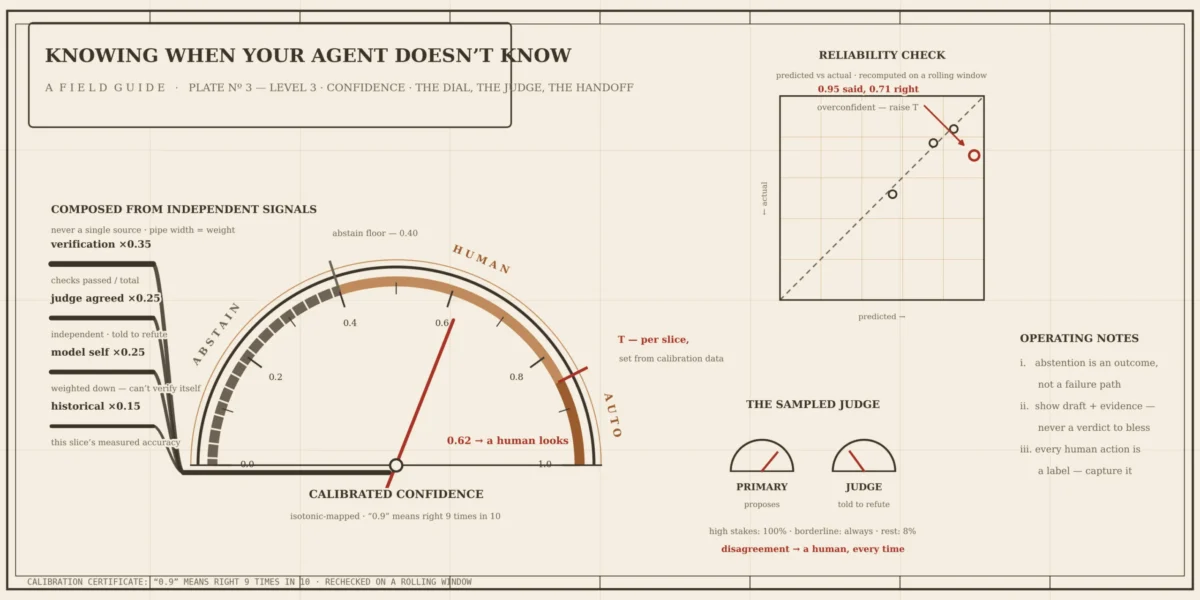
In the rapidly maturing landscape of Large Language Model (LLM) deployment, the industry has moved past the initial "wow" factor of generative AI. Enterprises are no longer satisfied with systems that merely produce creative text; they now demand reliability, accountability, and, most importantly, the ability to discern when a system is—or is not—capable of fulfilling a task.
This evolution represents "Level 3" in the six-level maturity model for LLM production. While Levels 1 and 2 focus on functional output and basic monitoring, Level 3 is defined by a singular, critical capability: Calibrated Confidence. A production-grade LLM system must be able to "know what it doesn’t know," routing ambiguous queries to human reviewers while automating only those decisions where its internal confidence has been verified against empirical, real-world data.
The Illusion of Model Self-Assessment
Ask a standard LLM, "How confident are you in this answer?" and the response is almost universally useless. Models are notorious for being "confidently wrong." Their internal probability distributions are not calibrated for real-world accuracy, and they possess a pathological tendency to hallucinate certainty.
Consequently, relying on a model’s self-reported confidence is a single point of failure. To achieve industrial-grade reliability, engineers must abandon the notion of a single source of truth and instead compose a production score from multiple, independent signals.
A robust confidence score is not a single number; it is a weighted aggregate. By combining the model’s internal self-assessment (weighted lower, at approximately 25%) with deterministic verification checks, historical accuracy metrics for specific data slices, and the verdict of an independent "judge" model, developers can construct a signal that actually represents the probability of a correct outcome.
The Chronology of Decision Engineering
The journey to a reliable LLM system typically follows a distinct evolutionary path, transitioning from manual oversight to sophisticated, risk-aware automation.
Phase 1: The Basic Implementation (Levels 1-2)
Initial deployments focus on getting the model to produce output that satisfies basic business requirements. In these early stages, visibility is the primary goal. Teams implement basic logging to see what the model is doing, but the automation is often binary: it either runs the model or it doesn’t.
Phase 2: Building the Confidence Dial (Level 3)
As volume increases, the "human-in-the-loop" (HITL) bottleneck becomes apparent. The system must now differentiate between high-stakes decisions (which require extreme caution) and routine, low-risk tasks. Developers introduce the "Confidence Dial"—a mechanism that uses the composed signals to decide whether to execute an action, abstain, or escalate.
Phase 3: The Adversarial Judge
The most advanced systems move beyond simple thresholds by implementing an adversarial judge. This is a secondary, often different, model family tasked with a specific directive: refute the primary model. By framing the judge’s prompt to be skeptical—asking "Where is this wrong?" rather than "Is this right?"—engineers can surface failure modes that would otherwise go unnoticed until a customer complaint triggers a manual investigation.
Supporting Data and Technical Implementation
The efficacy of these systems relies on mathematical rigor, specifically in the calibration of confidence scores. A score of 0.9 is meaningless unless it implies a 90% accuracy rate in practice.
Reliability Diagrams
Teams should use reliability diagrams to map predicted confidence against actual accuracy. If a system claims 95% confidence but only achieves 71% accuracy, the automation threshold is too loose, and the system is dangerously overconfident. By bucket-testing these predictions, engineers can create a calibration map—often using IsotonicRegression—that ensures the threshold T is truly representative of the probability of success.
The Weighting Framework
The following structure represents the foundational logic for composing a confidence score:
- Model Self-Reported Score (25%): A baseline, but treated with inherent skepticism.
- Deterministic Verification (35%): Checks passed (e.g., regex matching, JSON schema compliance).
- Judge Agreement (25%): The adversarial evaluation from the secondary model.
- Historical Slice Accuracy (15%): Measured performance of the model on similar, past data.
The Criticality of the Human-in-the-Loop (HITL)
Perhaps the most overlooked element of LLM production is the handoff to humans. A poorly designed HITL system is often worse than no human intervention at all. If the interface is designed as an "Approve" button, humans—under the pressure of high queue volumes—will eventually lapse into rubber-stamping, creating a false sense of accountability without actual oversight.
Principles of Effective Handoffs:
- Draft, Don’t Verdict: Show the human the draft and the evidence used to generate it. Do not force them to merely bless an already finalized output.
- Contextual Routing: Always include the
routed_becausemetadata. If a human knows why the system is unsure (e.g., "Confidence below 0.85" or "Judge disagreed"), they can focus their attention on the specific points of failure. - Actionable Feedback: Every human edit must be captured as a training signal. This closes the loop: the human’s correction becomes a new data point that improves the model’s performance for the next similar query.
Implications for Future AI Infrastructure
The transition to Level 3 maturity has profound implications for enterprise AI adoption.
Reducing "Unknown Unknowns"
The most powerful aspect of this architecture is the "abstain" floor. By establishing a lower bound—an ABSTAIN_FLOOR of, for example, 0.40—the system acknowledges its own limits. When a query falls below this threshold, the system declines to provide a draft at all, escalating it immediately to human intervention. This acts as a firebreak, preventing the system from guessing on inputs it doesn’t understand.
The Death of the "Black Box"
By moving toward a composed, calibrated, and judged architecture, companies are effectively killing the "black box" nature of AI. When a decision is made, the organization can provide a granular audit trail: "The system was 92% confident, the verification checks passed, and the adversarial judge was unable to find a fault." This is the foundation of trust.
Strategic Scaling
Organizations that implement these mechanisms can scale their automation much faster than those who rely on global, uncalibrated thresholds. Because the confidence dial is per-slice, a company might be 99% automated for simple administrative tasks while maintaining 100% human review for high-impact financial transactions. This nuanced approach allows for operational efficiency without compromising safety.
Conclusion: Knowing When to Stop
The ultimate goal of an LLM production system is not to be right 100% of the time, but to know exactly when it is going to be wrong. A system that "knows when it doesn’t know" is infinitely more valuable than one that forces an answer at all costs.
As we look toward the future of LLM deployment, the winners will be those who prioritize the structural integrity of their confidence mechanisms over the raw performance of their models. By composing independent signals, calibrating them against empirical reality, and treating human intervention as a high-value audit rather than a failure state, businesses can finally unlock the true, safe potential of generative AI.
The era of blind automation is over; the era of calibrated, evidence-based AI decision-making has begun.

 Nila Kartika Wati
 Neng Nana
 Basiran

 Iffa Jayyana
 Raul Delapena Setiawan
 Rifan Muazin
 Asro
Asro