
 Reynand Wu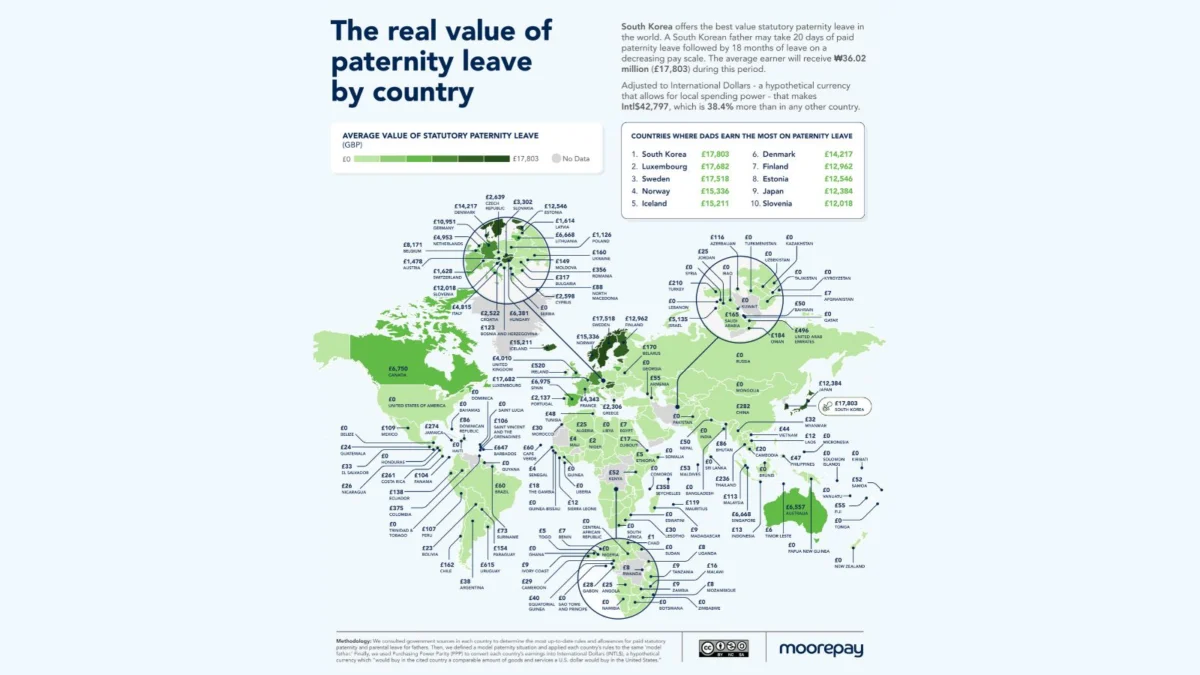
The landscape of global parental benefits is undergoing a seismic shift, yet a profound disparity remains between nations that view fatherhood as a public health priority and those that treat it as a private burden. A comprehensive new study by Moorepay, titled "The Ultimate Guide to Global Paternity Leave 2026," has revealed a staggering gap in statutory provisions for fathers. At the pinnacle of this global ranking sits South Korea, a nation that now offers fathers more than KRW 36 million (approximately £17,803 or Intl$42,797) in statutory paid leave. Conversely, the study highlights a sobering reality: 51 countries, including the United States, provide no statutory paid paternity leave whatsoever.
As governments grapple with declining birth rates and evolving workplace dynamics, the Moorepay study provides a critical benchmark for how different cultures value the role of the father in the early stages of a child’s life.
Main Facts: The Leaders and the Laggards
The Moorepay research, which utilized a standardized model to compare paternity and parental leave provisions across the globe, identifies South Korea as the world leader in financial support for new fathers. Under the study’s model—which assumes a firstborn child and a 50/50 split of shared parental leave—South Korean fathers are eligible for a total of 82 weeks of paid leave. When adjusted for "full-pay equivalence" (the number of weeks a father would receive if the benefit were paid at 100% of the average salary), South Korea still leads the pack at 43.4 weeks.
Japan follows closely in terms of duration, offering 48 weeks of paid leave, while Hungary ranks third at 42.1 weeks. However, the financial value of these benefits varies significantly when adjusted for Purchasing Power Parity (PPP). While South Korea offers the highest absolute value, European nations dominate the top ten list for overall support.
At the opposite end of the spectrum, the study identifies a "zero-provision" group. This list includes 51 countries where fathers have no legal right to paid time off. Notable among these are the United States, Serbia, and New Zealand. In these nations, any paid leave a father receives is entirely at the discretion of the employer rather than a guaranteed statutory right.
The Evolution of Paternity Leave: A Chronology of Change
The concept of statutory paternity leave is a relatively modern phenomenon compared to maternity leave, which saw widespread adoption in the mid-20th century. Historically, the burden of childcare was placed almost exclusively on mothers, with fathers expected to return to work immediately following a birth.
- The 1970s and 80s: Nordic countries began pioneering the "daddy quota"—non-transferable leave reserved specifically for fathers—to encourage gender equality in the home. Sweden was a frontrunner, introducing gender-neutral parental leave in 1974.
- The 2000s: The European Union began pushing for standardized minimums, leading to the 2019 Work-Life Balance Directive, which mandated at least 10 days of paternity leave across member states.
- The 2020s: Facing "demographic cliffs" (extremely low birth rates), East Asian nations like South Korea and Japan drastically increased their provisions. South Korea’s recent surge to the top of the rankings is a direct response to having the world’s lowest fertility rate, as the government attempts to remove the financial and professional barriers to starting a family.
The Moorepay study reflects this latest era of policy-making, where paternity leave is no longer seen just as a "nice-to-have" benefit, but as a critical lever for national survival and economic stability.
Supporting Data: Breaking Down the Top 10
To ensure a fair comparison, Moorepay’s methodology used the World Bank’s average income per capita for each country as the salary basis. Figures were converted into "International Dollars" using PPP conversion factors to account for the cost of living.
Top 10 Countries by Value of Statutory Paternity Leave (in International Dollars)
| Rank | Country | Average Value (GBP) | Paternity Pay (Intl$) | Full Pay Equivalent (Weeks) |
|---|---|---|---|---|
| 1 | South Korea | £17,803 | $42,797 | 43.4 |
| 2 | Japan | £12,384 | $27,518 | 31.9 |
| 3 | Sweden | £17,518 | $25,127 | 20.2 |
| 4 | Slovenia | £12,018 | $24,088 | 35.0 |
| 5 | Estonia | £12,546 | $23,974 | 38.2 |
| 6 | Luxembourg | £17,682 | $23,324 | 12.1 |
| 7 | Norway | £15,336 | $21,812 | 14.6 |
| 8 | Denmark | £14,217 | $19,057 | 14.4 |
| 9 | Finland | £12,962 | $18,905 | 16.4 |
| 10 | Iceland | £15,211 | $16,920 | 12.8 |
The data reveals that while South Korea provides the highest monetary value, countries like Estonia and Slovenia offer a higher "full pay equivalent" relative to their local economies. This suggests that while South Korean fathers receive more cash, Estonian fathers may experience less of a lifestyle "dip" during their leave period.
Official Responses and Expert Perspectives
The findings of the Moorepay study have reignited the debate over whether parental leave should be categorized as a labor issue or a public health issue.
Dr. Craig Garfield, a leading researcher and co-author of several papers on paternal mental health, emphasizes that the benefits of leave extend far beyond the household budget. "Our findings underscore that paternal leave is not just a workplace benefit; it’s a public health issue that can deeply impact families and children," Garfield stated.
According to Dr. Garfield, fathers who take leave are less likely to experience symptoms of depression and are more likely to be involved in childcare activities—such as feeding, bathing, and reading—long after the leave period ends. This "bonding capital" built in the first few months has been shown to improve a child’s cognitive development and emotional stability.
From a corporate perspective, the study’s authors at Moorepay suggest that employers in countries with low statutory requirements may need to step up to remain competitive. "As the global talent war intensifies, employees are looking beyond salary. They are looking at how a company supports them as a whole person, including their roles as parents," the report suggests.
Societal and Economic Implications
The disparity in paternity leave has far-reaching consequences for gender equality, workforce participation, and national economies.
1. Closing the Gender Pay Gap
One of the most significant implications of robust paternity leave is its impact on the "motherhood penalty." When only mothers take leave, they face a career hit that fathers do not. By encouraging or mandating that fathers take leave—as seen in the South Korean and Swedish models—the professional "risk" of having a child is distributed more evenly between genders. This helps keep women in the workforce and reduces the long-term pay gap.
2. Addressing the Demographic Crisis
In nations like South Korea and Japan, paternity leave is a tool of existential importance. With fertility rates well below the replacement level of 2.1, these governments are using generous leave policies to signal that the state will share the financial burden of child-rearing. However, the Moorepay study notes that "offering" leave is not the same as "taking" leave; cultural stigmas in corporate Asia often prevent fathers from utilizing the full 82 weeks available to them.
3. The "Zero-Leave" Economic Cost
In countries like the United States, the lack of statutory paid leave often forces fathers back to work within days of a birth. This can lead to increased stress, lower workplace productivity, and higher turnover rates as parents struggle to balance work and infant care. Economists argue that the lack of a federal policy creates an uneven playing field where only employees at high-end tech or finance firms enjoy these benefits, further widening the wealth gap.
4. Mental Health and Family Stability
The Moorepay study highlights that paternity leave supports fathers’ wellbeing during a period of high strain. By allowing fathers to be present, the physical and emotional burden on the mother is reduced, potentially lowering the incidence of postpartum depression. A stable home environment in the first year of life is a primary predictor of a child’s future success, making paternity leave a long-term investment in the national human capital.
Conclusion: The Path Forward
The Moorepay study serves as a wake-up call for policymakers worldwide. While South Korea’s KRW 36 million provision sets a high bar for financial commitment, the fact that 51 countries offer nothing suggests that the global community is far from a consensus on the value of a father’s time.
As we move toward 2026, the trend in developed economies appears to be shifting toward more flexible, better-paid, and "use-it-or-lose-it" paternity quotas. For the 51 nations currently at the bottom of the list, the pressure to reform is mounting—not just from human rights advocates, but from an economic necessity to support the next generation of workers and parents.
The message from the data is clear: Paternity leave is no longer a peripheral "perk." It is a fundamental component of a modern, equitable, and healthy society. Whether other nations will follow South Korea’s lead in making a multi-million won commitment to fathers remains to be seen, but the conversation has officially moved from the HR department to the halls of parliament.


 Pevita Pearce
 Suro Senen
 Laily UPN
 Iffa Jayyana
 Rifan Muazin

 Lina Hope
 Lina Irawan