
 Siti Muinah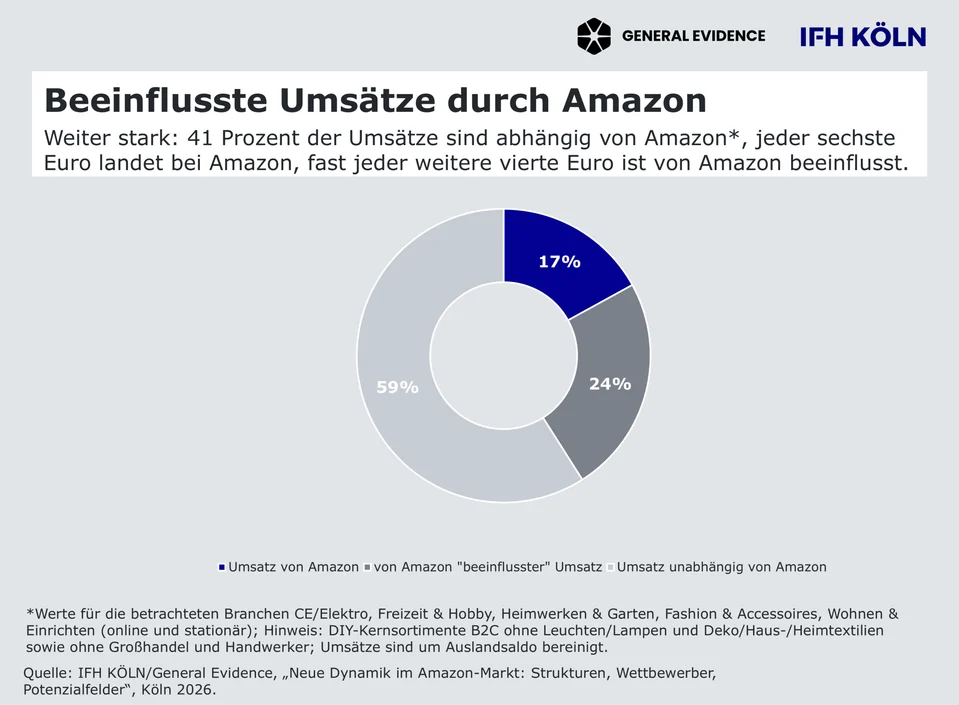
The retail landscape in Germany is undergoing a profound structural transformation, with Amazon cementing its position as the undisputed titan of commerce. A comprehensive new study conducted by the Institut für Handelsforschung (IFH Köln) and General Evidence reveals that the American tech giant now exerts influence over an astonishing 41 percent of all consumer spending in the product categories analyzed. Far from being merely an online bookstore or a marketplace, Amazon has become the foundational infrastructure upon which German consumption is built.
As the lines between digital and physical retail blur, Amazon’s reach extends far beyond its own servers, dictating the flow of goods and influencing the survival of independent merchants across the nation.
Main Facts: A Colossus of Consumption
The scale of Amazon’s operations in Germany is difficult to overstate. According to the IFH Köln report, Amazon generated an estimated 69.1 billion euros in sales within the German market last year. This figure represents a robust growth of 3.2 billion euros—a 5 percent increase over the previous year.
Perhaps the most telling metric of Amazon’s integration into German daily life is its reach: 97 percent of German online shoppers utilize the platform, and 59 percent of those consumers are dedicated Prime members. This membership model creates a "walled garden" effect, ensuring that the majority of online retail activity flows through Amazon’s ecosystem.
The company’s influence is two-fold:
- Direct Sales: Amazon acting as the retailer, accounting for 17.2 percent of online retail spending.
- The Marketplace Ecosystem: Selling partners, who utilize Amazon’s infrastructure to reach customers, dominate the landscape, accounting for 46.1 percent of online retail spending.
Combined, these figures mean that Amazon is responsible for a staggering 63 percent of all online retail spending in Germany. When factoring in the broader retail sector, including brick-and-mortar outlets, Amazon directly captures 17 percent of total spending in the categories studied, with an additional 24 percent of spending being indirectly influenced by the platform’s presence.
Chronology: From Niche Player to Market Arbiter
To understand how Amazon reached this level of saturation, one must look at the gradual evolution of the German e-commerce environment.
- Early 2000s: Amazon establishes its footprint in Germany, primarily as a provider of books and media. During this era, local retailers largely viewed the company as a secondary channel rather than an existential threat.
- 2010–2015: The rise of the Marketplace model. Amazon began aggressively onboarding third-party sellers, transforming from a retailer into a platform. This period saw the launch of Prime in Germany, which significantly increased customer retention and order frequency.
- 2016–2020: Logistics expansion. Amazon began heavy investment in its own fulfillment centers and delivery fleet in Germany, drastically reducing delivery times and setting a new industry standard that local competitors struggled to match.
- 2021–2023: The "Platform Era." With the COVID-19 pandemic accelerating online adoption, Amazon’s share of the market solidified. The company became the primary starting point for consumer product searches, bypassing traditional search engines like Google.
- 2024–Present: The challenge of "New Challengers." While Amazon continues to grow, the arrival of international low-cost platforms like Temu and Shein has introduced a new dynamic, forcing a shift in how German consumers perceive value and price.
Supporting Data: The Competitive Landscape
While Amazon remains the apex predator in the German retail market, the data suggests a shifting tide. The IFH Köln report highlights that while Amazon added 3.2 billion euros in sales, domestic stalwarts like Otto and Zalando also saw a combined growth of 1.4 billion euros. This indicates that while the total "online pie" is growing, domestic incumbents are finding ways to defend their turf.
The Rise of Chinese Disruptors
A significant portion of the recent narrative concerns the emergence of Temu and Shein. These platforms recorded a combined growth of approximately 1 billion euros in the German market last year. Although this is numerically smaller than Amazon’s growth, the velocity of their expansion is causing concern among analysts.
The study reveals that one in eight German shoppers is now diverting at least some of their purchasing power toward these Chinese platforms. The primary driver is, unsurprisingly, price. However, the data also provides a buffer for Amazon: when consumers are asked to rate platforms on "key performance indicators" such as ease of navigation, product variety, and delivery speed, Amazon remains the clear winner. This suggests that while consumers may chase bargain prices on Temu, they rely on Amazon for consistency, speed, and reliability.
Official Perspectives and Industry Implications
The dominance of a single entity in the retail sector has raised significant questions regarding market fairness and the health of the broader German economy.
The Regulatory and Economic Perspective
IFH Köln, in its research, emphasizes that Amazon’s influence is not limited to the digital screen. By setting the pace for delivery speed and pricing transparency, Amazon forces physical retailers to adapt or perish. Many local businesses have been forced to adopt a "hybrid" model—maintaining a physical storefront while selling through Amazon’s marketplace to stay relevant.
While the government has not issued a formal "response" to this specific study, the findings are likely to be scrutinized by the Bundeskartellamt (the German Federal Cartel Office). As a regulator, the office is increasingly focused on the role of digital ecosystems and whether such platforms are abusing their "gatekeeper" status to stifle competition.
The Consumer Psychology Factor
The high adoption rate of Prime (59 percent) is perhaps the most significant finding. This subscription-based loyalty model creates a psychological barrier to shopping elsewhere. Once a consumer pays for an annual Prime membership, they are incentivized to maximize their "return on investment" by purchasing almost all their goods on the platform. This creates a powerful cycle of dependency that is difficult for even the most innovative startups to disrupt.
Implications: The Future of German Retail
The data paints a clear picture: Amazon has successfully integrated itself into the fabric of German commerce. The implications for the future are manifold:
- The "Platformization" of Retail: Small and medium-sized enterprises (SMEs) in Germany are increasingly becoming dependent on Amazon’s ecosystem. This reduces their autonomy, as they are subject to the platform’s ever-changing algorithms and fee structures.
- Logistical Supremacy: Amazon’s continued investment in its logistics network ensures that it remains the benchmark for convenience. As long as Amazon can deliver products faster than the competition, it will retain its dominance.
- The Price vs. Quality War: The rise of Shein and Temu suggests that the German market is splitting. There is a segment of the population increasingly focused on the lowest possible price, even at the cost of delivery speed and service. Amazon must decide whether to compete on price—which could erode its margins—or double down on its reputation for quality and speed to retain its core, more affluent, customer base.
- The Sustainability Challenge: As consumption continues to shift toward online channels, the environmental impact of this logistics-heavy model is coming under increased scrutiny. Amazon will likely face greater pressure to prove its sustainability credentials as German consumers become more environmentally conscious.
Conclusion
Amazon’s dominance in Germany is no longer a matter of debate; it is a structural reality. With 63 percent of the online market under its influence and a firm grasp on the habits of 97 percent of online shoppers, the company is effectively the "operating system" for German retail.
While domestic players like Otto and Zalando remain resilient, and foreign challengers like Temu and Shein attempt to chip away at the edges, Amazon’s combination of logistical excellence, Prime-driven loyalty, and massive marketplace reach remains unmatched. For the German retail sector, the coming years will be defined by how businesses adapt to living in the shadow of this global giant—or finding innovative ways to navigate the new, platform-dominated reality of commerce.
As the IFH Köln report concludes, the dynamism of the market is far from settled. While the current snapshot shows Amazon in a position of supreme power, the shifts in consumer behavior toward value-driven platforms suggest that the next decade will be just as transformative as the last.


 Reynand Wu
 Rifan Muazin
 Nila Kartika Wati
 Raul Delapena Setiawan
 Dwi Wanna
 Muslim
 Nana Wu