
 Azzam Bilal Chamdy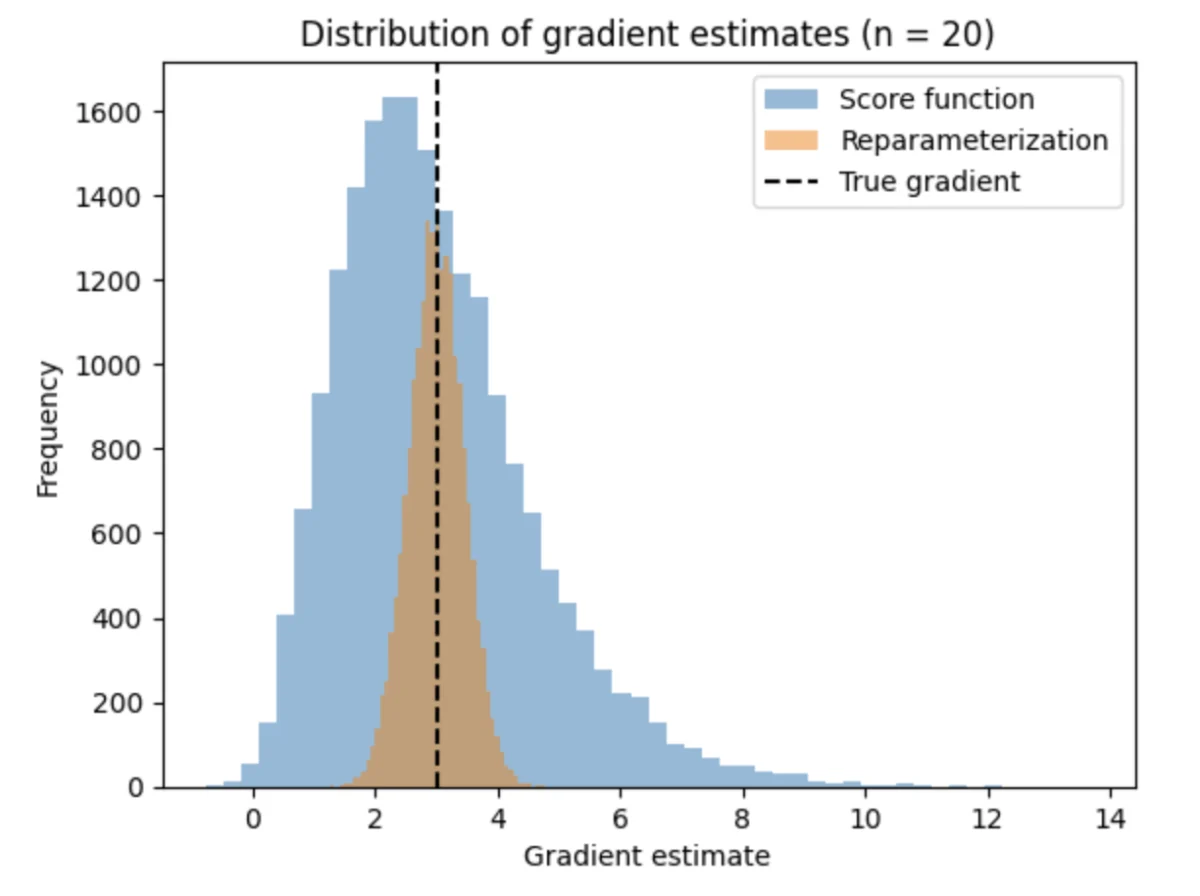
In the high-stakes world of deep learning, the ability to train complex models hinges on a single, elegant mechanism: the gradient. For years, the integration of stochastic processes—sampling data from probability distributions—created a "dead zone" for gradient-based optimization. This limitation threatened to stall the development of generative models like Variational Autoencoders (VAEs). The breakthrough, now known as the reparameterization trick, provided the mathematical architecture necessary to push gradients through random sampling operations, fundamentally changing how we approach uncertainty in artificial intelligence.
Main Facts: The Core of the Problem
At its most fundamental level, machine learning is the art of optimizing functions. When a model like a VAE aims to learn the underlying distribution of a dataset, it uses an encoder to map input data $x$ into a latent space $z$. A decoder then attempts to reconstruct $x$ from $z$. The training process relies on the Evidence Lower Bound (ELBO), an objective function that combines reconstruction accuracy with a regularization term to keep the latent space well-behaved.
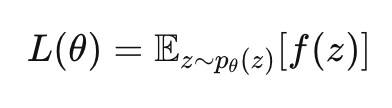
The bottleneck arises because the VAE objective requires us to compute the gradient of an expectation: $L(theta) = mathbbEz sim ptheta(z) [f(z)]$.
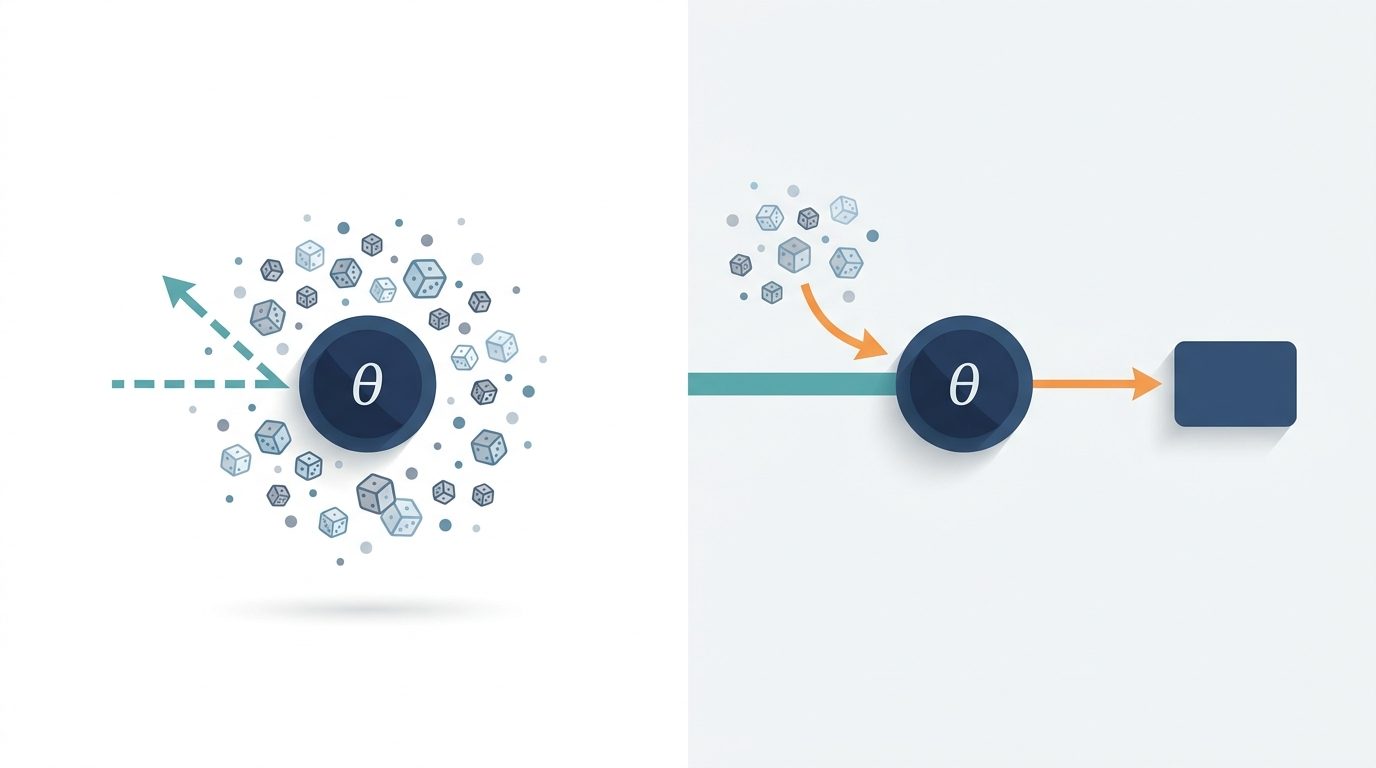
In standard backpropagation, we rely on the chain rule to propagate error signals through a deterministic computation graph. However, when the variable $z$ is sampled from a distribution that depends on parameters $theta$, the "sampling" step acts as a firewall. Because the distribution itself changes as $theta$ updates, we cannot simply differentiate through the random operation. This circularity—where the thing we are differentiating depends on the parameters we are differentiating with respect to—is the "pain point" of stochastic optimization.
Chronology: From REINFORCE to Pathwise Derivatives
The history of solving this problem can be traced back to two distinct schools of thought in gradient estimation.
The Score Function Era (REINFORCE)
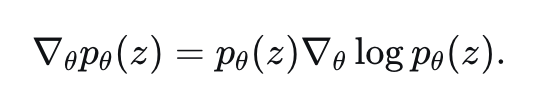
Before the reparameterization trick became the industry standard, the primary tool for gradient estimation was the score function estimator, popularized in reinforcement learning as the REINFORCE algorithm. By utilizing the log-derivative identity, researchers found they could rewrite the gradient of an expectation as an expectation of a gradient: $nablatheta mathbbE[f(z)] = mathbbE[f(z) cdot nablatheta log p_theta(z)]$.
This method was revolutionary because it was model-agnostic; it did not require the function $f(z)$ to be differentiable. However, it was plagued by extremely high variance. Because it only looks at the scalar output of $f(z)$ without considering how $f$ behaves locally in $z$-space, the gradient estimates were often noisy, requiring massive amounts of data and complex variance-reduction techniques like baselines and control variates to stabilize training.
The Reparameterization Breakthrough
The turning point arrived with the formalization of the pathwise derivative. By expressing $z$ as a deterministic function of parameters and independent noise—specifically $z = g(theta, epsilon)$ where $epsilon sim p(epsilon)$—researchers shifted the randomness outside the parameter-dependent part of the computation.
By isolating the noise $epsilon$ from the parameters $theta$, the expectation no longer depends on $theta$ inside the integral. Consequently, the gradient operator can move inside the expectation, allowing the chain rule to flow through the deterministic transformation $g$. This discovery, widely popularized by the VAE framework in 2013-2014, allowed for the training of deep generative models that were previously considered computationally intractable.
Supporting Data: Variance Reduction in Practice
The practical superiority of the reparameterization trick is not merely theoretical; it is empirically overwhelming. In a controlled test comparing the two estimators on a simple Gaussian distribution objective ($L(theta) = mathbbE[z^2]$ with $z sim N(theta, 1)$), the variance reduction is stark.
As documented in recent benchmarks, the score function estimator yielded a variance of 2.57, while the reparameterization estimator yielded a variance of only 0.20. This represents a 13x improvement in signal-to-noise ratio.
In high-dimensional spaces, where VAEs and Bayesian neural networks operate, this gap expands exponentially. When a gradient signal is noisy, the optimizer "wanders" aimlessly, unable to converge on the optimal weights. By providing a clean, low-variance signal, the reparameterization trick allows models to train deeper, faster, and with significantly more stability than those relying solely on score-function estimations.

Implications for Modern AI Architecture
The implications of this mathematical shift have cascaded through the entire field of artificial intelligence, impacting everything from continuous-control robotics to generative art.
1. Scaling Variational Inference
The reparameterization trick effectively unlocked scalable variational inference. By making the ELBO differentiable, it allowed researchers to use standard stochastic gradient descent (SGD) to optimize complex, high-dimensional latent spaces. This is the bedrock upon which modern generative modeling, including diffusion models and VAEs, is built.
2. Reinforcement Learning (RL)
While the score function estimator remains vital in discrete action spaces (where you cannot "reparameterize" a categorical choice), the reparameterization trick has become the backbone of continuous-control RL. Agents navigating physical environments—such as robotic arms or autonomous vehicles—rely on these pathwise gradients to learn smooth, efficient motor behaviors.

3. The Discrete Frontier
A major ongoing challenge remains: how to apply reparameterization to discrete variables. Because the reparameterization trick requires a differentiable path, discrete choices (like selecting a word in an LLM or a class label) are inherently non-differentiable. Researchers are currently tackling this through "relaxations," such as the Gumbel-Softmax trick, which approximates discrete distributions with continuous, differentiable counterparts. These developments suggest that the logic behind the reparameterization trick is now being applied to parts of the AI stack that were previously thought to be "off-limits."
Conclusion: A New Standard for Optimization
The reparameterization trick serves as a masterclass in how a subtle change of variables can transform an entire field. By redefining how we sample latent variables, we moved from "black-box" gradient estimation, which was prone to chaos and noise, to "glass-box" estimation, where the gradient flows cleanly through every component of the neural network.
While the score function estimator remains an essential tool for non-differentiable scenarios, the pathwise derivative has become the preferred choice for any system where it can be applied. As we continue to push toward more complex generative models and more efficient learning algorithms, the ability to "see" the gradient through the noise will remain one of the most critical advantages in the researcher’s toolkit. The history of this technique is a reminder that in deep learning, mathematical elegance is rarely just an aesthetic choice—it is the engine of progress.


 Suro Senen
 Asro
Asro
 Lina Irawan
 Ammar Sabilarrohman
 Nana Wu

 Jia Lissa