
 Layla Zulfa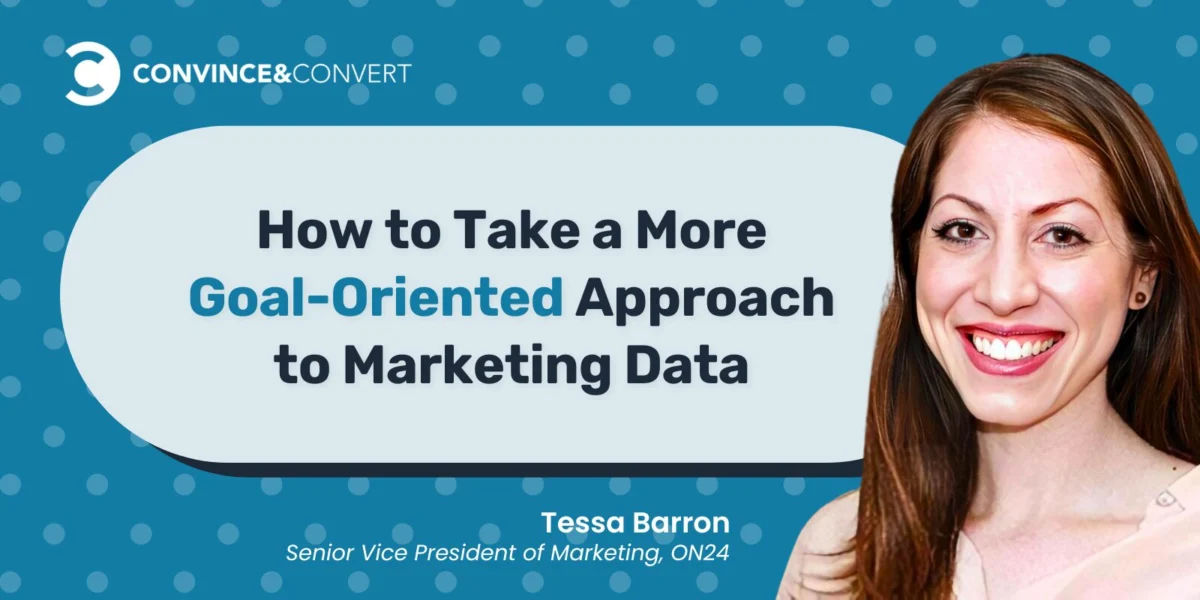
In the modern marketing landscape, the rallying cry of "do more with less" has become an omnipresent, often exhausting, mantra. For many marketing leaders, this directive feels paradoxical: how can teams expand their pipeline targets while budgets remain stagnant and resources tighten?
The industry is reaching a critical inflection point. As Tessa Barron, former Senior Vice President of Marketing at ON24, recently discussed on the Data-Driven Decisions podcast, the solution to this impasse is not found in harder grinding or higher-volume output. Instead, it requires a fundamental shift in philosophy—moving away from a "tactic-first" mentality toward a "goal-oriented, signal-driven" framework.
The Mandate for a Mindset Shift
The post-pandemic market is defined by a paradox of access: we have more data than ever before, yet customer attention is increasingly fragmented. Barron argues that many marketing teams are trapped in a cycle of inertia, repeating the same playbooks they utilized three or four years ago.
"We as marketers have to check in with ourselves and say, ‘have we changed? Are we still doing what we were doing three years ago?’" Barron notes. "And if the answer is yes, that is the first sign that we need to stop expecting that if we execute the same way… we’re going to get more in return."
For decades, the standard marketing cadence involved producing a set number of webinars, whitepapers, and blog posts. While these assets remain valuable, they have become commodities. When a team begins with a list of "things to do"—such as "we need four webinars in Q1"—they lose sight of the objective. The transition required is to start with the outcome: "In Q1, we need to achieve a 10% uplift in our pipeline target."
Chronology of a Data-Driven Pivot
The transition from tactical execution to strategic alignment generally follows a structured, three-phase chronology:
- The Discovery Phase (Audit): Marketing teams must first audit their existing lead-to-opportunity conversion rates. By identifying exactly where prospects drop off, teams can pinpoint the "bottleneck" that prevents pipeline growth.
- The Signal Extraction Phase (Integration): Once the goal is defined (e.g., improving first-meeting conversion rates by 10%), teams must integrate "signal-gathering" questions into their existing content. This involves transforming static content—like webinars—into interactive environments where audience behavior provides immediate intelligence.
- The Alignment Phase (Execution): Finally, the gathered signals are handed over to Sales. Rather than just passing a lead, Marketing provides a "contextual dossier" that allows Sales to prioritize high-intent prospects based on specific, demonstrated needs.
Supporting Data: Turning Noise into Signals
The sheer volume of digital exhaust produced by modern buyers—clicks, downloads, video watch times, and social interactions—is often categorized as "noise." Barron suggests that the distinction between noise and a "signal" is the degree of predictive intent.
A signal is a specific data point that indicates a buyer is more likely to convert. By "setting traps"—or, more accurately, creating meaningful engagement opportunities—marketers can uncover these signals with high precision.
Case Study: The Cloud Provider Insight
A prominent technology firm struggling to regain market share utilized this approach to great effect. Through internal data analysis, they discovered that prospects utilizing a specific cloud provider were 10 times more likely to convert into a qualified opportunity.
Instead of casting a wide net, they integrated a simple, non-intrusive poll question into their webinar: "What cloud provider are you currently using?" By identifying these high-propensity prospects in real-time, the sales team was able to prioritize outreach, effectively shortening the sales cycle and maximizing the efficacy of the marketing spend.
Case Study: The Pharmaceutical Approach
In the healthcare sector, a company aiming to support physicians treating high-risk patient bases needed to identify which doctors were most in need of their therapies. They shifted their webinar strategy to include a specific diagnostic question: "How would you rate the risk of your patient base?"
Doctors who selected "high" were essentially self-identifying as high-value, high-intent prospects. This allowed the company to tailor follow-up communications, not with generic sales pitches, but with educational resources specifically relevant to the management of high-risk cases.
Official Perspectives: The Sales-Marketing Nexus
A recurring theme in modern revenue operations is the friction between Marketing’s desire for lead volume and Sales’ demand for lead quality. Barron posits that this friction is largely a result of communication silos.
"Salespeople sit at the front lines of the prospect’s communication with a company," Barron emphasizes. "They can tell you much more about their needs, doubts, and expectations—insights you can use to inform your marketing."
The "Net" vs. the "Pipeline"
Perhaps the most controversial, yet necessary, realization for marketers is this: Marketing does not create pipeline; Sales does.
Marketing’s role is to create the "net"—a robust, data-enriched system that captures potential buyers and prepares them for the conversation. By aligning with Sales on the questions they ask to qualify a lead, Marketing can stop measuring success through vanity metrics like "webinar registrations" and start measuring it through "qualified signal volume."
This collaborative framework forces a change in the internal conversation. Instead of Marketing reporting on "how many people saw our webinar," they report on "how many prospects we identified as high-intent, and how many of those have progressed to the next stage of the funnel."
Implications for Future Strategy
The implications of this shift are profound, affecting everything from web design to content creation. When a team realizes that a 10% increase in conversion is more valuable than a 50% increase in reach, the following changes typically occur:
- Simplification of Forms: Long, cumbersome lead-capture forms are abandoned in favor of shorter, more targeted entry points.
- Contextual Content: Content is no longer produced for the sake of a calendar cadence but is created to address specific hesitations or questions identified by the sales team.
- Iterative Testing: Marketing departments move toward a "tuning" model. They look at the "little steps" between a lead and a sale—such as an automated email sequence or a landing page CTA—and run micro-tests to see what drives the highest velocity.
Communicating Value to Stakeholders
The final challenge in this transformation is reporting. Executives and stakeholders, often detached from the daily operations of marketing, require clarity. When data is presented as a complex web of KPIs, it obscures the truth.
Barron advises that marketers must present their data in the simplest, most visually engaging way possible. Stakeholders do not need to see the "how"—they need to see the "what." Does this strategy contribute to the bottom line? Is the conversion rate improving? By focusing on a "less is more" approach to data reporting, marketers can regain trust and secure the resources they need for future growth.
Conclusion: The Path Forward
The "do more with less" era is not a mandate for burnout; it is a wake-up call for intelligence. By stepping back from the tactical treadmill and focusing on the signals that actually move the needle, marketing teams can stop being cost centers and start being the architects of revenue.
As the industry continues to evolve, those who prioritize goal-oriented data strategies will find that they are not just surviving with less—they are thriving with more focus, more alignment, and ultimately, more results.
For more on these strategies and how to refine your data-driven approach, listeners can explore the full series of the Data-Driven Decisions podcast, which provides actionable frameworks for modern marketing leaders.


 Ammar Sabilarrohman
 Sagoh
Sagoh
 Raul Delapena Setiawan
 Reynand Wu


 Azzam Bilal Chamdy
 Ali Ikhwan