
 Iffa Jayyana
The weather report says 80 degrees Fahrenheit, but standing on a football field at Portland State University, that number feels like a polite fiction. Beside me, Professor Vivek Shandas—founder and director of the Sustaining Urban Places Research Lab—is busy recalibrating his equipment. We are not experiencing the temperate afternoon suggested by the local news; we are standing in the middle of an urban heat island, where the ground beneath our feet is radiating a blistering, synthetic energy.
The culprits are the blades of grass beneath our boots. They are not biological organisms capable of photosynthesis or transpiration. They are plastic—artificial turf designed to withstand the wear and tear of collegiate athletics. While natural vegetation acts as a biological air conditioner, "sweating" water vapor to cool the surrounding atmosphere, this plastic surface serves as a heat battery. It absorbs the sun’s relentless energy during the day and radiates it back into the ambient environment, creating a microclimate that is both physically punishing and scientifically alarming.
The Science of Surface Temperature: Beyond the Thermometer
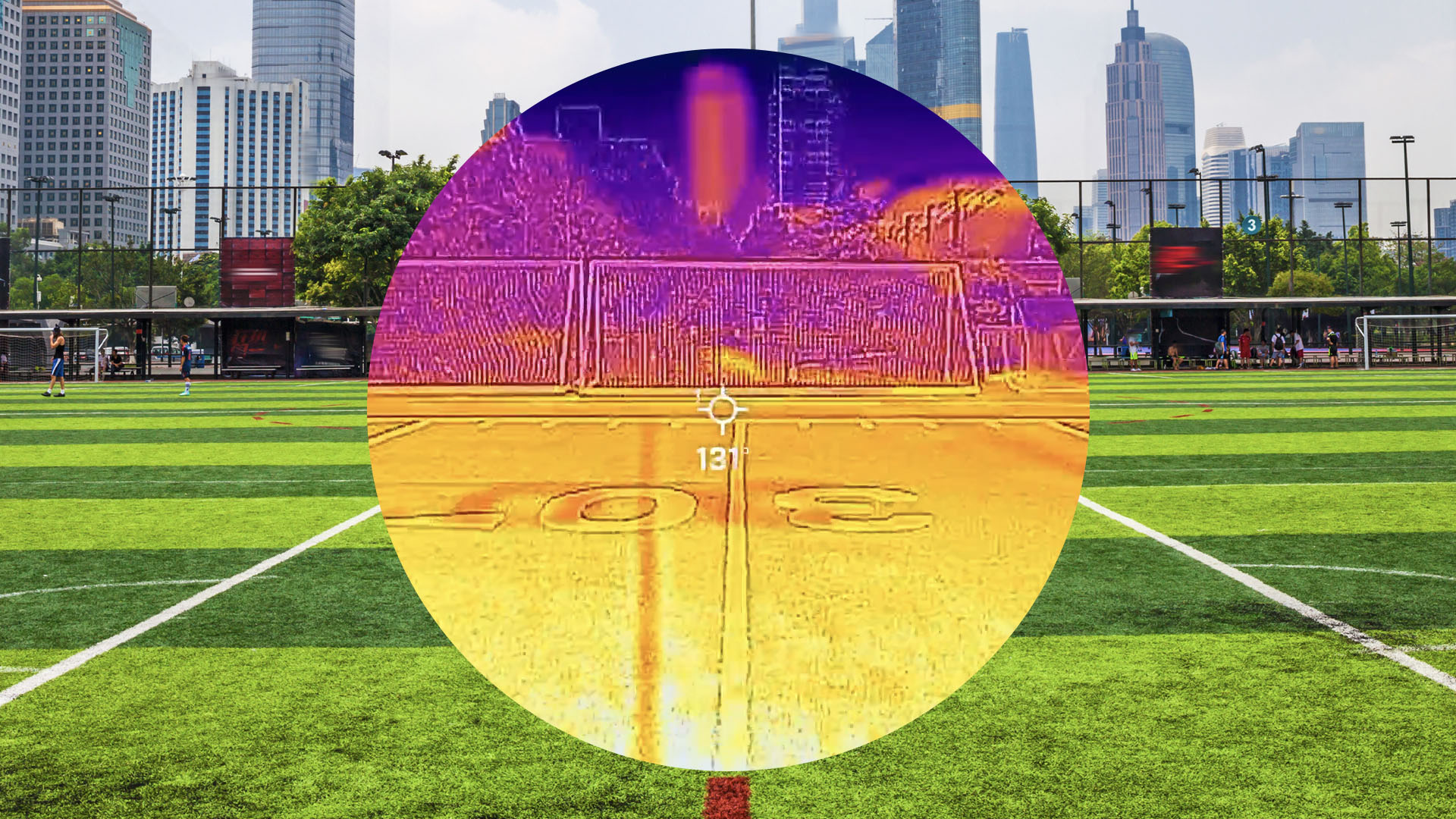
To understand the scale of this phenomenon, Shandas pulls out a Flir (forward-looking infrared) camera, which I mount to my smartphone. As I scan the field, the screen reveals a harrowing, color-coded map of heat. While the official air temperature is 80 degrees, the plastic turf beneath me is registering upwards of 150 degrees Fahrenheit.
In contrast, a patch of natural grass nearby sits at a relatively mild 100 degrees. Even on the field itself, the thermal variance is stark: the bright white painted yard lines are roughly 10 degrees cooler than the surrounding green turf, proving that simple reflectivity is a powerful, if underutilized, tool for cooling our cities.
"If you think about a 100-degree day during a football game on a surface like this, those athletes are in trouble," Shandas explains, pointing his own thermal sensor at the field. "You’re looking at a high risk of physiological distress. When the ground is 150 degrees, your joints are absorbing that heat, and your body is struggling to regulate its internal temperature. It is a recipe for disaster."
A Chronology of Rising Temps: From Highways to Neighborhoods
Our investigation continues as we move to a vantage point overlooking the I-405 highway. If the turf field is a localized heat trap, the highway is a regional furnace.
1:45 PM: We stand on a hill overlooking the multilane thoroughfare. The asphalt, which has been baking in the sun for hours, acts as a thermal mass, soaking up solar radiation. Added to this are the thousands of internal combustion engines passing below, each emitting waste heat and generating friction-based heat from tire-to-road contact. From our vantage point, the highway surface registers at 120 degrees. When I pan the camera to a patch of shaded vegetation just a few feet away, the temperature drops to the mid-80s—a life-saving difference of nearly 40 degrees.
2:30 PM: We return to the car, where Shandas mounts a magnetic sensor to the roof. As we drive through downtown Portland, the contrast becomes clear. In the dense, skyscraper-heavy city core, the shade provided by the buildings keeps the street-level temperature at a manageable 84 degrees.
3:15 PM: As we cross the Willamette River and move into lower-density neighborhoods, the data begins to climb. The temperature hits 85, 86, 87, and eventually 89 degrees. The reason for this disparity is rooted in urban planning: neighborhoods with fewer trees and more open, heat-absorbing asphalt lack the "sweating" cooling effect of vegetation. In these areas, the heat does not dissipate at night, leading to an accumulation of thermal energy that poses a chronic health risk to residents.
Supporting Data: The Disproportionate Burden of Heat
The data collected by Shandas’s lab reveals a grim reality: urban heat is not an equal-opportunity offender. It is a symptom of socioeconomic inequality etched into the landscape.
Lower-income neighborhoods frequently suffer from a "tree canopy deficit." With fewer trees to provide shade and lack of the cooling benefits of evapotranspiration, these residents are forced to endure higher daytime temperatures and, more critically, higher nighttime temperatures. When the concrete doesn’t cool down after dark, the human body never gets the recovery time it needs to regulate its core temperature.
The disparity is widening. On an 80-degree day, Shandas has documented differences of up to 7 degrees between neighborhoods. During extreme heat waves, that gap balloons. In a recent study, he recorded 125 degrees in an industrial, low-tree-cover area on the city’s east side, while a nearby verdant, hilly neighborhood remained at 99 degrees.
"On a 90-degree day, the difference between neighborhoods is about 15 to 18 degrees," Shandas notes. "On a 110-degree day, that gap stretches to 25 degrees. We are rapidly approaching a limit that I’m not sure we want to cross."
Official Responses and Strategic Interventions
For urban planners and city officials, the challenge is clear: how do we cool a city that has been built to store heat? Shandas suggests that there is no "silver bullet," but rather a menu of necessary interventions:
- Strategic Canopy Expansion: Planting trees is the most effective way to reduce the "urban heat island" effect. It provides shade, adds moisture to the air, and improves air quality.
- Reflective Surfaces: Utilizing white or "cool" roof technology can significantly lower building temperatures, preventing the "heat sink" effect that makes homes unlivable during the summer.
- Urban Agriculture: Integrating urban farms not only provides local food security but introduces biological cooling systems into the concrete desert.
- Targeted Shade Structures: For neighborhoods where tree planting is difficult due to underground infrastructure, building shade structures over transit hubs and bus stops can provide immediate relief to the most vulnerable pedestrians.
"We are looking for the right mix of interventions," Shandas says. "It’s about identifying where the heat is most intense and applying the appropriate tool to mitigate that specific risk."
The Implications: A Many-Headed Emergency
The implications of rising urban temperatures extend far beyond discomfort. Extreme heat is the deadliest natural disaster in the United States, yet it often lacks the visceral urgency of a hurricane or a wildfire.
Economically, heat is a productivity killer. As temperatures rise, labor output decreases, particularly for outdoor workers in construction and agriculture. The healthcare system faces mounting pressure as heat-related illnesses—ranging from exhaustion to organ failure—strain emergency services. Furthermore, our aging electrical grid is reaching a breaking point as the demand for air-conditioning surges in response to the very heat that our infrastructure is exacerbating.
"Everything is dependent on that peak temperature," Shandas says, watching the data stream from his roof sensor. "In the coming years, we are going to see these numbers crank up more and more. The way we design our cities will determine who survives this transition and who is left behind."
As our cities continue to grow, the necessity of cooling our streets, rooftops, and athletic fields has transitioned from an aesthetic choice to a public health imperative. The "invisible furnace" of our urban environment is no longer a fringe concern; it is the central challenge of 21st-century city planning. If we fail to adapt our infrastructure, we are effectively choosing to make our homes, our jobs, and our public spaces increasingly hostile to the people who inhabit them.


 Ammar Sabilarrohman
 Nana Wu
 Lina Irawan

 Suro Senen
 Jia Lissa