
 Nila Kartika Wati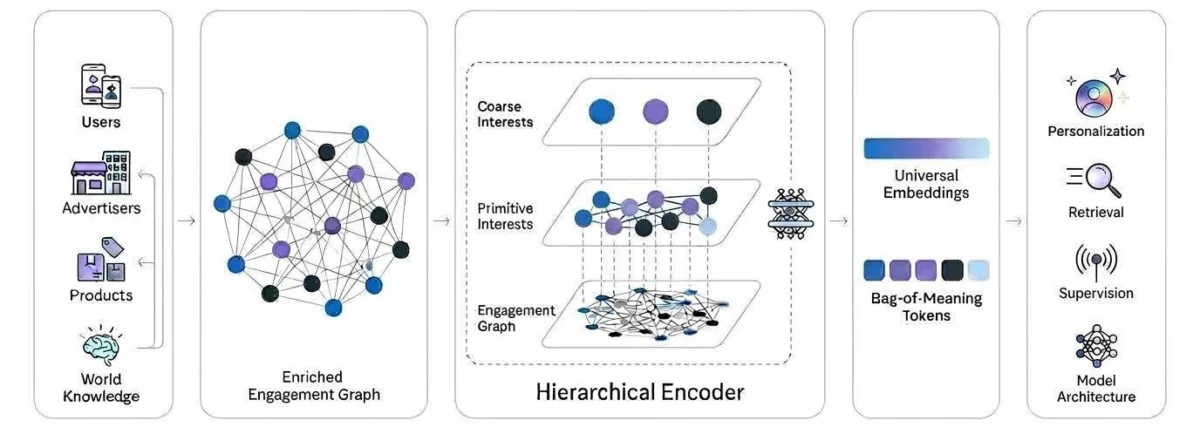
In an era where digital advertising is increasingly defined by the ability to connect hyper-specific user intent with vast, heterogeneous product catalogs, Meta has unveiled a groundbreaking advancement in machine learning: Hierarchical Interest Representation (HIR). This new "upstream" representation layer is designed to solve the perennial challenge of signal scarcity in the "deep funnel"—the critical final stages of the consumer journey where intent transforms into action.
By integrating multi-modal world knowledge with graph-based engagement data, HIR aims to serve as the foundational "brain" powering Meta’s broader recommendation ecosystem, including its Generative Ads Model (GEM), the Andromeda retrieval engine, and the Adaptive Ranking Model.
The Core Objective: Bridging the Gap in Digital Intent
At its core, Hierarchical Interest Representation is an upstream modeling layer designed to distill sparse, noisy engagement data into meaningful, stable interest clusters. Users interact with Meta’s platforms by scrolling, liking, and clicking, creating a complex web of signals. However, in the deep funnel—where advertisers track conversions, purchases, and subscriptions—these signals are often sparse.
Meta’s mission with HIR is to bridge this gap by connecting businesses with the specific population segment most likely to hold a latent, genuine interest in their offerings. By utilizing frontier AI to map these interests across a "super-graph" of users, products, and advertisers, the system transforms how Meta understands the relationship between content discovery and commercial intent.
Chronology and Technical Evolution
The development of HIR represents the latest milestone in Meta’s aggressive push to optimize ad performance through AI.
- Foundation (Pre-2024): Meta relied on traditional engagement signals, which, while effective for surface-level interest, struggled to capture the nuance of long-term, deep-funnel conversion intent.
- The Rise of Graph-Based Learning: As Meta’s internal infrastructure evolved, the focus shifted toward treating user-ad interactions as a massive, industry-leading graph network.
- Integration Phase (2025–2026): The development of GEM and the Adaptive Ranking Model paved the way for HIR. Engineers realized that by applying LLM-inspired transformer architectures to these graphs, they could move beyond simple "click-through" prediction toward "intent-aware" representation.
- The Launch of HIR (Present): The current deployment introduces a hierarchical, structural shift. By projecting raw graph data into configurable "super-graphs," the model can now navigate both high-level interest anchors and highly specialized, granular user intent.
The Technical Challenges of Massive-Scale Graph Modeling
Meta’s ads ecosystem is arguably one of the most complex in the world. Operating at this scale introduces three primary technical hurdles that the engineering team had to overcome:
1. User Inferred Signal Dynamics
While tools like "Interested/Not Interested" buttons allow for explicit user feedback, they represent only a fraction of the data. Much of the system relies on inferred interests. The challenge lies in balancing real-time, fleeting engagement signals with the need for stable, long-term user profiles.
2. Large Networks with Sparse Connections
Meta serves millions of ads to billions of users. Despite this massive volume, the number of "deep funnel" interactions—such as a specific purchase from a specific advertiser—is statistically sparse. This creates a "cold-start" problem where the model lacks enough data to make highly accurate predictions for niche products.
3. Long-Range, Global Relationships
Capturing relationships between users and products that are several "hops" away in the graph is computationally prohibitive. Traditional message-passing models tend to "over-smooth" this data, losing the specificity required for precision targeting. Meta addressed this by designing memory-efficient attention kernels capable of maintaining structural awareness without exhausting hardware resources.

How Hierarchical Interest Representation Works
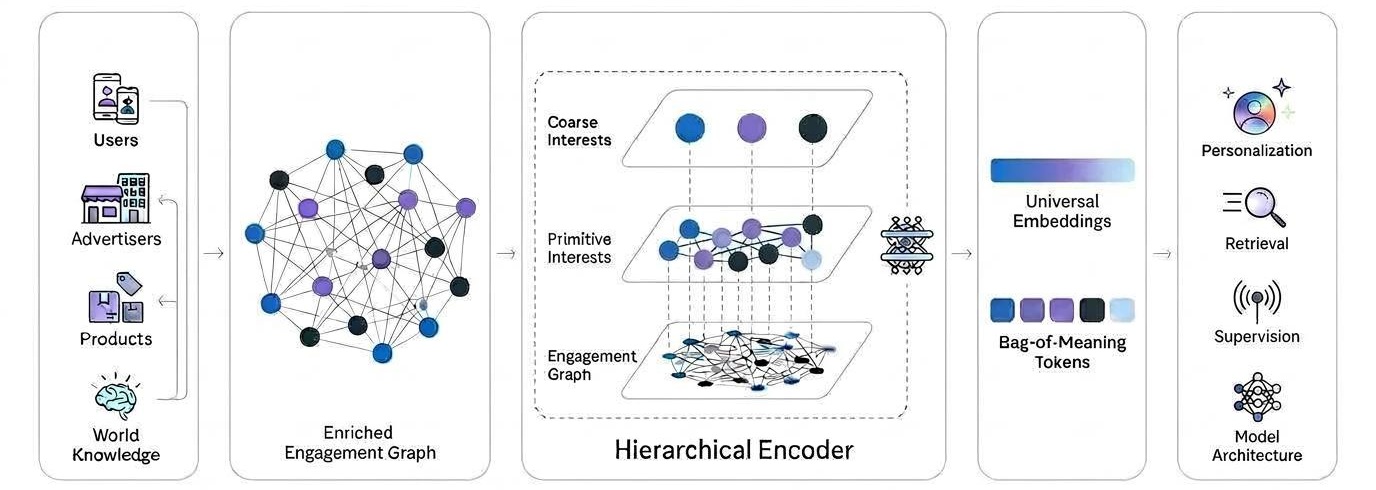
The HIR architecture is defined by four core design properties that allow it to function as a universal, relational representation layer.
Dimension Reduction through "Super-Graphs"
HIR projects the raw, messy graph of billions of interactions into a manageable "super-graph." In this space, each node is a learned latent interest primitive. This effectively densifies the sparse data, turning erratic user-ad edges into a more stable, predictable vocabulary of interests.
Multimodal Knowledge Enrichment
Perhaps the most significant innovation is the inclusion of "world knowledge." The system does not merely analyze how a user interacts with an ad; it uses multimodal models (vision and language) to understand what the product actually is. By pulling metadata, images, and video descriptions from advertiser catalogs, the model gains a semantic understanding of the product, allowing it to make accurate predictions even for new items that lack historical interaction data.
Unified Relational Representation
HIR places users, products, and advertisers into a single, unified metric space. This allows the model to compute proximity scores: how close is a user to a specific interest primitive? Which products share the closest affinity with a specific user group? This unified space is the engine that drives recommendations across the entire delivery stack.
Multi-Hierarchical Granularity
The system recognizes that different tasks require different levels of detail. By cascading through multiple hierarchical layers, HIR provides a flexible framework. It can perform broad, high-level categorization for general discovery, or zoom into fine-grained, specific intent for deep-funnel optimization.
Architecture: The Engine Under the Hood
The HIR system is powered by a transformer-based hierarchical encoder. Its design is notable for several sophisticated components:
- Enriched Engagement Graph: This is a typed, time-decayed graph that tracks the "user-ad journey." By using deep-hash embeddings, Meta manages to keep the vocabulary size within memory limits even as the number of entities grows into the tens of billions.
- Structural Bias in Transformers: By injecting graph-structural signals—such as node-type transitions—directly into the attention mechanism, the model becomes "topology-aware." This prevents the model from treating the graph as a random "bag of nodes," instead forcing it to respect the inherent relationships in the data.
- FlexAttention: To solve the memory intensity of graph-based attention, Meta implemented "FlexAttention." This allows the system to compute bias terms on the fly rather than materializing full, massive matrices, leading to a 30x improvement in wall-clock speed during training.
Training and Infrastructure
Training a model of this magnitude requires extreme efficiency. Meta employs a Cross-View Distillation scheme, where a "teacher" model with a broad view of the graph instructs a "student" model on how to map sparse interactions to stable interest clusters.
To prevent "future leakage" (where the model accidentally uses data from the future to predict the past), the system strictly enforces temporal causality. Training and evaluation are conducted in chronological windows, ensuring that the model only learns from information that would have been available at the time of the ad impression.
Furthermore, the introduction of "Bag-of-Meaning" (BoM) tokens allows for the discretization of these complex continuous embeddings. This makes the data accessible for traditional inverted-index retrieval, essentially translating the "black box" of latent AI embeddings into a format that can be quickly searched and aggregated.
Implications for the Future of Advertising
The deployment of Hierarchical Interest Representation signals a paradigm shift for advertisers on the Meta platform.
Enhanced Performance for Advertisers
For businesses, the implication is improved return on ad spend (ROAS). By moving beyond simple behavioral patterns and incorporating semantic understanding of products, Meta can now match a user’s "latent" interest—the things they are likely to want before they even search for them—with the most relevant catalog items.
Discovery-Oriented Experiences
The technology encourages "discovery-oriented" ad experiences. Instead of bombarding users with irrelevant content, the system identifies stable interest anchors, leading to a more seamless, personalized feed where ads feel like a natural extension of the content a user is already engaging with.
Scalable Infrastructure
As Meta continues to scale, HIR provides a future-proof foundation. The ability to perform objective-conditional fine-tuning means that as new ad formats (such as generative video or interactive AR ads) emerge, the upstream representation layer can be specialized for these new objectives without requiring a full rebuild of the underlying architecture.
Conclusion: A New Standard in AI
Hierarchical Interest Representation is more than just an update to a recommendation algorithm; it is a fundamental rethinking of how a platform of Meta’s size interprets the "world" of commerce. By merging the structural rigor of graph theory with the semantic flexibility of Large Language Models, Meta has created a system that is as adept at understanding human desire as it is at navigating the technical complexities of a billion-node network.
As the industry moves further into the age of generative AI, the ability to ground these models in real-world, structured knowledge will be the differentiator between systems that merely react to user behavior and those that truly understand the intent behind it. With the implementation of HIR, Meta appears to have set a new benchmark for the future of intelligent, personalized advertising.
Acknowledgements: This research was made possible through the collaboration of an extensive team of engineers and researchers at Meta, including Sammy Bald, Shaoqing Yuan, Chuan Hu, and many others whose work in production engineering and machine learning continues to define the boundaries of the field.


 Lina Hope

 Ammar Sabilarrohman
 Suro Senen
 Jia Lissa
 Evan Lee Salim

 Ali Ikhwan