Lina Hope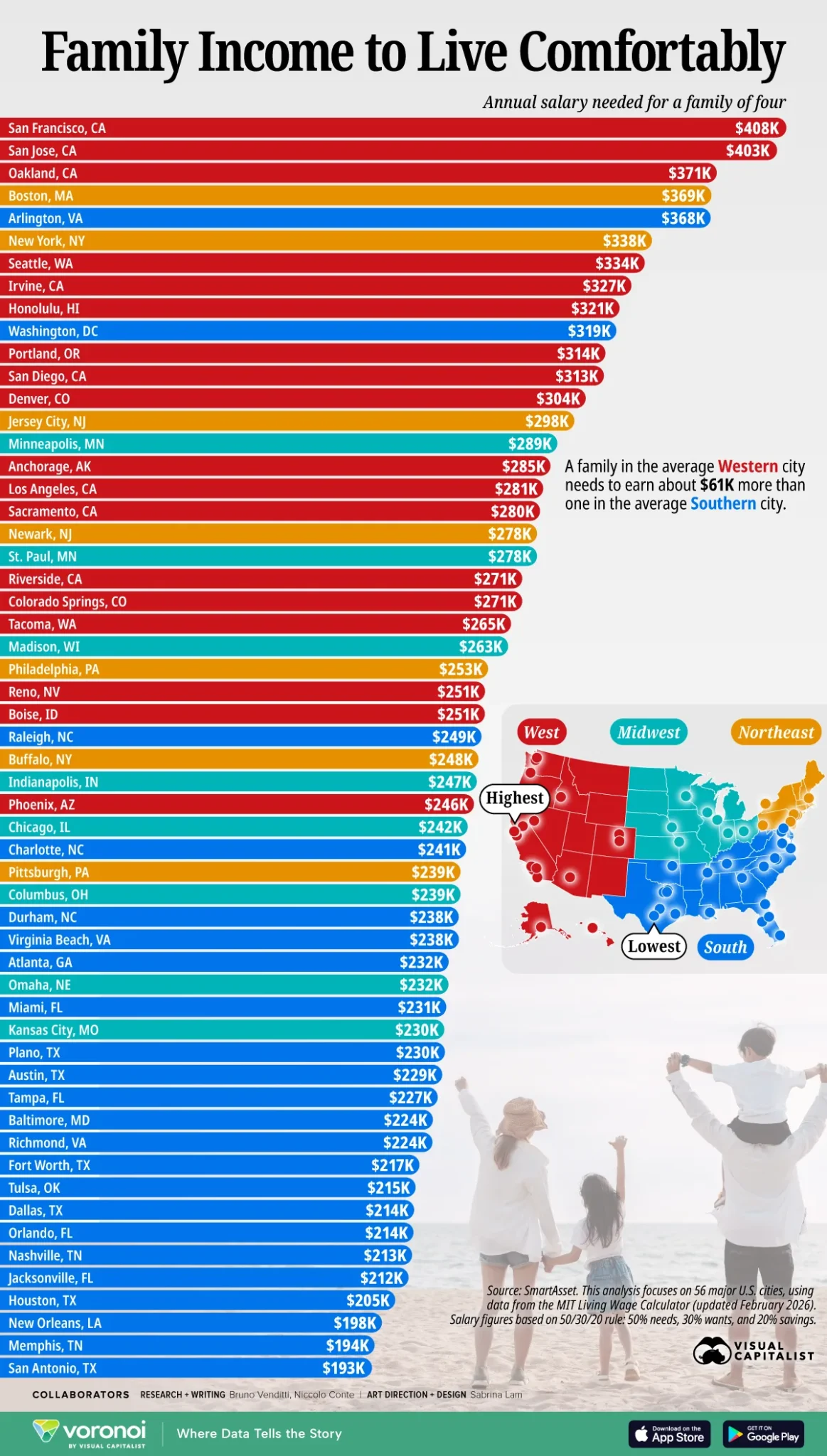
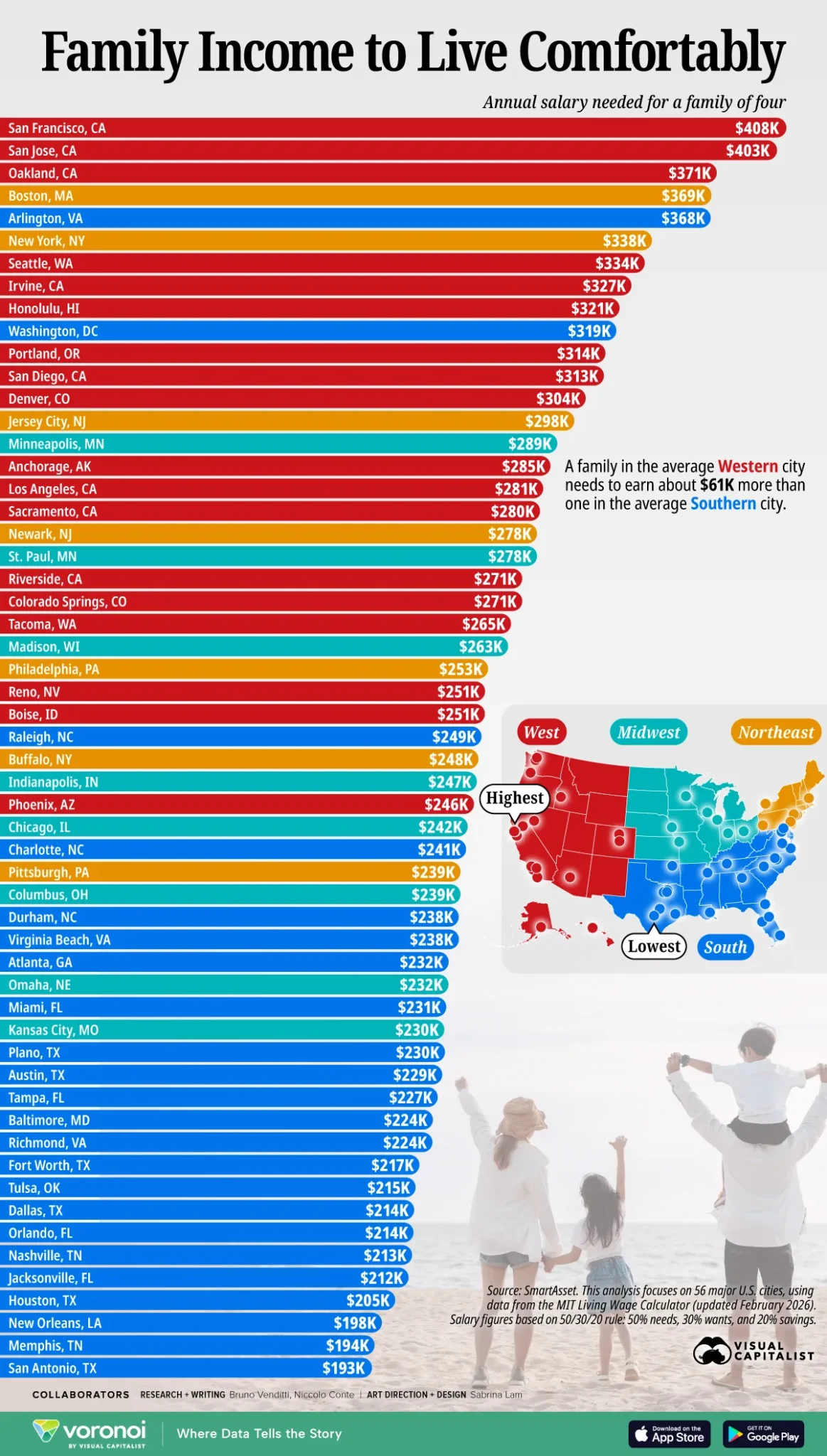
In the high-stakes arena of coastal American economics, the definition of a "middle-class lifestyle" has undergone a seismic shift. New data confirms that a family of four in San Francisco now requires an annual household income of $408,000 to maintain a standard of living traditionally categorized as "comfortable." This figure, which places the threshold for a middle-class existence well within the top 5% of American earners, serves as a stark indicator of the deepening affordability crisis plaguing the nation’s most desirable urban hubs.
The Evolution of the "Comfortable" Benchmark: A Chronology
The debate over what constitutes a middle-class salary is not new, but the velocity of the required increase is unprecedented. As recently as 2018, the benchmark for a comfortable middle-class life in an expensive coastal city was widely cited at $300,000. When this estimate was first proposed, it met with significant public skepticism; critics labeled the assessment as delusional or out of touch.
However, the rapid escalation of living costs—driven by housing, private education, and healthcare—has proven those initial projections to be conservative. By December 2019, following the birth of a second child, the necessary income threshold was adjusted to $350,000. Today, the $408,000 figure represents a 36% increase over the 2017 baseline. This translates to a compound annual cost-of-living inflation rate of roughly 3.5%, a figure that far outpaces the standard Consumer Price Index (CPI) when applied to the "personal inflation basket" of a modern family, which is heavily weighted toward non-discretionary costs like tuition and real estate.
Supporting Data: Deconstructing the $408,000 Reality
To understand how a nearly half-million-dollar income can be "consumed" rather than saved, one must look at the fiscal reality of tax brackets and cost-of-living distributions. After accounting for a 32% effective tax rate—covering both federal and state obligations—a household earning $408,000 is left with approximately $277,440 in net disposable income.
The Anatomy of a High-Cost Household Budget
A realistic breakdown for a family of four in a city like San Francisco reveals a precarious balance:

- Taxes: Approximately $121,000 annually.
- Housing and Education: Private grade school tuition often accounts for $90,000 or more, acting as the "elephant in the room" for middle-class budgets.
- Essential Living: Food costs, utilities, and insurance often exceed $3,000 per month.
- Savings: After taxes and expenses, funding retirement accounts and college savings plans often leaves the household with a savings rate that is adequate for survival but potentially insufficient for early retirement (FIRE) goals.
The accumulation of these "reasonable" expenses creates a scenario where the budget is entirely spoken for. Unlike a luxury lifestyle, which might include private jets or vacation homes, this middle-class benchmark covers the basics: home ownership in a safe neighborhood, high-quality schooling, occasional travel, and adequate retirement contributions.
Implications for Financial Stability and FIRE
The most significant implication of this rising threshold is the growing difficulty of achieving financial independence. For those aiming to retire early, the target gross passive investment income required to maintain this lifestyle exceeds $380,000. Because investment income—derived from dividends, long-term capital gains, and rental income—is often taxed at a lower effective rate (around 26%) than W2 wage income (32%), families must strategically pivot their income sources to maintain their standard of living.
Furthermore, there is a psychological shift occurring. Many families find themselves caught in a "work trap," where the high cost of living necessitates high-stress, 60-hour-a-week jobs, which in turn diminishes the "comfort" that the income is supposed to provide. As one observer noted, the ultimate luxury is no longer just money; it is the freedom to opt out of the relentless grind.
Strategic Responses: Geoarbitrage and Income Optimization
When an income fails to meet the comfort threshold, households generally have three levers: increase earnings, reduce expenditures, or engage in "geoarbitrage."
The Hierarchy of Geoarbitrage
Many households reflexively look toward moving to another country, such as Thailand or Portugal. However, experts suggest a more measured approach:
- Intra-City Arbitrage: Moving to a less expensive neighborhood within the same city. Often, a move of just a few miles can reduce housing costs by 30-40% without sacrificing access to professional networks or social circles.
- State-Level Arbitrage: Relocating to a city with a lower cost-of-living index, such as Honolulu or San Diego, where the "comfort threshold" might drop by $80,000 to $100,000 annually.
- National/International Arbitrage: A final, more drastic step, which involves moving to a region with lower taxes and lower costs, such as the American South or overseas.
The power of this strategy is profound. By moving to a city where the required income for comfort is $87,000 lower, a family effectively preserves roughly $2.2 million in capital over the long term, assuming a 4% withdrawal rate.
Attacking the Income Side
If relocation is not an option, households must focus on aggressive income optimization. This involves:
- Negotiating Severance: Rather than quitting a job—which leaves money on the table—highly skilled workers often negotiate severance packages during corporate restructuring, essentially getting paid to exit a role they intended to leave regardless.
- Maximizing Tax Efficiency: Utilizing tax-advantaged accounts, depreciation-sheltered rental income, and qualified dividends to reduce the total effective tax burden.
- Career Pivoting: Leveraging the high-value network inherent in expensive coastal cities to move into roles with higher variable compensation or equity participation.
Conclusion: Redefining Comfort
The $408,000 figure is more than just a statistic; it is a reflection of a changing American dream. For the middle class, "comfort" is no longer a destination reached through steady employment and modest saving. It is a moving target that requires constant vigilance, tactical financial maneuvering, and, occasionally, the willingness to redefine what "home" looks like.
Whether through the diligent application of geoarbitrage or the strategic expansion of passive income, the path to comfort in the modern era requires a departure from traditional "save and wait" mentalities. In an environment where the cost of living continues to inflate, financial literacy and the ability to pivot are the only true safeguards against the encroaching squeeze of the top-tier economy. As the data shows, the middle class is not disappearing; it is simply becoming significantly more expensive to join.


 Jia Lissa
 Raul Delapena Setiawan
 Nila Kartika Wati

 Basiran
 Sagoh
Sagoh