
 Lina Hope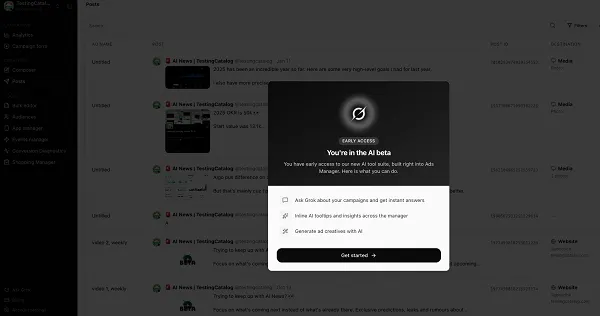
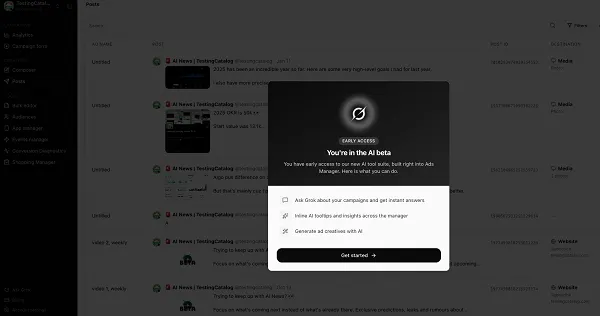
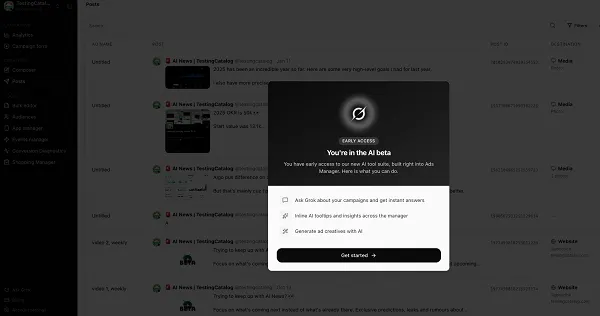
In a move that underscores its commitment to an AI-first future, the social media platform X (formerly Twitter) has officially launched beta testing for its new Grok-powered integration within Ads Manager. This development represents more than just a minor feature update; it is a strategic pivot that brings the power of xAI’s large language model directly into the hands of marketers, promising to streamline campaign management through generative intelligence and real-time data analysis.
As the digital advertising landscape becomes increasingly complex, X is positioning its platform as an intuitive, "agentic" environment where human oversight is augmented—and eventually perhaps automated—by sophisticated AI assistants.
The Core Development: Grok Enters the Ad Suite
The recent beta rollout, first spotted by industry observers on platforms like Threads, allows select advertisers to leverage Grok as an interactive consultant for their marketing strategies. Rather than manually navigating complex targeting parameters or guessing which creative assets will resonate with a specific demographic, advertisers can now query the chatbot for actionable guidance.
This integration is designed to function as an "always-on" assistant. By providing real-time advice on campaign architecture, the tool helps marketers optimize their spend and creative approach. Furthermore, the update introduces new, context-aware tooltips that provide immediate suggestions on how to generate and refine ad creatives directly within the in-stream interface.
This is not a standalone experiment. It is the logical progression of the "rebuilt" Ad Manager platform that X introduced in April. That system, which the company hailed as the most significant upgrade in its history, laid the groundwork by embedding AI-powered guidance at every operational level. By folding Grok into this architecture, X is effectively closing the loop between data-driven insight and creative execution.
A Chronology of X’s AI-Driven Evolution
To understand the magnitude of this shift, one must look at the timeline of X’s transformation under the ownership of Elon Musk.
- Pre-2023: X relied heavily on traditional interest-based targeting, often criticized by marketers for a lack of precision compared to platforms like Meta or Google.
- April 2024: X unveiled its "rebuilt" Ad Manager. The platform shifted toward an AI-first model, prioritizing user interest signals over static targeting. This update focused on improving ad relevance by better interpreting real-time trends on the platform.
- August 2025: Elon Musk, in a wide-ranging discussion with Digiday, articulated a clear vision for the future: a fully automated advertising ecosystem. Musk suggested that Grok would eventually handle the end-to-end lifecycle of an ad campaign, from initial concept to deployment and optimization.
- Late 2025/Early 2026: The beta testing phase for the Grok-Ads Manager integration officially begins, marking the first time the chatbot has been deeply embedded into the revenue-generating side of the business.
This trajectory reveals a company determined to shed its reputation for inconsistent ad performance, replacing manual complexity with a streamlined, machine-learned approach.
The Mechanism: How Grok Empowers Advertisers
The primary value proposition of the Grok integration lies in its ability to synthesize vast datasets into actionable intelligence. For the average advertiser, the challenge is often the "analysis paralysis" caused by thousands of potential audience segments and creative variations.
The Agentic Shift
By building a chatbot directly into the dashboard, X is facilitating "agentic ad generation." In this context, an agentic system is one that can act on behalf of the user to achieve a specific goal. Instead of the user selecting "Male, 25-34, Interested in Tech," the user might ask Grok: "Find the segment of my audience most likely to convert on this high-end laptop promotion based on their recent engagement with tech news."
Grok can process the massive volume of comparative data—spanning X’s 550 million active users—to identify patterns that a human analyst might miss. It can correlate profile data, in-app activity, and real-time sentiment to construct highly accurate "persona matches."
Creative Guidance
The tooltips mentioned in the beta release serve as a bridge between data and creative. If an ad campaign is underperforming, the AI doesn’t just show a red arrow; it can suggest creative adjustments. For instance, if the data suggests that users are responding better to short-form video than static images in a particular segment, Grok can suggest specific copy tweaks or call-to-action (CTA) button changes to better align with that preference.
Supporting Data: Why X Needs This Now
The business case for this integration is rooted in the platform’s scale and the need for improved monetization. With over 550 million monthly active users, X sits on a goldmine of real-time human discourse. This is a unique advantage; while other platforms have high levels of engagement, X captures the intent and opinion of the global zeitgeist in real-time.

However, historical data suggests that advertisers have been cautious about the platform’s brand safety and targeting consistency. By utilizing xAI’s capacity to assess massive arrays of signals, X is attempting to solve two problems simultaneously:
- Relevance: Increasing the likelihood that a user sees an ad they actually care about.
- Efficiency: Lowering the barrier to entry for small-to-medium businesses (SMBs) who do not have a dedicated ad agency to manage their campaigns.
The shift toward AI-automated ad safety checks—as mentioned by Musk—is critical here. An automated system can scan for potential negative brand associations in real-time, ensuring that ads do not appear next to content that violates a brand’s safety guidelines. This, combined with content matching, creates a "brand-safe by default" environment that could draw back major advertisers who have been hesitant to commit to the platform.
Official Stance and Future Implications
While X has not released a comprehensive white paper on the long-term impact of this tool, the signals from leadership are clear. The company views AI as the primary vehicle for scaling its revenue.
The Vision of Full Automation
Elon Musk’s ambition for "full advertising automation" implies a world where an advertiser provides a website URL and a budget, and the AI handles the rest. This includes:
- Creative Generation: Building visuals and copy based on the brand’s identity.
- Dynamic Bidding: Adjusting spend in real-time based on the probability of conversion.
- Safety Guardrails: Monitoring for toxic content to protect the brand.
The Competitive Landscape
This puts X in direct competition with the "Advantage+" suite from Meta and the "Performance Max" tools from Google. All three tech giants are racing toward a future where the platform effectively acts as the advertiser’s partner. However, X has a unique "secret weapon": the Grok model, which has been trained on the very conversations happening on the platform, theoretically giving it a deeper understanding of current events and niche community subcultures than models trained on more static, archival data.
Challenges and Considerations
Despite the enthusiasm, there are significant hurdles to clear.
- The "Black Box" Problem: Advertisers are often wary of fully automated systems. If an AI spends their budget in a way that doesn’t yield results, it is difficult to "debug" why the AI made that decision. Transparency will be key to adoption.
- Data Quality and Hallucinations: As with all Large Language Models (LLMs), there is the risk of "hallucinations"—where the AI might provide incorrect data or suggest a marketing strategy based on a misunderstanding of a trend. Ensuring that the tool is grounded in actual performance data is a technical challenge X must navigate.
- Trust and Brand Safety: The history of X’s relationship with major advertisers has been turbulent. While the tech is impressive, the platform must prove that its AI-driven safety tools are robust enough to satisfy the most demanding enterprise clients.
Conclusion
The integration of Grok into the X Ads Manager is a watershed moment for the platform. It signals that X is no longer merely a social network where ads are placed; it is becoming an intelligent engine that actively participates in the marketing process.
If successful, this transition to agentic advertising will make X a far more efficient and accessible platform for businesses of all sizes. By lowering the technical barriers to entry and leveraging its massive, real-time dataset, X is attempting to rewrite the rules of social media advertising. Whether this will lead to the "full automation" vision projected by Musk remains to be seen, but one thing is certain: the era of manual, static ad management on X is rapidly coming to an end, replaced by a dynamic, AI-powered future.
As the beta testing continues, the industry will be watching closely to see if these tools truly deliver the ROI that modern advertisers demand. For now, the integration serves as a bold declaration that X intends to remain at the forefront of the artificial intelligence arms race.


 Reynand Wu
 Iffa Jayyana
 Raul Delapena Setiawan

 Sagoh
Sagoh

 Azzam Bilal Chamdy
 Ali Ikhwan