
 Raul Delapena Setiawan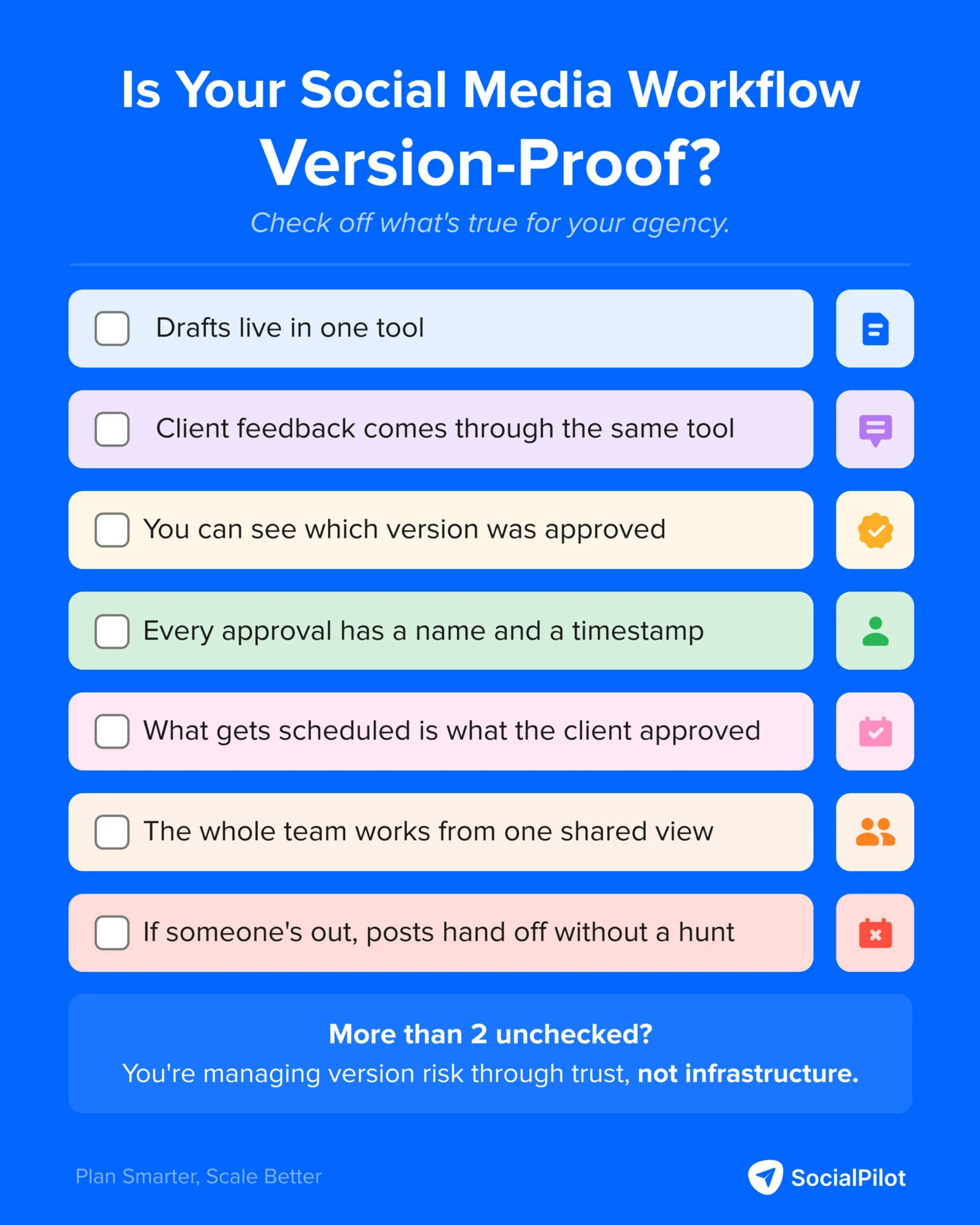
It is a scenario every social media agency manager dreads: 6:00 PM, a post goes live, and within minutes, the client is on the phone. They aren’t calling to praise the copy or the imagery; they are asking why the post contains a version of the caption that was rejected three weeks ago.
Behind the scenes, the team is baffled. Three different people "approved" the post. Yet, not a single one of them approved the same version.
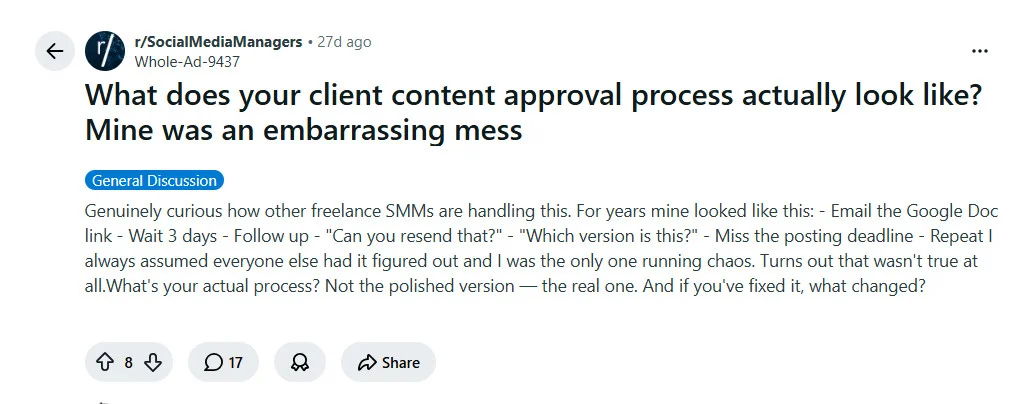
This isn’t a story of incompetence. It is a story of a systemic failure. The Slack thread said "all good" at 11:00 AM; the email said "approved" at 2:00 PM; and the post that eventually went live was pulled from a dusty Google Doc saved weeks earlier by an employee who had no idea that two rounds of critical revisions had occurred in the interim.
The client’s question is rarely "Why did this happen?"—it is "Which version did you think we approved?" When your approval trail is scattered across four different tools, that question has no good answer.
The Anatomy of Version Drift
The phenomenon of "Version Drift" is the silent killer of agency-client trust. A post rarely starts as a disaster; it begins as a single, coherent draft. It only becomes a problem when it begins to split.
This fracture point typically occurs during the transition from the "creative phase" to the "approval phase." Consider the standard sequence:
- The Draft: A copywriter creates a master document in Google Docs.
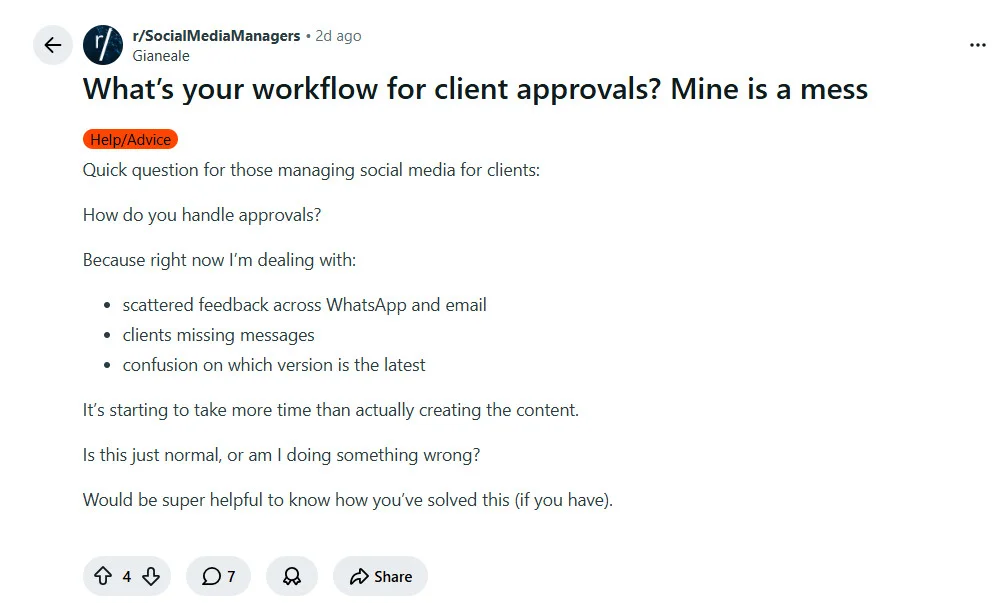
- The Feedback: A client provides comments via email, which are then copied and pasted into a Slack thread for the design team.
- The Disconnect: A designer makes changes based on the Slack thread but saves the file locally to their desktop, creating a secondary version.
- The Collision: The account manager, unaware of the local file, grabs the original Google Doc—which has since been updated by a third party—and hits "publish."
In this sequence, nobody made a mistake. Everyone acted in good faith, working from the version they believed was authoritative. The failure is not individual; it is architectural. There is no system in place to declare which version is the "final" truth.

Agencies managing five clients face the same risk as those managing fifty. Scale does not change the failure mode; the infrastructure does. If you are relying on manual processes to track the "state" of a post, you are essentially gambling with your client’s brand reputation.
The Myth of the "Collaborative" Toolset
For years, the industry has relied on a suite of "collaboration" tools—Google Docs, Slack, Email, and WhatsApp. While these are excellent for communication, they are fundamentally ill-equipped for state management.
State management is the difference between "this is where the file lives" and "this version was approved by the client at 3:47 PM on Tuesday, and no other version supersedes it."
The Tool Gap Analysis
| Tool | What It Does Well | What It Cannot Do |
|---|---|---|
| Google Docs | Store and share drafts | Lock an approved version; record audit trails of who approved it and when. |
| Slack | Facilitate quick feedback | Create a traceable approval record tied to a specific creative asset. |
| Capture long-form client revisions | Connect those revisions directly to the file in the scheduler. | |
| Get a quick "looks good" | Confirm that the "looks good" refers to Version 3, not Version 2. |
The failure is structural: none of these tools share state. There is no point in the workflow where "this version is the one" becomes an official, visible, and locked fact. This fragmentation is precisely why many agencies hit a growth ceiling at roughly 15 clients. Once the number of approval threads exceeds the capacity for human memory, the "version drift" becomes inevitable.
The Data: The High Cost of Disconnection
The impact of these disjointed workflows is not just reputational—it is financial. Research from Swydo (2026) highlighted an agency that lost 14 hours of billable time on a single campaign because three team members were editing different versions of the same post simultaneously.
When you multiply that inefficiency by a dozen clients, the lost revenue is staggering. Furthermore, the "coordination overhead"—the time spent checking Slack threads, searching through email chains, and verifying Google Doc timestamps—is work that provides zero value to the client. It is defensive work, performed only to prevent a catastrophic error.
Shifting from Conversation to System State
The agencies that have successfully eliminated version conflicts have all made the same pivot: they stopped treating "approved" as a conversation and started treating it as a system state.
In a mature agency workflow, a post should not be "approved" because a client sent an emoji in Slack. It should be approved because the post has reached a specific, immutable status within a centralized platform.
The Path to a Single Source of Truth
"Single Source of Truth" is often misunderstood as a file-management strategy. A shared Google Drive folder is not a single source of truth; it is simply a shared graveyard for fifteen versions of the same caption.
A true single source of truth is a system where the approval state is locked, not implied. The workflow should look like this:
- Draft: Open for internal editing.
- In Review: The version is frozen for the client.
- Client Approved: The system locks the file and prevents further edits.
- Scheduled: The platform pulls only from the locked, approved state.
When a post reaches the "Client Approved" status, the previous drafts should cease to be accessible for publishing. The system itself should hold the authoritative version. This shifts the team’s internal dialogue from "Which version is final?" to "What is the status of the Q3 campaign?"
The Future: Centralized Approval Portals
Modern platforms, such as SocialPilot, are designed to solve this by bringing every draft, edit, and approval under one roof. By creating a contained workspace for each client, agencies can ensure that every team member is viewing the exact same version at the exact same time.
The advantages of this centralized approach are quantifiable:
- Elimination of Parallel Files: No more local copies or multiple Google Doc links floating in Slack.
- Auditability: Every approval is stamped with a user ID and a timestamp, providing a clear history for both the agency and the client.
- Structural Impossibility: If a post is not marked as "Approved," the system prevents it from being scheduled. It is no longer possible to accidentally publish a draft.
This transition allows account managers to recover hours of lost time, moving away from "coordination work" and toward "strategic work." When you remove the need to manage version drift, you allow your team to focus on the content itself rather than the logistics of document control.
Audit Your Workflow: Are You Version-Proof?
If you are unsure whether your agency is at risk, conduct a simple audit of your current workflow. Ask your team the following:
- Can you prove which version of a post a client approved six months ago?
- Is it possible for two people to edit different versions of the same post at once?
- Do you have to cross-reference multiple tools (e.g., Slack + Email) to confirm an approval?
- Is there a "lock" mechanism that prevents an unapproved draft from being published?
If you answered "yes" to these, you are managing risk through human vigilance rather than robust infrastructure. In the agency world, human vigilance is a finite resource—and eventually, it will fail.
Conclusion: The Only Version That Counts
Clients do not see your process; they see the final result. When an incorrect version goes live, the conversation with the client is no longer about the marketing strategy. It is about the competency of your agency. Most clients will offer one opportunity to explain a version error; very few will offer a second.
The agencies that never have this conversation did not get lucky. They made the decision to move their approval process out of the "conversational" tools and into a "systematic" one. By adopting a single source of truth, they have insulated themselves from the most common cause of client churn.
The question for your agency is no longer whether you can afford to implement a dedicated approval system. It is whether you can afford the cost of the next version error.


 Reynand Wu
 Iffa Jayyana


 Sagoh
Sagoh

 Azzam Bilal Chamdy
 Ali Ikhwan