
 Rifan Muazin
The digital landscape is undergoing its most significant shift since the inception of the search engine. For two decades, the "blue link" model—where users typed queries into a search engine and sifted through a list of websites—defined the consumer journey. Today, that model is being rapidly dismantled by the rise of Generative AI.
Instead of browsing, consumers are now engaging in dialogue. Whether it is asking ChatGPT for the best electric vehicle (EV) for long-range travel or querying Google’s AI Overviews about the most effective sunscreen for sensitive skin, users are bypassing traditional websites in favor of synthesized, instant answers. With ChatGPT processing an estimated 2.5 billion prompts daily and Google’s AI Overviews now appearing on roughly one-fifth of all search queries, the way consumers discover, evaluate, and choose brands has fundamentally changed. Your brand is now either part of the AI-generated answer, or it effectively does not exist.
The New Search Frontier: Understanding the Shift
The traditional marketing funnel, once focused on Search Engine Optimization (SEO) for organic rankings, must now evolve into a strategy for "AI Visibility." The core of this challenge lies in a simple, uncomfortable truth: most brands have no visibility into what AI models are saying about them.
"We’re seeing a bigger and bigger part of the consumer purchase journey being shaped by AI," says Alistair Wheate, Principal Solution Strategist at Brandwatch. "We absolutely need to be having a good handle on what the AI is saying to these consumers."
When a consumer asks an AI for a recommendation, the model does not browse the web in the traditional sense; it synthesizes information from a vast array of sources—ranging from official corporate documentation to niche Reddit forums and independent review sites. If your brand is not present in these sources, or if your messaging is inconsistent, the AI will simply omit you or, worse, favor your competitor.
A Four-Step Framework for AI Visibility
For brands looking to regain control of their narrative, the path forward requires a transition from passive observation to active "Search Intelligence." By tracking consumer behavior across Google, ChatGPT, Perplexity, and other AI platforms, companies can identify the specific questions their audience is asking and, more importantly, whether they are being recommended in the resulting answers.
To audit your current standing, follow this four-step framework:

Step 1: Isolate a Single Market
Search behavior is deeply rooted in geography and culture. A query about a telecommunications issue in the United States may differ significantly from the same inquiry in Germany or Japan.
Consider the case of the multinational telecommunications giant Orange. By analyzing search data in French-speaking markets, the company identified that customers were frequently searching for answers to specific technical frustrations—such as "How do I fix this bug?" or "Why is my TV not working?"
Previously, the brand’s website lacked troubleshooting content for these specific pain points. As a result, AI models had no helpful information to synthesize, and the company’s call centers were overwhelmed with preventable inquiries. By using Search Intelligence to map these specific queries, Orange created a library of targeted, high-value content. The result was twofold: a massive boost in organic traffic and a 25% reduction in call center volume.
Step 2: Define Your Category with Granularity
Broad search terms are no longer sufficient. If you operate in the automotive industry, monitoring "cars" is a waste of resources. Instead, focus on specific segments like "electric SUVs under $50,000" or "luxury sedans."
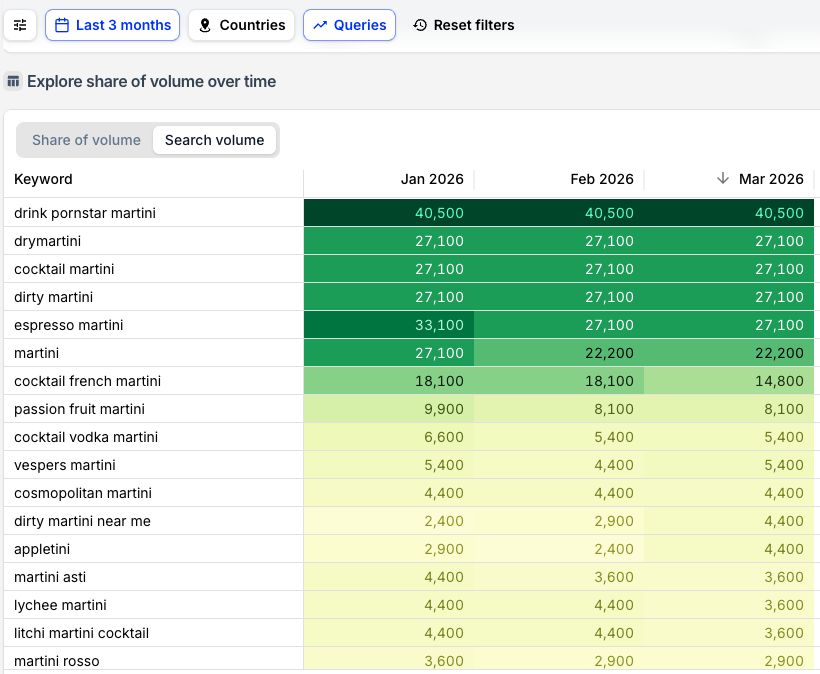
The Campari Group, a leader in the beverage industry, provides a blueprint for this strategy. Their go-to-market success depended on knowing which cocktails were trending in specific regions. By moving from a reliance on external local agencies to an in-house Search Intelligence model, Campari gained real-time visibility into drinking trends across 15 markets, reducing costs by 50% while increasing the speed of their campaign deployment.
Step 3: Identify the Top 100 Questions
The objective here is not to hit a specific number, but to build a comprehensive map of consumer intent. Search data is the most unfiltered form of market research; it reveals exactly what problems customers are trying to solve and how they evaluate their options.
Aromazon, a French skincare brand, leveraged this by identifying the exact questions people asked about fragrances and essential oils. By building dedicated landing pages that directly addressed these queries, the brand scaled from zero to €40 million in annual revenue. As Matthew Danieleu, a leading voice in consumer data, notes, "When people search on Google, Amazon, or Walmart, they tell you exactly what they’re looking for."
Step 4: Audit AI Citations
Once you have defined your category and identified the primary questions, the final step is to test those queries against major AI platforms like ChatGPT, Gemini, and Perplexity.
Does your brand appear in the response? If so, is the description accurate? Are you cited as a source? AI platforms often provide hyperlinked citations that point to Reddit threads, industry blogs, or retailer reviews. These "silent" citations are what determine how an AI categorizes your brand. If your competitors are consistently cited in these responses, they are effectively "winning" the AI-driven portion of the market.
Addressing the Gaps: What to Do When You Are Missing
If your brand is currently absent from AI responses, you must optimize the three pillars that inform AI knowledge:
- Owned Content: Ensure your website hosts dedicated FAQ pages, troubleshooting guides, and deep-dive blog posts that provide direct, clear answers to the questions you identified in your audit.
- Earned Coverage: While major publishers like The New York Times or the BBC may block scrapers, AI models still ingest information from the ripple effects of that coverage on social media and independent platforms. Prioritize presence on trade publications, Substack newsletters, and niche community forums.
- Community Participation: AI models learn from the collective human conversation. By engaging on platforms like Reddit, responding to customer reviews, and participating in industry forums, you are providing the "signals" that AI models use to build their authority scores.
The Future of the Purchase Journey
The integration of AI into the search process is not a temporary trend; it is the new standard of consumer interaction. As AI models become more sophisticated, they will not just provide information; they will increasingly facilitate transactions and make brand recommendations on behalf of the user.
"AI is—not so quietly—shaping how people decide what to buy," says the team at Brandwatch. "When someone asks ChatGPT ‘what’s the best [your category],’ and your brand doesn’t come up, you’ve lost them before they even found you."
To remain competitive, companies must shift their workflows to include monthly audits of their AI visibility. AI answers are fluid and change as new content is indexed. By treating AI as a vital, evolving channel—much like you would treat traditional SEO or paid media—brands can ensure they remain at the forefront of the digital conversation, ready to meet consumers at the exact moment they ask for help.


 Reynand Wu
 Iffa Jayyana
 Raul Delapena Setiawan

 Sagoh
Sagoh

 Azzam Bilal Chamdy
 Ali Ikhwan