
 Sagoh
Sagoh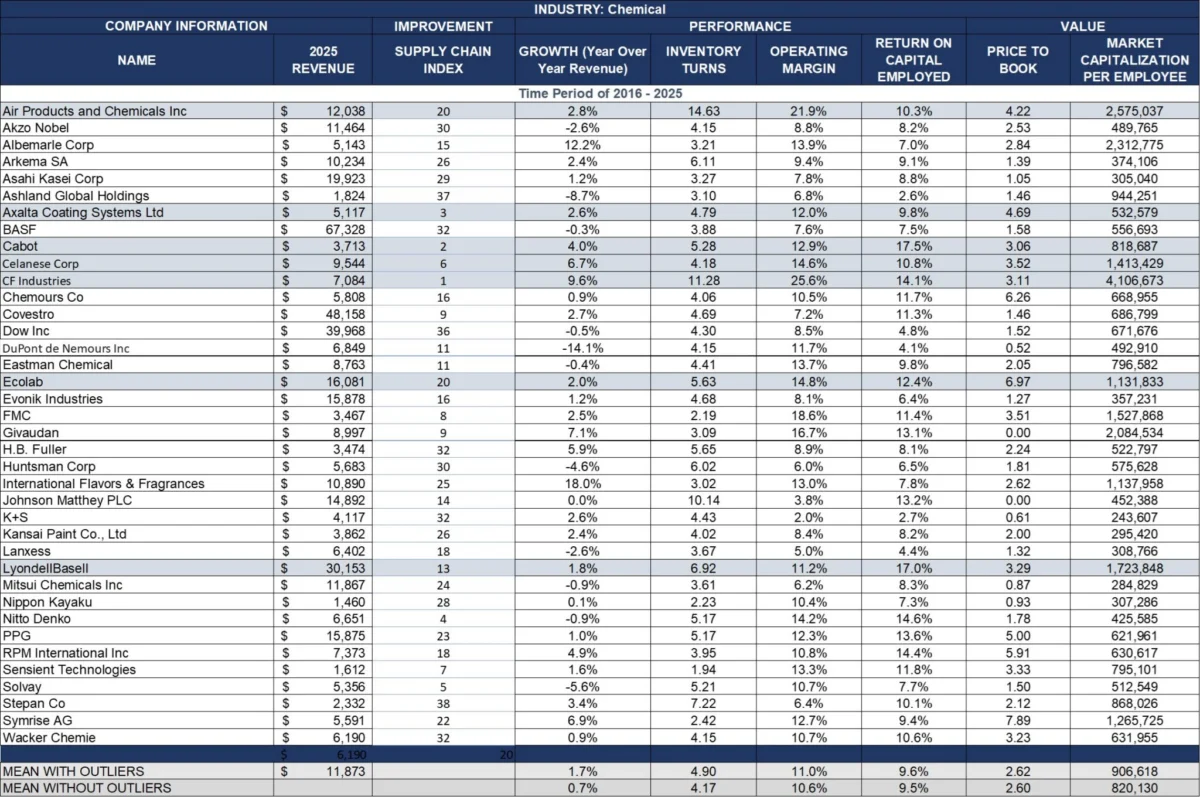
For the better part of the last decade, the corporate narrative surrounding supply chain management has been dominated by the seductive allure of digital transformation. We are told that the future is autonomous, AI-driven, and hyper-efficient. Yet, beneath the polished LinkedIn updates from industry conferences and the expensive gala dinners, a sobering reality is emerging: supply chain leaders are automating outdated, "inside-out" processes while simultaneously failing to deliver tangible business value.
In the industry, there is a growing, dangerous divide between the marketing rhetoric of technology vendors and the actual financial performance of the companies they serve. It is time to look past the industry jargon—the "Hooey"—and confront the "Phooey," or the internal disgust that arises when we realize that the promise of the autonomous supply chain is, in many cases, a mirage.
The Prologue: A Culture of Performative Progress
Walking through the halls of a major supply chain event, one is struck by the opulence. There is a palpable sense of self-congratulation among “supply chain retreads” who post celebratory photos, toast their latest implementations, and treat software deployments as synonymous with business success.
However, there is a fundamental disconnect. Lucrative compensation packages for executives and aggressive sales targets for technology vendors have created an environment where closing a deal is celebrated more than the realization of actual ROI. There is a profound lack of accountability. If a company implements a new ERP or APS system and their margins fail to improve, the failure is rarely attributed to the software’s inadequacy or the flawed process it digitizes. Instead, it is blamed on "implementation challenges" or "change management."
The industry currently waxes eloquent about AI, focusing on making current workflows faster or "hands-free." But if you are automating a process that is fundamentally flawed—such as treating orders as perfect proxies for demand—you are simply achieving a state of "faster failure." Without a rigorous, industry-wide definition of what constitutes value, the autonomous supply chain remains little more than an expensive, automated fantasy.

Chronology of a Structural Crisis: The Chemical Industry Case Study
To understand the failure of modern digital transformation, one must look at data, not marketing brochures. The chemical industry between 2016 and 2025 serves as a chilling case study. During this period, the industry faced a structural imbalance between supply growth and weakening global demand.
The Three Eras of Change:
- Pre-COVID (2016–2019): The era of "inside-out" obsession. Companies poured capital into internal efficiency, focusing on manufacturing output and inventory turns, erroneously believing that internal process optimization was equivalent to market excellence.
- The Shock (2020–2022): The pandemic exposed the fragility of these systems. The very processes designed to maximize efficiency became the primary obstacles to agility when supply chains were disrupted.
- The Post-COVID Realignment (2023–2025): The "new normal" proved that historical models were insufficient. Companies that doubled down on traditional digital transformation—often those touted by consultants as "leaders"—suffered the most significant declines in margin potential.
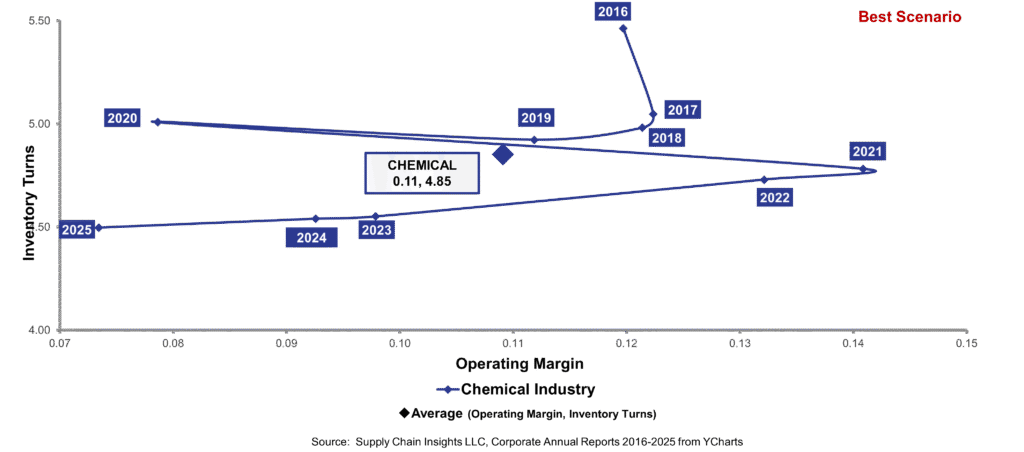
Figure 1 (The Chemical Industry Orbit Chart) illustrates a downward slide in the intersection of operating margins and inventory turns. The data confirms that the companies with the most robust, high-spend digital transformations often underperformed. When AI models are trained on this flawed, legacy data, they don’t provide "intelligence"—they provide an echo chamber of past failures.
Supporting Data: Debunking the Myths of Excellence
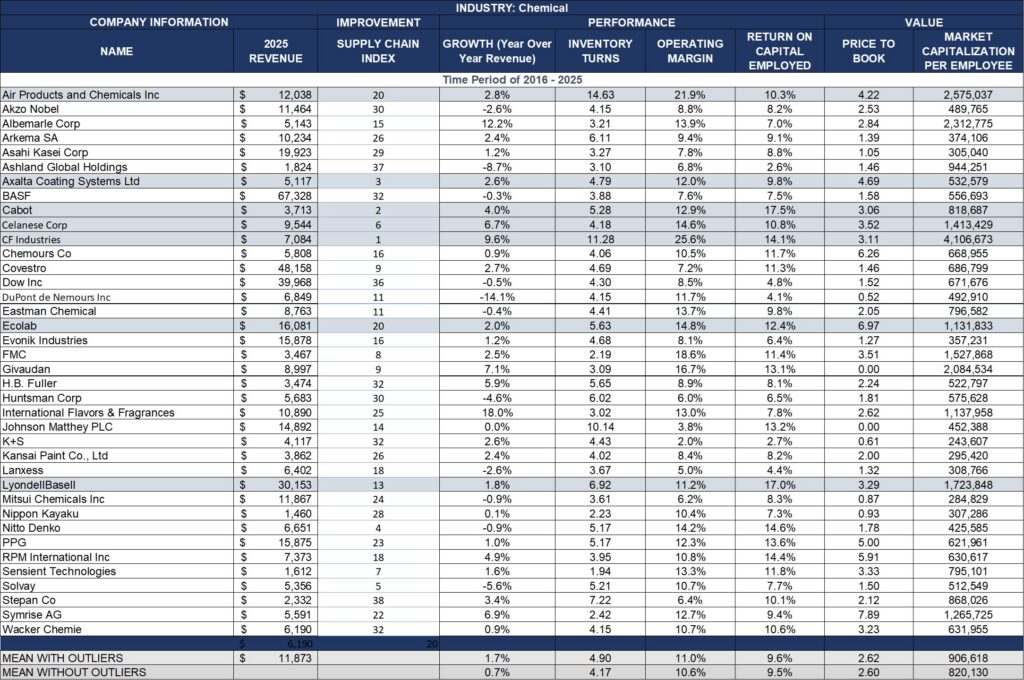
When one asks generative AI models to identify the top-performing chemical companies, the answers are predictably misaligned with financial reality. Tools like ChatGPT frequently cite giants like BASF or Dow as leaders, a designation that crumbles under the weight of "Supply Chains to Admire" analysis.
The data shows a recurring trend: companies that invest heavily in the standard menu of supply chain software—ERP and APS systems—often fail to outperform their peers. The reason is simple: the software assumes the status quo is the goal.
If we look at the prevalence of the Excel spreadsheet, we find the industry’s dirtiest secret. Despite billions spent on sophisticated platforms, Excel remains the number one supply chain planning technology. Why? Because the software doesn’t fit the way people actually work. It doesn’t solve the user’s problem; it forces the user to solve the software’s problem. When industry pundits like Knut Alicke "vibe code" S&OP software in 30 hours, or when experts postulate on "three layers of Context Engineering," we have to ask: Does this provide any tangible value to the business, or is it just another layer of technical noise?
Official Responses and Industry Resistance
The reaction to these critiques is often defensive. Technology vendors and large consultancy firms argue that the problem is not the technology, but the "maturity level" of the organization. They argue that if only the client had better data or more disciplined change management, the software would work as advertised.
This is a convenient narrative. It shifts the burden of failure onto the customer while insulating the vendor from the need to innovate. When a company like Eastman Chemical is touted as a success story for a specific planning solution, the industry cheers. Yet, when we see massive layoffs at firms like Dow—companies that once featured prominently in high-production marketing campaigns—the silence is deafening.
The "rich reward systems" for technologists and the entrenched nature of traditional software architectures drive an intense resistance to change. If the current model is making everyone rich, why would they push for a definition of "value" that requires transparency?
Implications: The Death of the "Inside-Out" Mindset
The primary implication of our current trajectory is that we are building "WAYMO cars" for a terrain that doesn’t exist. We are creating autonomous systems that are perfectly capable of driving off a cliff because they are following a map drawn in 1995.
True value in supply chain management is not found in "continuous decisioning" or "agent-driven systems" that simply move faster. Value is found in:
- Demand-Driven Architectures: Moving away from the assumption that the order equals demand.
- User-Centric Design: If the team refuses to use the software, the software is a failure, no matter how clever the algorithm.
- Outcome-Based Metrics: We must stop measuring "system usage" and start measuring "margin health" and "market responsiveness."
- Security and Scalability: An app built in a weekend might look impressive on a demo, but it lacks the enterprise-grade foundation required for global operations.
Moving Beyond the "Hooey"
The time for mindless adoption of "AI-everything" is over. We are currently in an era where the supply chain professional must be a skeptic first and a user second.
We must stop being impressed by the speed of software deployment and start demanding evidence of performance. Is the decision intelligence being proposed actually a course correction, or is it just a recommendation that reinforces current, failing biases? We need to prototype models that create value by challenging the status quo, not by digitizing it.
Supply chain management is serious, heavy-duty work. It affects the livelihoods of thousands of people and the viability of global economies. When we treat it as a playground for buzzwords and "vibe coding," we aren’t just wasting budget—we are actively dismantling the reliability of the global supply chain.
It is time to dispense with the "Hooey." It is time to embrace the "Phooey"—to look at the current state of the industry with a healthy dose of disgust, and use that energy to build something that actually works. We don’t need more automation; we need more clarity. We don’t need more "digital transformation"; we need a return to value-driven, human-centered, and reality-based supply chain planning.
The next time you see a post about a revolutionary new AI-driven supply chain tool, ask the only question that matters: Does this drive value, or is it just more noise in an already deafening room?


 Ali Ikhwan
 Raul Delapena Setiawan
 Reynand Wu


 Azzam Bilal Chamdy
