
 Nana Muazin
In the high-stakes arena of Olympic weightlifting, victory is often measured in millimeters and milliseconds. When an athlete stands on the platform, preparing to execute a snatch or a clean and jerk, they are not merely battling gravity; they are engaging in a sophisticated, split-second collaboration with their equipment. At the heart of this interaction is a phenomenon known as "the whip"—the intentional flexing and recoiling of a high-performance barbell.
While elite lifters have long understood the whip as an intuitive part of their technique, the precise physics governing these oscillations has remained largely anecdotal. Recently, however, researchers have begun to quantify exactly how these bars behave under load, revealing that the engineering of a barbell may be as critical to a gold medal as the athlete’s own training regimen.
The Anatomy of a Lift: Defining the Whip
Olympic weightlifting is built upon three foundational movements: the snatch, the clean, and the jerk. Each requires a seamless transfer of energy from the athlete’s body into the barbell. In the clean and jerk, for example, an athlete pulls the bar from the floor to their shoulders before driving it overhead.
The "whip" occurs when the bar bends under the immense stress of the loaded plates and the athlete’s explosive movement. By timing their movements to match the bar’s natural frequency of oscillation, an athlete can essentially "ride" the recoil. As the bar dips and then flexes back upward, it provides a surge of upward momentum that can help the lifter secure a heavier weight than they might otherwise move.
"When they dip down, they can feel when the bar flexes back up and use that to accelerate the movement upward to increase the amount they can lift," explains Joshua Langlois, a graduate student at Pennsylvania State University. A competitive Strongman athlete himself, Langlois has long observed the profound impact this phenomenon has on performance. Seeking to move beyond intuition, he recently presented a formal modal analysis of barbell mechanics at a meeting of the Acoustical Society of America in Philadelphia.
Methodology: Putting the Barbell to the Test
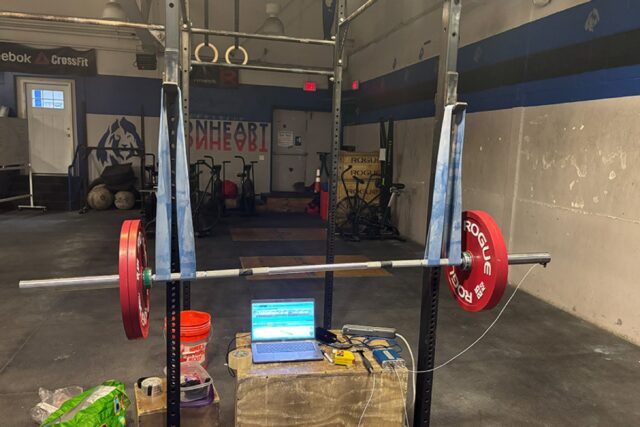
To unravel the mystery of the whip, Langlois devised an experimental setup designed to isolate the barbell’s movement. He suspended four standard 20-kg men’s barbells—the type used in professional competition—from elastic resistance bands. This "floating" configuration allowed the bars to vibrate freely without interference from the floor or external support.

Each bar was loaded with 50 kg on either end, simulating a typical training load. Langlois then utilized accelerometers—sensors that measure changes in velocity—at the ends of the bars. By tapping specific points along the shaft with a calibrated hammer, he could excite the bar into vibration and record how the structure responded. By comparing different barbell brands and varying the loads, Langlois began to map the "modal patterns" that define the whip.
The Discovery: Frequency Shifts and Structural Surprises
The findings of the study challenged several long-standing assumptions regarding barbell dynamics. Initially, Langlois hypothesized that the barbell’s sleeves—the rotating cylinders at the ends where weight plates are attached—would have a uniform impact on the vibration.
He discovered that a bar floating in space exhibits a higher frequency of vibration when the sleeves are removed. This aligns with standard physics: adding mass to the ends of a system generally decreases the rate of oscillation and shifts the "nodes," or the points where the bar remains stationary during vibration.
However, the most significant discovery involved the higher "flexural modes" of the bar. Under higher loads, the frequency of these vibrations actually increased.
"The bar becomes more fixed, so the actual wavelength of the bar is less," Langlois explained during a media briefing. "With a set wave speed, wavelength is inversely proportional to the rate of oscillation, so we get a higher frequency. This is something we did not foresee happening."
This counterintuitive discovery underscores the complexity of steel engineering. It suggests that as a lifter adds weight, the structural characteristics of the bar shift in ways that could either assist or hinder their specific technique.
The Competitive Edge: Why One Percent Matters
While the variance in frequency discovered by Langlois is subtle—hovering in the range of a single percentage point—its implications for elite sport are seismic. At the Olympic level, where the difference between a podium finish and sixth place can be a matter of a single kilogram, a one-percent improvement in energy transfer is the difference between a new world record and a failed attempt.
"For elite sports, a single percent makes all the difference," Langlois noted.
He draws a parallel to professional golf, where top-tier players can sense the precise flex of their clubs during a swing. Similarly, the world’s best weightlifters possess a heightened proprioception that allows them to feel the whip of the bar. It is a sensory feedback loop that takes years to master, rendering the "whip" a tool that is largely inaccessible to casual gym-goers but essential for the professional elite.
The Proprietary Problem: A Lack of Transparency
One of the primary hurdles in this field of study is the "black box" nature of barbell manufacturing. While all competition bars must adhere to strict requirements regarding length, diameter, and weight, the internal construction—the steel composition, heat treatment, and the exact "Young’s modulus" (stiffness)—is often kept secret.
"We don’t have a good feel for this because no barbell manufacturers will tell you exactly how they make the bar," Langlois said. "It’s all proprietary."
This secrecy extends to the coupling mechanisms that connect the shaft to the sleeves. Currently, the market offers various configurations, ranging from bushings (solid metal sleeves) to high-end needle bearings designed to allow the sleeves to spin independently of the shaft. While manufacturers typically recommend bearings for Olympic lifting to minimize torque on the athlete’s wrists, the interaction between these mechanical couplings and the bar’s overall whip remains an area of ongoing investigation.

Implications for Future Training
The research presented by Langlois marks the beginning of a shift toward data-driven equipment selection. As the mechanics of the whip become better understood, weightlifting coaches and equipment managers may eventually move toward "barbell matching," where athletes are paired with specific bars that complement their individual lifting speed and rhythm.
The next phase of the research, as outlined by Langlois, involves moving the study from the lab to the platform. By gathering data on elite men and women while they perform actual lifts, researchers hope to map the interaction between human biology and material science in real-time.
"We know that the bar matters," says Langlois. "We know that it changes shape and frequency with load. Now we are going to take data with real Olympic weightlifters so we can see exactly how they use the whip and how the bar matters for them."
Conclusion: The Final Frontier of Performance
The science of the barbell is no longer just about metallurgy; it is about the intersection of wave mechanics and human performance. As we look toward future Olympic Games, the equipment will undoubtedly continue to evolve. Whether this leads to standardized, "smart" equipment or simply a better understanding of how current tools can be optimized, one thing is certain: the quest for the perfect lift is as much about the physics of the bar as it is about the strength of the person holding it.
For the elite athlete, the whip is not just a feature of the barbell—it is a partner in the pursuit of perfection. By quantifying this invisible force, science is finally catching up to the incredible feats of strength performed on the Olympic stage.


 Reynand Wu
 Sagoh
Sagoh
 Raul Delapena Setiawan

 Azzam Bilal Chamdy
 Ali Ikhwan