Ali Ikhwan
One person calls in sick. An urgent client meeting runs over. A marketing director takes a long weekend. In the fast-paced world of digital marketing, these are standard, everyday occurrences. Yet, for many social media agencies, these minor human events trigger a catastrophic operational freeze.
The content is ready. The creative is polished. The strategy is sound. But the calendar sits stagnant. Why? Because the entire operation is tethered to a single, fragile link in the approval chain. When that one person—whether it’s a senior manager, a creative lead, or a client’s primary point of contact—becomes unavailable, the engine stops.
The Anatomy of a Content Blackout
This phenomenon is not a failure of talent or a lack of preparation; it is a fundamental design flaw. Agencies frequently mistake this "single-approver" model for quality control. It begins innocently enough: the agency founder or the client’s marketing director wants oversight. They want to ensure the brand voice remains consistent.
However, as the agency scales from one client to eight, or as a marketing department grows, that oversight habit hardens into a rigid, singular bottleneck. When an agency manager on r/SocialMediaManagers recently vented about their team being paralyzed by a single, unreachable approver, the response was a chorus of shared frustration from industry professionals across the globe.
The impact is tangible:
- Missed Campaign Windows: High-stakes launches scheduled for conference weeks or seasonal events are delayed, causing missed impressions and lost revenue.
- Competitor Dominance: While your feed sits idle due to an internal bottleneck, competitors are firing on all cylinders, seizing the digital real estate you should be occupying.
- Operational Friction: Teams spend more time chasing signatures and sending "just checking in" emails than they do on creative strategy.
A Chronology of the Bottleneck
The evolution of this problem typically follows a predictable trajectory.
Phase 1: The Honeymoon Period
At the start of a partnership, a single-approver workflow is often efficient. With one client and one point of contact, the communication loop is tight and responsive. The agency owner personally manages the quality, and the client feels secure knowing exactly who is vetting their brand assets.
Phase 2: The Scaling Trap
As the agency gains traction, the complexity of the workflow increases. The team grows, but the approval process remains stuck in its original configuration. The "approver" becomes overwhelmed by the sheer volume of assets, while the team below them faces constant delays. Because the process "worked" in the early days, no one questions the necessity of the bottleneck until a crisis occurs.

Phase 3: The Operational Collapse
The breaking point is usually reached when the primary approver is incapacitated—due to illness, travel, or an emergency. Because no backup was ever formalized, the agency is forced to initiate an "emergency" workflow that lacks structure, often leading to rushed approvals, missed errors, or a complete stop in publishing.
Supporting Data: The High Cost of Stagnation
The numbers paint a bleak picture for agencies clinging to outdated approval models. According to data from Gleanster and Kapost, a staggering 92% of marketers cite approval delays as the primary reason for missing deadlines.
The issue is equally prevalent in the B2B sector. The Content Marketing Institute’s 2025 research indicates that 47% of B2B marketers view workflow and approval management as a significant operational bottleneck. Furthermore, a report from Ziflow (2023) highlights that 65% of marketing professionals lose more than one full day every single week simply chasing feedback.
When we aggregate these statistics, the conclusion is unavoidable: the single-approver model is a massive, silent tax on agency profitability and productivity.
Rethinking the Workflow: Official Strategies for Resilience
Agencies that have successfully eliminated content blackouts have done so by shifting from a "person-centric" model to a "system-centric" model. This requires three distinct strategic pillars.
1. The Institutionalized Backup
The most resilient agencies do not rely on verbal agreements. They formalize backups within client contracts and internal operating procedures. A designated backup must have the same access rights and context as the primary approver. This ensures that when the primary is unreachable, the transition is seamless and requires zero handover time.
2. The Policy of Two Sentences
Complexity is the enemy of efficiency. Agencies should implement a concise coverage policy that clearly defines:
- Who steps in when the primary is away.
- The specific timeline (e.g., after 24 hours of no response) before the backup assumes authority.
3. Tool-Enabled Autonomy
Modern social media management platforms, such as SocialPilot, have been engineered specifically to solve this structural issue. By moving away from email-based approval chains and into shared, cloud-based queues, agencies can ensure that content moves forward regardless of one individual’s availability.
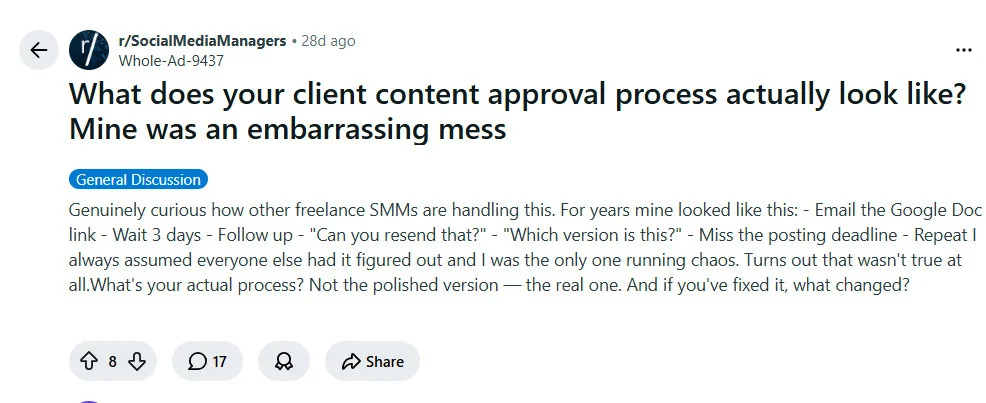
Features like Auto-Approve toggles and shareable approval links—which require no login for the client—are not just "nice-to-haves"; they are essential tools for maintaining momentum in a 24/7 digital environment.
The New Standard: Comparison of Workflows
| Feature | The Legacy Setup | The Resilient System |
|---|---|---|
| Responsibility | One person receives all requests | Multiple approvers pre-configured |
| Communication | Constant chasing and follow-ups | Automated queues; no handover needed |
| Client Interaction | Single contact goes dark = silence | Backup uses secure, shareable links |
| Reliability | Posting gaps occur frequently | Auto-Approve prevents scheduling gaps |
Implications: Is Your Agency One Absence Away from Failure?
If you find yourself answering "no" to the following questions, your current operations are inherently unstable:
- Is there a named, trained backup approver for every client account?
- Does your contract explicitly state the approval protocol for when the primary contact is away?
- Does your backup have active, current access to your management tools?
- Is there a pre-defined window for escalation before auto-publishing kicks in?
- If you or your client lead were unreachable for 48 hours, would the content calendar continue to run?
Answering "no" to more than two of these questions suggests that your next content blackout is not a matter of "if," but "when."
Conclusion: Designing for Continuity
The goal of a high-performing agency is to ensure that the content operation is larger than any single individual. When you rely on one person to approve every post, you have built a system where that individual’s personal life becomes everyone else’s professional emergency.
Transitioning away from this model doesn’t require a radical, expensive overhaul. It requires a commitment to formalizing roles, documenting policies, and leveraging the right technology to ensure that the "nod" of approval is a distributed capability rather than a single point of failure.
If your answer to the question "what happens when the approver is out?" is still "we’ll figure it out," you are operating on borrowed time. It is time to replace the bottleneck with a pipeline. Your team, your clients, and your bottom line will thank you.


 Reynand Wu
 Iffa Jayyana
 Raul Delapena Setiawan

 Sagoh
Sagoh

 Azzam Bilal Chamdy