
 Iffa Jayyana
For decades, the lifecycle of a website has been governed by an unwritten law: the day of launch is its peak. The moment the final deployment script completes, the site exists in a state of "brief perfection." It is polished, performant, and precisely aligned with the company’s current messaging. Yet, from that second onward, it begins an inevitable, silent slide into obsolescence.
This isn’t because the code breaks or the servers fail. It is because the world around the website—market trends, competitive landscapes, design systems, and user expectations—continues to shift, while the static code remains frozen in time. A year later, that once-perfect site is a "period piece," a digital artifact that no longer accurately reflects the business it represents.
Pierre Burgy, founder of Fimo, suggests that we have been accepting this "digital decay" as an unavoidable tax on web development. But what if a website could be alive? What if, instead of drifting into irrelevance, a site could continuously optimize itself while its human creators moved on to more creative, high-impact work? The promise of the "autonomous website" is seductive, but as Burgy and his team discovered, the path to achieving it is blocked by a significant, non-technical hurdle: nobody actually wants a website that changes entirely on its own.
The Genesis of Autonomous Web Infrastructure
The concept of the autonomous website is not merely about automation; it is about shifting the role of the developer from a manual maintenance technician to a "curator of systems."
In the traditional model, a web team operates like a construction crew that hands over a finished building and then is forced to return every time a lightbulb flickers or a wall needs repainting. In an autonomous framework, the building maintains itself. During the night, an AI-driven agent might notice that a design-system update wasn’t correctly applied to the pricing page; it corrects the CSS, runs a test, and publishes the fix. Another agent might scan for uncompressed images or accessibility regressions, applying fixes automatically or flagging them for human review.
However, when Fimo began building this architecture, they encountered a fundamental psychological barrier. Developers and stakeholders alike were wary of the "black box" approach. Total autonomy, it turned out, was not the goal. The goal was calibrated autonomy.
The Three Tiers of Web Maintenance
To understand why users resist full automation, one must categorize the work that goes into a website. By breaking down the tasks, a clear hierarchy of control emerges.
1. The "No-Brainer" Chores (The 80%)
The vast majority of website maintenance is rule-bound, repetitive, and undeniably joyless. This includes tasks like updating meta tags, ensuring accessibility compliance across thousands of subpages, fixing broken links caused by URL restructuring, or propagating design tokens.
None of these tasks require human intuition or brand strategy. They are governed by logic and standards. By offloading this 80% to autonomous agents, teams are not losing control; they are being liberated from the drudgery that prevents them from doing meaningful work.
2. The "Untouchable" Creative Core
At the opposite end of the spectrum is the work that defines a brand—the layout choices that evoke a specific emotional response, the tone of voice in a landing page, or the strategic placement of a call-to-action. This is the domain of human judgment and taste. No AI, regardless of its sophistication, can replicate the nuanced intent of a human designer. Protecting this "creative core" is why many teams initially resist autonomous systems.
3. The Contextual Gray Area
The most complex segment lies in the middle. Here, the decision to automate depends entirely on the stakeholder. Consider a request to make "Dark Mode" the default for a website. A developer might view this as a simple configuration change—a "no-brainer" to be automated. A brand designer, however, might see it as a fundamental shift in how the brand’s identity is perceived at the first point of contact. Because "right" is a function of the stakeholder’s role, a one-size-fits-all automation policy is destined to fail.
Reimagining Control: The Agent-Based Model
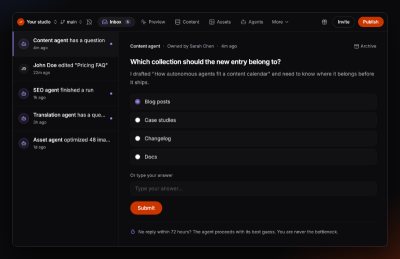
The epiphany for the Fimo team was that "autonomy" shouldn’t be a binary toggle. Instead, it must be modular. Rather than handing the keys to the entire site, stakeholders should be able to compose specific agents for specific tasks.
By treating the agent as the unit of control, organizations can define boundaries. One might trust an "Accessibility Agent" to have full authority to push updates to production, while keeping a "Content Agent" on a strict "human-in-the-loop" leash.
This model changes the nature of the relationship between human and machine. It allows for a "trust-gaining" trajectory. As the agent proves its competence in handling minor tasks, the human operator can gradually expand the scope of its authority. This isn’t just about setting preferences; it is about building a digital partnership that evolves over time.
The True Risk: The Frozen Site
The primary fear cited by skeptics is that an agent might make a change that the owner doesn’t like. However, this fear fails to account for the much greater risk of the "frozen site."
A website that never changes is a website that is dying. In the modern digital economy, search engines, users, and competitors punish stagnation. A site that hasn’t been updated in six months is effectively invisible to modern algorithms and off-putting to users who associate freshness with company viability.
The "frozen" state is a hidden risk. It is a slow, quiet rot that occurs in the background, unnoticed until the moment a potential client visits the site and perceives an outdated, neglected digital storefront. By moving toward an autonomous model, companies shift their focus from maintaining the past to iterating on the future.
Implications for the Future of Web Development
The move toward autonomous websites signals a major shift in the professional landscape of web design and development.
- Increased Velocity: Teams that automate the "80%" can ship high-value features faster. The bottleneck of "waiting for someone to fix the footer" is eliminated.
- Shift in Talent Focus: Junior developers who once spent their time hunting for broken links or updating CSS tokens will be freed to focus on architecture, performance, and user experience strategy.
- The Rise of Digital Governance: Organizations will need to develop "Agent Governance" frameworks. Just as companies have policies for social media or data privacy, they will soon need policies for which AI agents are authorized to touch which parts of the brand’s digital infrastructure.
Conclusion: The Point of Autonomy
The ultimate goal of an autonomous website is not to remove humans from the process. It is to remove the decay.
We have spent decades treating website maintenance as an endless, manual chore. By embracing agents that can handle the mundane, we do not surrender our websites to the machines; we reclaim our time. The most successful teams will be those that draw the line of authority carefully, keeping their hand on the pulse of the brand while letting agents handle the endless, necessary adjustments that keep a site relevant.
As we look toward the next generation of web development, the question is no longer "How do we build this site?" but "How do we build a system that keeps this site alive?" The future of the web is not static—it is a continuous, living stream, and the tools to manage that stream are finally within our reach.


 Ali Ikhwan

 Nana Muazin

 Suro Senen

 Azzam Bilal Chamdy

 Asep Darmawan

 Nana Wu

 Nana

 Muslim
