
 Siti Muinah
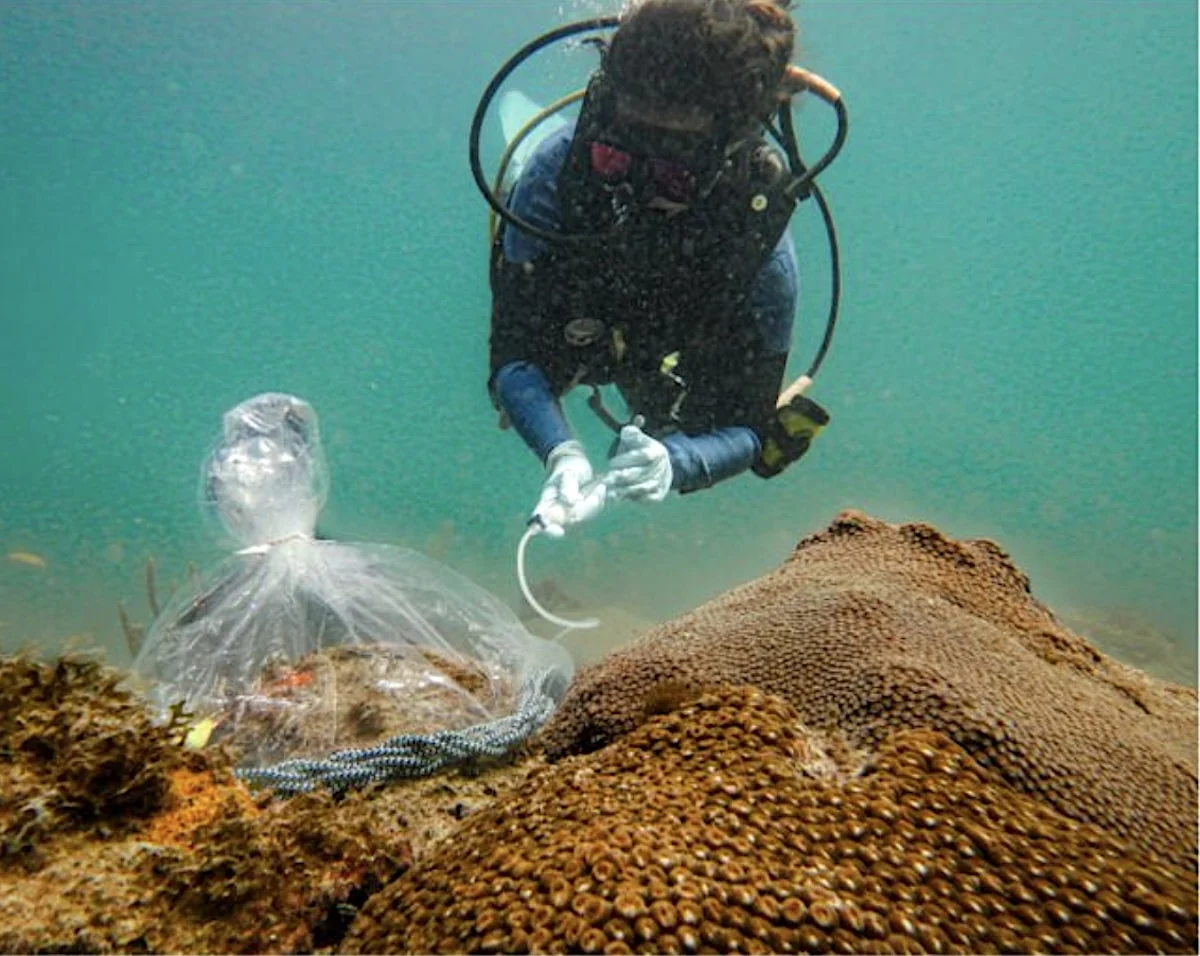
The health of the world’s oceans is inextricably linked to the survival of coral reefs—complex, vibrant ecosystems that support a quarter of all marine life. However, for years, the reefs off the coast of Florida have been under siege by a relentless and lethal threat known as Stony Coral Tissue Loss Disease (SCTLD). Now, a breakthrough in marine biotechnology, published in the journal Frontiers in Marine Science, suggests that a specialized bacterial probiotic could provide a powerful defense against this ecological crisis.
Researchers from the Smithsonian Marine Station have demonstrated that a probiotic strain, MCH1-7, can significantly mitigate the spread of SCTLD in the great star coral (Montastraea cavernosa). By utilizing a novel “whole-colony bagging” technique, scientists have achieved long-term protective results that were previously thought impossible, marking a significant milestone in the ongoing effort to save the Caribbean’s reefs from total collapse.
The Crisis: Understanding Stony Coral Tissue Loss Disease
SCTLD first emerged in Florida waters around 2014, quickly gaining notoriety for its rapid progression and high mortality rate. Unlike many coral diseases that move slowly, SCTLD is highly contagious, moving across reefs like a wildfire. It targets approximately 20 species of hard, reef-building corals, causing lesions that consume the coral’s living tissue until only the stark, white calcium carbonate skeleton remains.
The impact has been catastrophic. In less than a decade, the disease has decimated vast stretches of the Florida Reef Tract. As the reefs decline, so too does the habitat for commercially important fish, the protection against storm surges for coastal communities, and the biodiversity that draws millions of tourists annually. For marine biologists, the search for a remedy has become an urgent race against time.
Chronology of the Discovery: From Natural Resistance to Laboratory Success
2018: The Discovery of MCH1-7
The foundation for this recent breakthrough was laid in 2018 when scientists at the Smithsonian Marine Station made a fortuitous observation. While surveying coral colonies devastated by SCTLD, researchers identified a single colony of Montastraea cavernosa that appeared entirely unaffected by the surrounding outbreak.
Upon analyzing the microbiome of this resilient specimen, they isolated the MCH1-7 bacterial strain. This bacterium was found to naturally produce a compound called tetrabromopyrrole (TBP). Preliminary laboratory tests suggested that TBP might be the “secret weapon” helping the coral fend off the invading pathogens responsible for SCTLD.
Testing the Probiotic: The Bagging Method
Following the initial identification, the research team transitioned from laboratory observations to field applications. Over the past two and a half years, the team has been refining how to deliver the MCH1-7 probiotic to wild colonies.
The researchers tested two distinct methods:
- The Lesion-Paste Method: A direct application of the probiotic to visible disease lesions.
- The Whole-Colony Bagging Technique: A more intensive approach involving the installation of a weighted, water-tight bag around the entire coral colony, into which the probiotic was injected to bathe the organism in a concentrated dose of the beneficial bacteria.
The Findings: A Clear Winner
The results, documented in the recent Frontiers in Marine Science study, provided a clear verdict. While the lesion-paste method showed limited success in preventing the progression of the disease, the whole-colony bagging technique yielded remarkable results.
Corals treated with the bagging method experienced a tissue loss rate of only 7% over the 2.5-year observation period. In contrast, untreated control colonies lost an average of 35% of their tissue to the disease. The longevity of this protection is particularly significant, suggesting that the probiotic does not merely offer a temporary fix but may help the coral maintain a defensive microbiome against future threats.
Supporting Data: Why TBP Matters
The effectiveness of MCH1-7 is largely attributed to the compound TBP. Biologists have long theorized that TBP acts as a natural "settlement cue" for coral larvae. In nature, coral larvae seek out specific environments to grow; if bacteria that produce TBP are present, it signals a healthy, viable reef.

“If TBP is a natural settlement cue, and if bacteria that also produce this compound protect corals from disease, it makes sense that larvae would settle where those compounds are being produced,” explains Jennifer Sneed, a lead biologist at the Smithsonian Marine Station.
The data suggests that by fortifying the coral with these bacteria, scientists are not just fighting the disease—they are restoring the chemical signals that allow a reef to thrive. The survival rates of the treated colonies indicate that the bacteria successfully integrate into the coral’s mucus layer, creating a persistent, protective barrier against the SCTLD pathogen.
Official Responses and Scientific Perspectives
The research community has reacted with cautious optimism. While the results are statistically robust, experts emphasize that this is not a "magic bullet."
Lead Author Perspective
Kelly Pitts, the study’s lead author, underscores the need for perspective. “It’s important to understand that this is the very beginning,” Pitts stated in an interview with Mongabay. “This is definitely not a cure-all, but we’re definitely moving in the right direction.”
Addressing Operational Challenges
The study acknowledges the logistical hurdles inherent in the bagging method. Deploying divers to install bags around large, intricate coral colonies is time-consuming and expensive. However, the authors argue that the trade-off is justified. “While the whole-colony bagging method does involve more material transport by divers and more time for deployment and retrieval, its performance at treating SCTLD and promoting long-term resistance outweigh these costs,” the team noted in their paper.
The researchers have already begun developing standardized protocols for scuba divers to perform these treatments in the field, ensuring that the process does not negatively impact neighboring coral species or the broader reef environment.
Implications for the Future of Marine Restoration
The implications of this research extend far beyond the immediate mitigation of SCTLD. As climate change continues to increase ocean temperatures and alter water chemistry, coral reefs are becoming increasingly susceptible to various diseases. The success of MCH1-7 suggests that "probiotic therapy" could become a standard tool in the marine conservationist’s toolkit.
Potential for Scalability
If the bagging method can be refined to be more cost-effective—perhaps through modular, easier-to-deploy equipment—it could be used to protect "nursery" reefs or particularly valuable genetic stock. By creating a network of disease-resistant "super corals," scientists hope to preserve the genetic diversity necessary for the reefs to eventually adapt and recover on their own.
The Need for Continued Research
Despite the excitement, the research team remains focused on the gaps that still exist. Future studies will need to address:
- Species Specificity: Determining if MCH1-7 or similar probiotic strains can be effective against other coral diseases or on different species of coral.
- Environmental Impact: Long-term monitoring to ensure the introduced bacteria do not cause unintended shifts in the microbial ecology of the reef.
- Scaling Operations: Finding ways to treat larger swaths of the reef, as the current bagging method is inherently limited by the number of colonies a team of divers can physically reach.
Conclusion: A Step Toward Resilience
The battle to save Florida’s reefs is far from over, but the work of the Smithsonian Marine Station represents a vital shift in strategy. Instead of merely documenting the decline of these underwater cathedrals, scientists are now actively intervening with sophisticated, biological solutions.
The success of the MCH1-7 probiotic is a testament to the power of scientific observation—taking a hint from a single, healthy colony and scaling that resilience to the rest of the reef. As the research continues, the hope is that these methods will evolve from localized interventions into a robust strategy for global coral conservation. For now, the sight of corals thriving where they once perished offers a glimmer of hope that, with human ingenuity and scientific rigor, we can turn the tide on the destruction of our planet’s most vital marine ecosystems.


 Suro Senen
 Pevita Pearce
 Iffa Jayyana

 Basiran
 Azzam Bilal Chamdy

 Nila Kartika Wati
