
 Asro
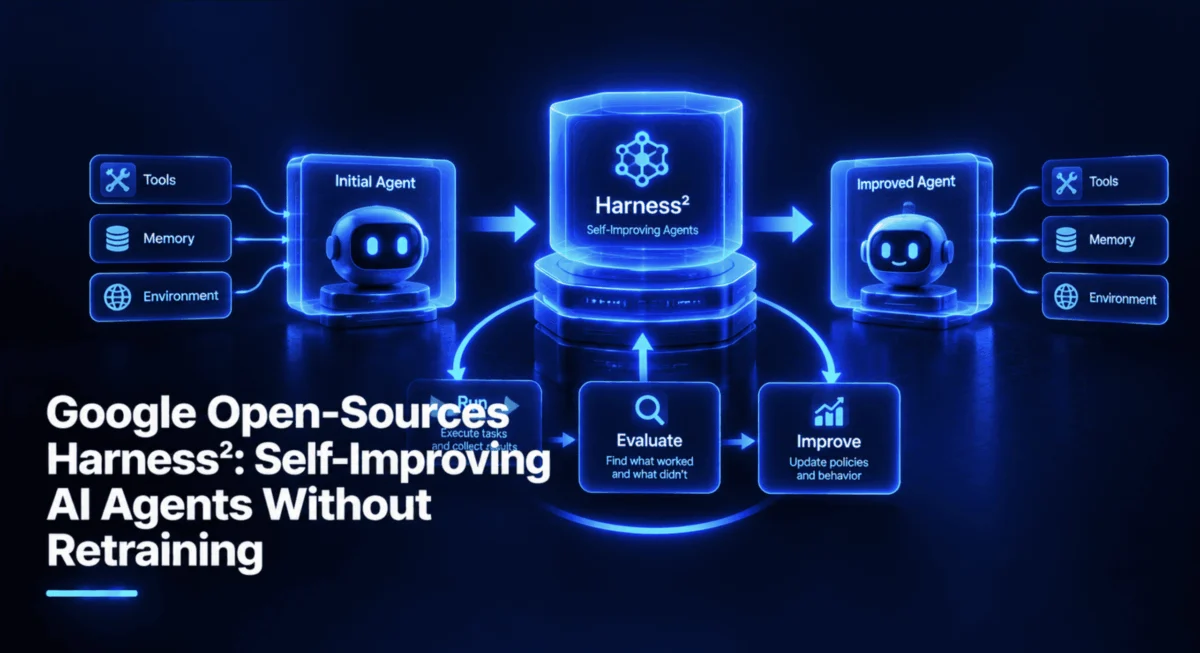
In the rapidly evolving landscape of artificial intelligence, the standard methodology for enhancing an agent’s performance has long been synonymous with retraining or fine-tuning. However, this resource-intensive process often proves prohibitive for organizations lacking massive GPU clusters or proprietary access to model weights. Challenging this status quo, Google Research has officially open-sourced Harness² (Harness-squared), a novel framework that enables AI agents to improve their performance autonomously without ever modifying the underlying model’s core weights.
Instead of adjusting the model itself, Harness² treats the "harness"—the peripheral architecture surrounding an AI—as a dynamic, editable interface. By iteratively refining prompts, tools, memory structures, and script logic, the framework allows agents to learn from their mistakes in real-time, effectively creating a self-improving ecosystem that persists across tasks.
The Core Concept: Engineering the "Harness"
At the heart of the project is the realization that an AI agent is only as effective as the environment in which it operates. A "harness" encompasses every component that facilitates the agent’s decision-making process: system prompts, guardrails, memory banks, specialized skills, tool guidance, helper scripts, sub-agent delegation, and middleware plugins.
Traditionally, optimizing these components is a manual, labor-intensive cycle. An engineer observes an agent failing, manually debugs the prompt or adds a tool, and restarts the process. This approach is sufficient for static environments but falters in "open-world" scenarios where agents encounter unanticipated tasks. Harness² automates this optimization cycle, treating the entire harness as a modular, version-controlled repository of behavioral instructions. By fixing the model weights, the framework maintains the consistency of the underlying intelligence while evolving its external capabilities.
The Two-Level Recursive Architecture
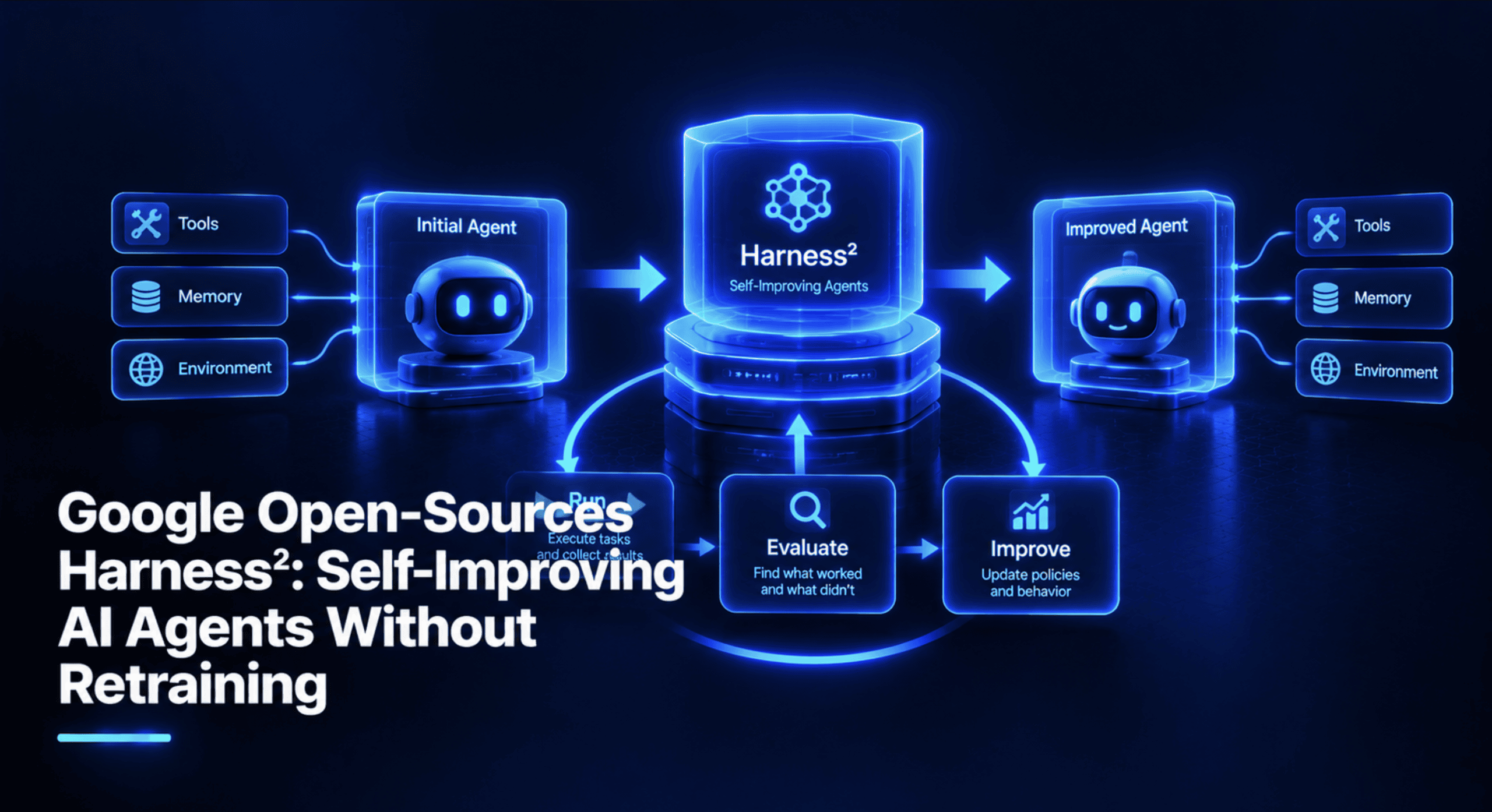
The "²" in Harness² denotes a sophisticated dual-loop recursion system designed to ensure that an agent not only improves on a single task but becomes more adept at handling future challenges.
Loop 1: Task-Level Recursion (Propose–Probe–Compose)
This loop operates during a single task. Harness² leverages behavioral contrasts between different executions to identify where a process went wrong. Crucially, it does not require a ground-truth "answer key." Instead, it compares the outcomes of different iterations and uses the logic of "success" to refine its own parameters. It generates candidate edits to the harness, probes them to see if they yield better results, and composes the most successful adjustments into a final, optimized configuration.
Loop 2: Harnessing-Level Recursion
The second loop acts as a long-term memory for the system. Once a task is completed, an "experience reflector" evaluates the changes that led to the success. These findings—supported by evidence—are stored in a persistent improvement harness. When the agent moves to a new, unseen task, it carries this library of lessons with it. Over time, the framework creates an accumulation of institutional knowledge, making it increasingly efficient at tuning itself for novel domains.
Empirical Performance and Benchmarking
Google’s research team tested the framework against several state-of-the-art configurations, including GLM-5 and Gemini 3.5 Flash. The results, while preliminary, indicate significant performance gains.
In tests involving WorkBuddy-Bench (covering office and web tasks), the framework demonstrated improvements of up to 11.5 points. Similarly, in the LAB (Legal Aid Benchmark), which tests complex legal reasoning and documentation, Harness² showed an improvement of up to 11.8 percentage points in partial pass rates. JobBench results also showed a 4.5-point increase in professional work efficiency. These benchmarks suggest that even with a single step of optimization (k=1), the agent’s ability to navigate complex, multi-step workflows increases substantially without the need for additional training data.
Practical Implications for AI Development
The shift toward "harness-based" improvement carries three significant practical advantages for the broader developer community:
- Lower Computational Barriers: Because Harness² does not require updating model weights, it eliminates the need for expensive GPU training runs. Developers can optimize performance using standard inference APIs.
- Explainability and Auditability: Unlike a black-box fine-tuned model, improvements in Harness² are stored as plain-text files—rewritten prompts, updated scripts, or new guardrail logic. This allows developers to audit, review, and roll back changes as easily as they would manage source code.
- Transferability: Lessons learned in one domain (e.g., legal document summarization) can be curated into a library that helps the agent handle related tasks more effectively, facilitating a form of modular intelligence that scales horizontally across departments.
A Technical Walkthrough: From Demo to Deployment
Google has provided an accessible path for developers to explore the framework. By utilizing tools like uv for environment management, users can run a local demo that showcases how the framework autonomously corrects a bug in a Python script without explicit instructions.
The Lifecycle of an Optimization
- Initialization: The user sets up the environment and defines the target domain.
- Recursive Refinement: The system executes the task, observes failures, and performs "improver sessions" to rewrite scripts or prompts.
- Evidence Recording: The "Experience Reflector" writes an
EXPERIENCE.mdfile, documenting the logic behind each edit. This serves as a "lesson learned" log that can be reviewed by human developers. - Transfer: The system updates the library, ensuring that the next task begins with the benefit of the previous success.
For those looking to deploy this on production models, the integration with Vertex AI is seamless. By configuring the HARNESS2_SOLVER_MODEL and HARNESS2_IMPROVER_MODEL environment variables, developers can bridge the gap between their local code and Google’s powerful LLMs.
Challenges and Future Outlook
Despite the promise of Harness², several questions remain for the research community. The primary concern is the potential for "harness bloat," where the accumulation of too many lessons might complicate the agent’s decision-making process. Furthermore, the framework relies heavily on the quality of the "judge" model—the AI responsible for evaluating whether an edit was actually an improvement. If the judge is flawed, the agent may "optimize" itself into a less effective state.
However, the open-sourcing of the code under the Apache 2.0 license invites community-driven solutions to these issues. As researchers and developers begin to stress-test the framework, we can expect to see optimizations in how these "lesson libraries" are pruned and managed.
Conclusion
Harness² represents a fundamental shift in how we think about AI agent capability. By moving the focus from the model’s internal weights to the external environment, Google has provided a blueprint for more transparent, efficient, and modular AI development. As the industry moves away from the "train-everything" mentality, frameworks that prioritize iterative, explainable, and resource-light refinement—like Harness²—are likely to become the new standard for enterprise AI.
Whether you are a developer looking to optimize a custom agent or a researcher exploring the limits of autonomous learning, the release of Harness² offers a tangible, actionable tool to explore the next frontier of AI evolution. For those ready to begin, the project documentation and full source code are currently available on GitHub and the official project site.



 Nana Muazin

 Nila Kartika Wati


 Layla Zulfa

 Jia Lissa
 Nana

 Rifan Muazin
