
 Lina Irawan
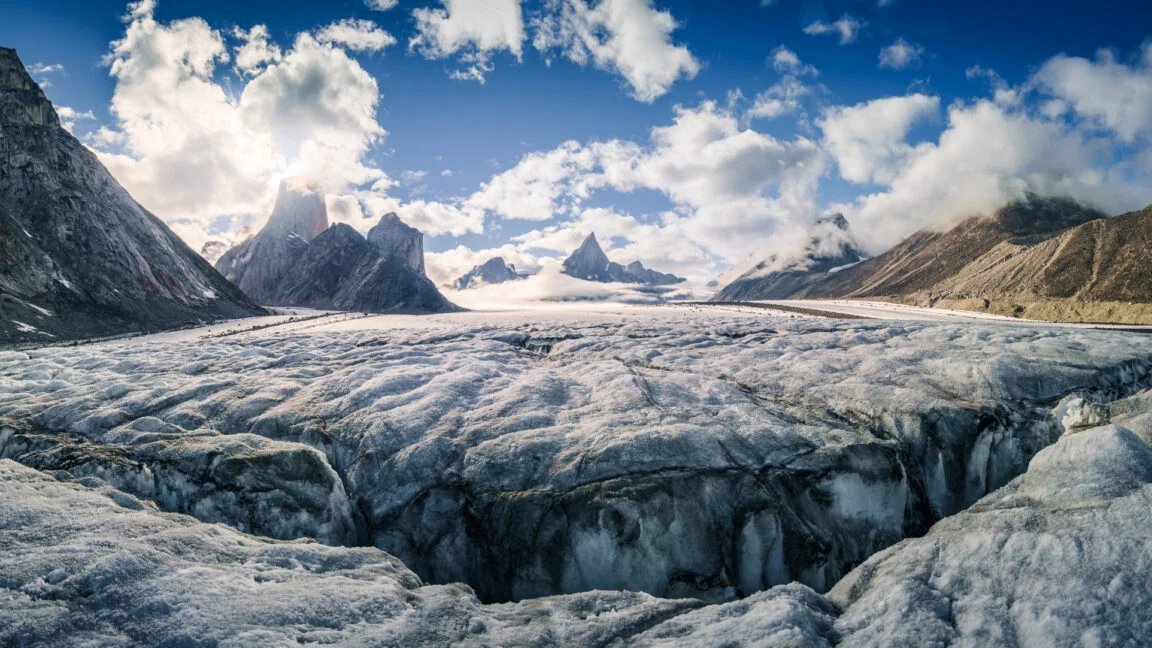
On the central plateau of Baffin Island, tucked deep within the Canadian Arctic, sits the Barnes Ice Cap. To the casual observer, it is a striking, desolate remnant of a bygone era. To geologists, however, it is a high-stakes witness to Earth’s climatic history. A recent study published in the journal Science has revealed that this frozen relic is not merely a fading vestige of the massive Laurentide Ice Sheet; it is the physical proof of a planetary shift that began 2,000 years ago—and the target of a modern, human-driven disruption that has fundamentally altered the Earth’s natural rhythm.
The Laurentide Legacy
The Laurentide Ice Sheet was the titan of the Pleistocene epoch. At its peak, this colossal expanse of ice buried the vast majority of North America under two miles of frozen water, effectively locking away enough volume to lower global sea levels by approximately 80 meters. As the climate warmed following the last glacial maximum, the Laurentide retreated, eventually leaving behind fragmented remnants. The Barnes Ice Cap is the last surviving core of these once-mighty domes.
For decades, the Barnes Ice Cap has remained a subject of intense scientific scrutiny. Unlike most glaciers, which are "warm-based"—meaning they sit atop a layer of meltwater that allows them to slide and grind the bedrock beneath—the Barnes is "cold-based." It is frozen directly onto the bedrock, much like ice plastered to a frozen windshield. This unique characteristic is what makes the Barnes an unparalleled geological archive. By remaining stationary, it has preserved the tundra landscape beneath it for millennia, rather than erasing it.
A Chronology of Retreat and Re-expansion
The narrative of the Laurentide, as reconstructed by lead author Nicolás Young and his team at Columbia University’s Lamont-Doherty Earth Observatory, is one of surprising complexity. By utilizing advanced dating techniques, the team has mapped a timeline that challenges our understanding of glacial stability.
The Retreat (10,000–3,600 Years Ago)
Following the end of the last ice age, the Laurentide retreated steadily across the Canadian Arctic. By roughly 3,600 years ago, the ice sheet had shrunk to its smallest extent, retreating well onto the Baffin Island plateau. During this period, the warming climate allowed for the colonization of the newly exposed ground by tundra vegetation, including hardy mosses.
The Turnaround (2,000 Years Ago)
The findings indicate that this period of retreat was not a permanent trend. Approximately 2,000 years ago, the climate trajectory shifted. Solar energy reaching the high northern latitudes, which had been declining since the early Holocene, reached a critical threshold. Despite a modest increase in atmospheric carbon dioxide during that period, the cooling influence of reduced solar insolation prevailed. The result was the onset of a new, long-term glacial advance.
The Little Ice Age (1800 CE)
The expansion that began 2,000 years ago continued, culminating in the "Little Ice Age," a period roughly coinciding with 1800 CE. During this time, glaciers across the Northern Hemisphere reached their most extensive positions in recent millennia. The Barnes Ice Cap was not an anomaly; it was a participant in a multi-millennial pulse of cooling that suggested the Earth was steadily marching toward a new glacial epoch.
Supporting Data: Beryllium-10 and Radiocarbon "Kill Dates"
To confirm this timeline, the researchers employed two robust, independent dating methodologies that provided a clear window into the past.
Beryllium-10 Surface Exposure Dating
The team utilized beryllium-10, an isotope that accumulates in rock surfaces exposed to cosmic radiation. By measuring the concentration of this isotope on boulders recently uncovered by the ice, scientists could calculate exactly how long those rocks had been exposed to the sky. This confirmed the timing of the Laurentide’s initial retreat to its minimum size around 3,600 years ago.
The Radiocarbon "Kill Date"
To track the re-expansion, the researchers turned to the preserved mosses trapped beneath the ice. Because the Barnes Ice Cap is cold-based, it acted as a perfect, refrigerated tomb for the vegetation it overran. By radiocarbon dating these mosses, the team established "kill dates"—the precise moment the advancing ice smothered the plants, effectively recording the footprint of the glacier’s advance.
The analysis of nearly 200 samples from the Barnes and neighboring ice caps revealed a consistent pattern: no ice caps in the region show evidence of expansion older than 2,000 years. This serves as the definitive temporal marker for the start of the last, albeit interrupted, glacial cycle.
The Tug of War: Solar Forcing vs. Carbon Dioxide
The study highlights a delicate "tug of war" between orbital mechanics and atmospheric composition. For thousands of years, the Earth’s orbital tilt and distance from the sun led to a cooling trend in the high latitudes. While atmospheric carbon dioxide levels rose by approximately 20 parts per million (ppm) between 8,000 and 2,000 years ago, this warming influence was insufficient to counteract the loss of solar energy.
However, the introduction of the Industrial Revolution fundamentally broke this balance. Between 1750 and 1850, CO2 levels rose by 12 ppm, followed by an acceleration that has seen levels spike by over 138 ppm since 1960. This rate of increase is unprecedented in the geologic record, shifting the Earth’s climate balance so drastically that the long-term, natural cooling cycle was essentially nullified.
Official Responses and Implications
The scientific consensus surrounding these findings is sobering. As Nicolás Young notes, the Barnes Ice Cap has entered a terminal phase. In the 1960s, roughly 35 percent of the ice cap’s surface was situated above the regional snow line, allowing for accumulation. By the early 2000s, that number plummeted to 3 percent. Today, that figure is effectively zero.

The End of a Cycle
The most profound implication of this study is the realization that human activity has terminated one of the most consistent and regular cycles in Earth’s history. For the last 2.5 million years, the pacing of ice ages has been a cornerstone of the planetary climate system. The current intervention via greenhouse gas emissions has, for all intents and purposes, canceled the next scheduled glaciation.
"We have evidence now that humans, and specifically greenhouse gases, have actually terminated one of the most consistent cycles on Earth," Young explains.
Does this "Cancel" the Ice Age?
Some may ask if the rapid warming of the planet has saved humanity from a future ice age. Experts are quick to clarify that this is a misconception. The natural progression into a full-scale ice age would have taken tens of thousands of years—a timescale that offered humanity vast opportunities for adaptation. Instead, by rapidly pumping greenhouse gases into the atmosphere, we have replaced a slow, predictable, and manageable cooling trend with a rapid, chaotic warming event that threatens ecosystems, sea levels, and the stability of the global climate.
The Barnes Ice Cap is now considered a "dead" glacier. With no accumulation zone to replenish the ice lost during summer melt, the ice cap is projected to disappear entirely within a few centuries. As it melts, it will continue to reveal the "kill dates" of the plants trapped beneath it, providing further evidence of a climate that was once steadily cooling, and a future that we have irrevocably altered.
Conclusion
The story of the Barnes Ice Cap is a testament to the power of human influence on the natural world. By analyzing the mosses and rocks of Baffin Island, scientists have been able to look back through a 2,000-year window, witnessing the Earth’s attempt to enter a new ice age. That attempt, however, has been silenced by the modern rise in atmospheric carbon. As the last fragment of the Laurentide Ice Sheet vanishes, it serves as a stark reminder that the Earth’s long-term climate rhythms are no longer under the sole influence of orbital mechanics, but are now deeply, and perhaps permanently, defined by human activity.


 Raul Delapena Setiawan

 Nana

 Pevita Pearce

