
 Muslim

The S&P 500 has surged nearly 57% in the past two years, more than doubling in value over the last five. For the average investor, this represents a golden era of portfolio growth, transforming retirement projections from modest savings goals into surplus-filled, early-exit realities. Yet, beneath this veneer of prosperity lies a pervasive anxiety: Is this an unprecedented economic expansion, or are we witnessing the formation of a precarious financial bubble?
As Artificial Intelligence (AI) dominates the headlines and the balance sheets of the world’s largest corporations, the question of whether this growth is sustainable has become the central debate of the 2025 financial landscape.
The Fundamentals of Value: A Rental Property Analogy
To understand the current market volatility, one must return to the bedrock of financial theory. A stock is, at its core, a claim on the future earnings of a business—a concept easily understood through the lens of real estate.
If you own a rental property, your profit is the rent collected after expenses. If the property’s market value doubles, but the rent remains stagnant, you haven’t necessarily become wealthier in terms of cash flow. You are simply holding an asset with a higher price-to-earnings (P/E) ratio. For the current owner, this is a windfall; for the prospective buyer, it is a liability.
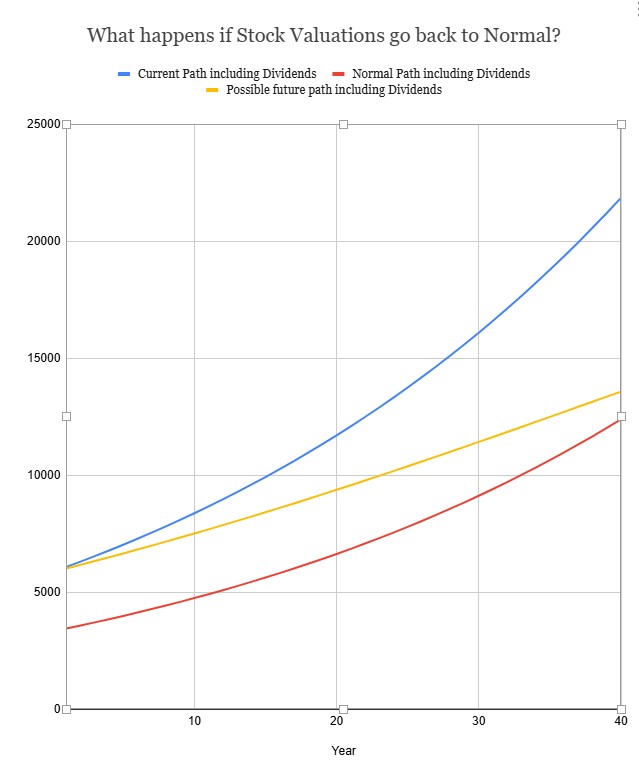
Today’s stock market mirrors this scenario. Between 2019 and 2025, a $100,000 investment in an S&P 500 index fund would have ballooned to over $256,000. However, the actual earnings generated by those underlying companies grew by only 42%. Consequently, the market’s P/E ratio has expanded from roughly 20 to 30. Investors are paying significantly more for every dollar of earnings than they were just a few years ago. While this does not render the market "unprofitable," it mathematically guarantees lower future returns for those entering at today’s inflated valuations.
Chronology of a Tech-Driven Boom
The trajectory of this market cycle has been dictated by a narrow concentration of power. The "Magnificent Seven"—Apple, Nvidia, Microsoft, Amazon, Google, Meta, and Tesla—have accounted for approximately 75% of the market’s recent growth.

- The Catalyst: The breakthrough in Large Language Models (LLMs) and generative AI triggered a massive capital expenditure cycle.
- The Infrastructure Phase: Tech giants are currently funnelling hundreds of billions into "Stargate-scale" data centers. This has created a massive demand spike for hardware providers, most notably Nvidia, whose GPUs have become the "picks and shovels" of the AI gold rush.
- The Productivity Promise: Beyond infrastructure, the narrative has shifted to corporate efficiency. AI is now capable of performing high-level cognitive tasks—writing code, auditing legal documents, and accelerating drug discovery—that were previously the sole domain of human labor.
The prevailing market optimism rests on the assumption that AI will usher in an era of "infinite" labor, effectively decoupling economic output from the constraints of human headcount.
Supporting Data: Examining the P/E Disconnect
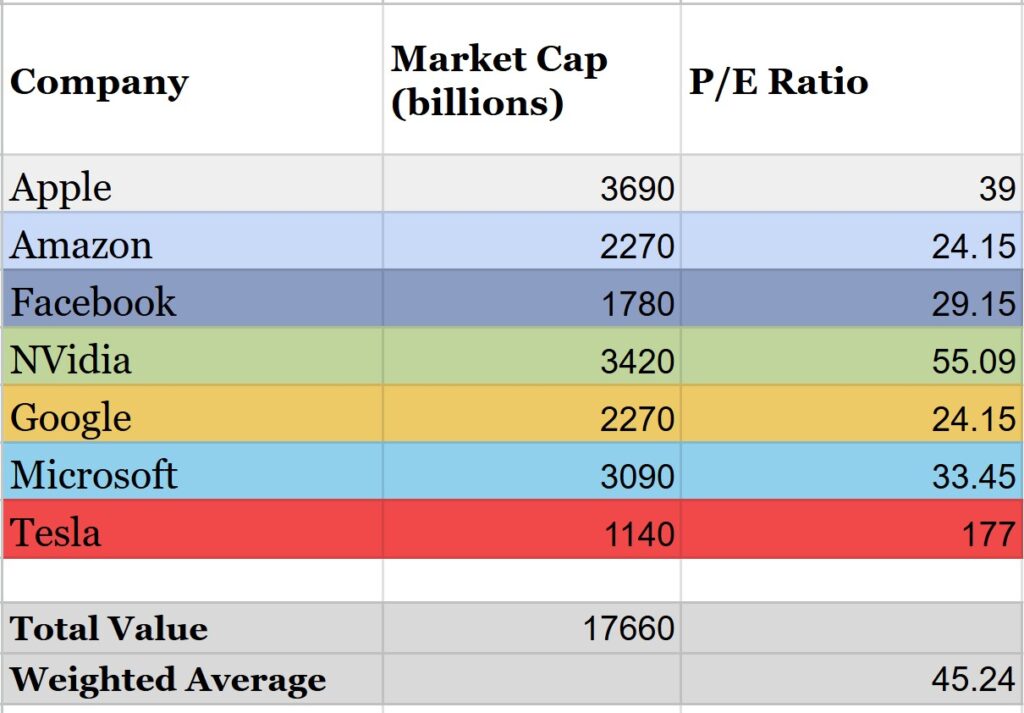
If we exclude the "Magnificent Seven" from the S&P 500, the remaining 493 companies trade at a P/E ratio of approximately 20. While historically elevated, it is far more grounded than the weighted average of 45 commanded by the tech giants.
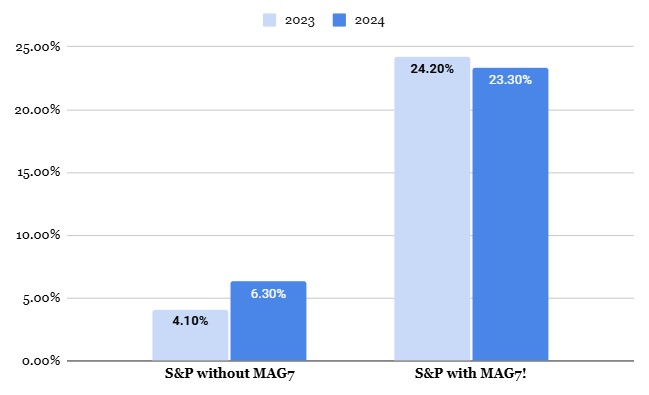
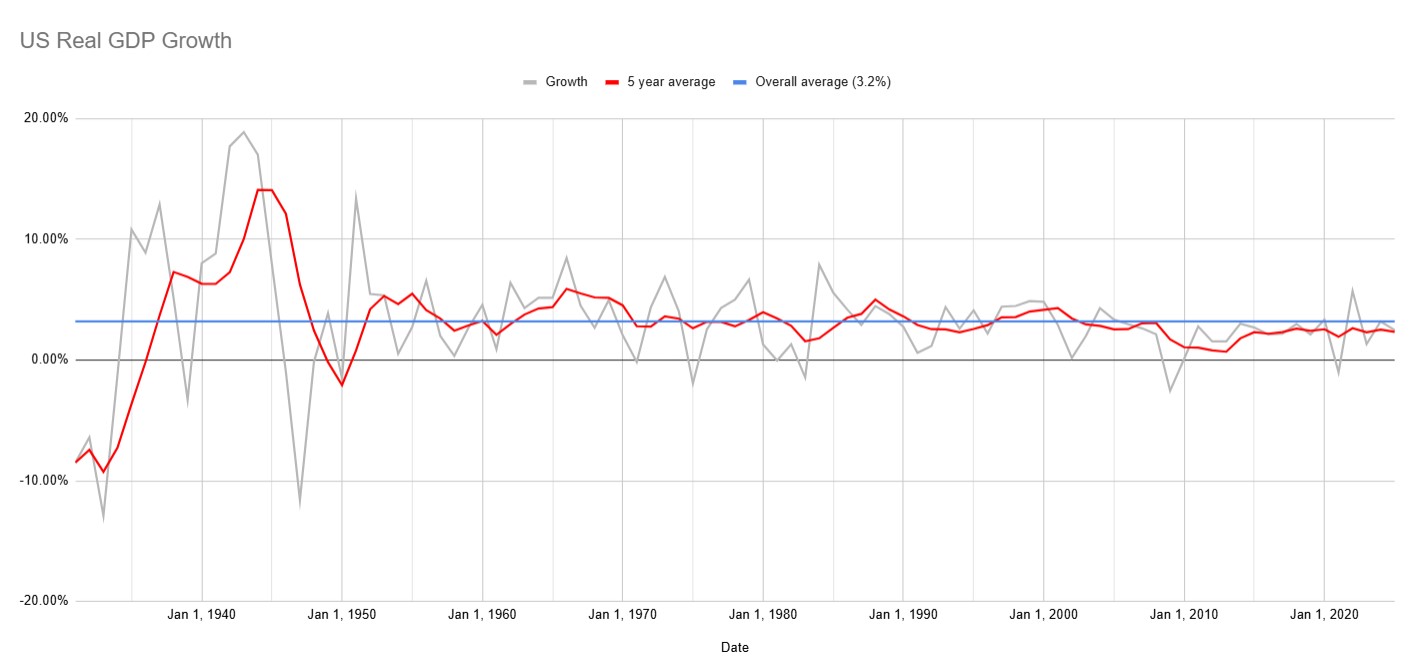
This divergence suggests a bifurcated economy. The market is pricing in a future where tech behemoths achieve unprecedented scale, while the broader economy remains relatively stable. However, history provides a sobering check: long-term U.S. GDP growth has remained remarkably consistent at roughly 3% annually after inflation, even as technological paradigms have shifted. Recent decades have actually seen growth slightly below this average, raising the question of whether current share prices are detached from the reality of underlying economic output.
Official Perspectives and Institutional Caution
The investment community is not blind to these risks. Vanguard’s latest ten-year annualized return forecasts suggest a pivot: the firm anticipates that international stocks and even bonds may outperform the U.S. market in the coming decade. International markets, trading at P/E ratios closer to 15.9, offer a "discount" that the US market has long outpaced, albeit for the wrong reasons—as AI enthusiasm remains heavily concentrated in American tech hubs.
Warren Buffett, the quintessential value investor, has adopted a defensive posture. Through Berkshire Hathaway, Buffett is currently sitting on a record $334 billion in cash. By refusing to engage in aggressive stock repurchases or massive new acquisitions, the "Oracle of Omaha" is signaling that the current market environment lacks the margin of safety required for prudent capital deployment.
Implications for the Modern Investor
For the individual investor, the current market climate presents a paradox. The temptation to "time the market"—selling during the highs to buy during the inevitable correction—is historically a losing strategy. The most successful approach remains a disciplined, long-term adherence to index fund investing, regardless of current P/E volatility.

1. Diversification vs. Concentration
The outperformance of the "Magnificent Seven" has left many portfolios heavily skewed toward tech. Investors might consider "robo-advisor" models, such as those used by Betterment, which utilize automatic rebalancing to distribute assets across global markets. This approach accepts lower short-term returns in exchange for reduced volatility and exposure to potentially undervalued international assets.
2. The Debt Dilemma
With interest rates remaining higher than they were in the previous decade, the calculus of paying off a mortgage versus investing in the market has shifted. If your mortgage rate is 7%, paying it down is akin to securing a guaranteed 7% return—a compelling option when the expected future returns of an overpriced stock market appear increasingly muted.
3. The Psychological Factor
The greatest risk to long-term wealth is not the market crash itself, but the reaction to it. Market manias and panics are cyclical, but human productivity remains the fundamental driver of wealth. The most prudent investors are those who can tune out the daily volatility of the "Magnificent Seven" tickers and focus on maintaining their personal savings rate.
Conclusion: The Path Forward
The "AI revolution" is undoubtedly real, and the potential for a massive boost in global productivity is significant. However, the market has a habit of pricing in perfection years before that perfection manifests. Whether this is a bubble or a "new normal" remains a matter of intense debate.
Ultimately, the most effective hedge against market uncertainty is not a complicated derivative strategy or an attempt to pick the next winner, but a return to basics. Ensure your debt is manageable, maintain a globalized, diversified portfolio, and—most importantly—reinvest the time saved from watching financial news into physical pursuits. History shows that while the stock market is a fickle master, the resilience of the global economy and the individual’s ability to maintain a long-term perspective are the only constants.
As the market continues its dance with AI-fueled exuberance, the best advice remains the most difficult to follow: Stay the course, keep your expenses low, and remember that your greatest financial asset is not the stock you hold, but the time you have to let compound interest work its quiet, relentless magic.


 Rifan Muazin
 Nana

 Neng Nana

 Evan Lee Salim

 Ammar Sabilarrohman


 Jia Lissa

 Nila Kartika Wati
