
 Neng Nana
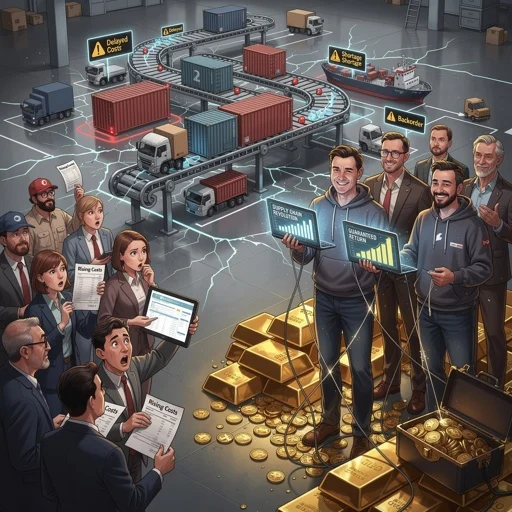
For decades, the promise of "End-to-End" (E2E) supply chain planning has served as the Holy Grail of enterprise software. It is a siren song that has lured countless supply chain executives into multi-million dollar digital transformation projects, only to leave them shipwrecked on the rocks of poor operating margins and inflated inventory levels.
Recently, industry analyst Lora Cecere reignited a fierce debate with her blog post, The Myth of End-to-End Planning, which resonated with over 27,000 readers. The discourse has exposed a painful reality: the enterprise software industry is effectively "gaslighting" its customers by layering modern, AI-driven buzzwords over deeply flawed, legacy taxonomies. As vendors gather at global conferences to tout the latest "orchestration" platforms, the question remains: are we witnessing innovation, or simply the latest iteration of the "Misguided Gold Digger" phenomenon?
The Anatomy of a Failed Promise: Main Facts
The core contention is that the current industry standard for "End-to-End" planning is conceptually and structurally broken. Modern supply chain stacks are built upon a series of transactional handoffs—a "connect-the-dots" approach—rather than a cohesive, governed decision model.
When a vendor claims to offer an E2E solution, they are frequently doing nothing more than wrapping disparate legacy modules in a new, aesthetically pleasing user interface. These systems suffer from a fatal flaw: they rely on data aggregation. By the time information is pulled from the shop floor, the warehouse, and the procurement office to be "integrated" into a planning dashboard, the granular, operational reality—the specific rules that actually govern a supply chain—is stripped away.
Factors such as minimum order quantities (MOQ) per supplier, shelf-life constraints, and fluctuating lead times are lost in the translation process. Consequently, the "E2E" system provides a high-level view that is mathematically disconnected from the reality of the transaction, rendering the output ineffective for actual decision-making.
Chronology of a Disillusioned Industry
The history of supply chain technology is a roadmap of missed expectations.

- The 2000s: The rise of "Integrated Business Planning" (IBP) and S&OP suites aimed to harmonize demand and supply. However, these systems remained trapped within the silos of the ERP.
- The 2010s: The emergence of cloud-based planning tools promised to bridge the gap. Instead, they merely created new silos of "software-as-a-service" that struggled to communicate with legacy, on-premise infrastructure.
- The 2020s: The advent of "AI-first" and "Agentic" workflows. Rather than fixing the underlying data architecture, vendors are now using AI to automate the same flawed, siloed processes at a faster rate, a phenomenon Cecere aptly labels "AI Stupid."
The current cycle is marked by a frantic rush to host conferences in major hubs like Shanghai or Chicago, where vendors promise that their new "orchestration" layer will finally unify the supply chain. Yet, for the average business leader, the result is the same: a complex, expensive system that requires manual, spreadsheet-based workarounds to function.
Expert Perspectives: The Structural Breakdown
The failure of the E2E model is not for a lack of computational power, but due to fundamental design flaws. Three prominent industry voices provide a harrowing diagnostic of why the current stack is beyond repair without a paradigm shift.
Julien Brun, CEO & Founder of SIMCEL
Brun argues that the problem lies in the act of aggregation itself. "The moment you aggregate, you destroy the rules that actually run a supply chain," he notes. According to Brun, the industry’s obsession with "integrated" planning is actually a hindrance. He advocates for keeping the decision chain at the order level, simulating the logic of the ERP against the reality of the market. "It’s hard, and we deliberately don’t call it end-to-end management. It’s conceptually one decision layer with no data break."
Trevor Miles, Founder of Azirella
Miles highlights the semantic crisis at the heart of supply chain IT. "You cannot compose decisions across systems that disagree about what a site is," Miles explains. In a typical stack, a "site" is defined differently by the TMS (a dock), the planning system (a stocking point), and the ERP (a plant). Because these systems are built for transactions—carrying only quantities and dates—rather than "streams" of reasoning, the context of a decision dies the moment it crosses from one module to the next.
Pat Byrne, Founder and Chairman of IndEco Systems
Byrne points to the "missing layer": governance. "The missing layer is not another planning module or another AI agent," Byrne states. "It is a governed way to answer: What decisions are being made? Who has authority? What evidence is required?" Until these questions are encoded into a shared ontology, AI will simply accelerate disconnected decisions inside failing architectures.
Implications: The High Cost of Stagnation
The implications of this "E2E myth" are severe. When companies invest in platforms that promise integration but deliver silos, they suffer from:

- Inventory Bloat: Because the planning system cannot see the true, granular lead-time variability, it defaults to massive, inefficient safety stock buffers.
- Margin Erosion: Reactive, siloed decisions lead to expediting costs, poor fill rates, and a failure to shape demand effectively.
- Talent Burnout: Highly skilled planners spend 80% of their time "cleaning data" and managing manual workarounds rather than making strategic, value-added decisions.
A Path Forward: Redefining the Strategy
To escape the grip of the "Misguided Gold Diggers," organizations must pivot toward an "outside-in" approach that prioritizes data flow over software branding.
1. Rethinking the Role of EDI
While often viewed as an antiquated, "non-sexy" technology, Electronic Data Interchange (EDI) remains the only effective standard for interchange in value networks. Rather than discarding EDI in favor of proprietary vendor APIs, companies should leverage EDI’s proactive alerting and predictive analytics. By moving EDI from the basement of the IT department to the center of supply chain strategy, companies can gain visibility into real-time lead-time shifts and stock availability.
2. Demand Management as a Flow
Demand must be treated as a continuous stream of market signals, not a periodic, time-phased batch output. Organizations should map these flows to identify which items are forecastable and which require a "make-to-order" or "responsive" supply strategy. By measuring the "Forecast Value Added" (FVA) at every stage, leaders can stop chasing the impossible dream of a perfect forecast and start building a resilient flow.
3. Synchronizing Master Data
Lead time is the most critical, yet most abused, parameter in the modern enterprise. With over fifteen systems (from MRP to TMS) typically relying on lead-time data, discrepancies are guaranteed. Organizations must stop using "set-and-forget" values. Instead, they should integrate transportation visibility data to ensure that every system in the stack is synchronized with current, real-world market reality.
Conclusion: Erasing "Stupid"
The industry stands at a crossroads. We can continue to buy into the marketing of "End-to-End Orchestration" and continue to suffer the same operational inefficiencies, or we can embrace a more difficult, honest path. This path requires us to demand better from our vendors, prioritize shared decision-making ontologies over transactional integration, and treat our supply chains as dynamic, rule-based systems rather than static data sets.
As Lora Cecere suggests, it is time to "erase stupid." The era of the Misguided Gold Diggers is nearing its expiration date. It is time for leaders to stop looking for a software panacea and start building the governed, intelligent trade flows that the modern market actually demands.

 Sagoh

 Ali Ikhwan

 Reynand Wu



 Azzam Bilal Chamdy


 Iffa Jayyana
