
 Raul Delapena Setiawan
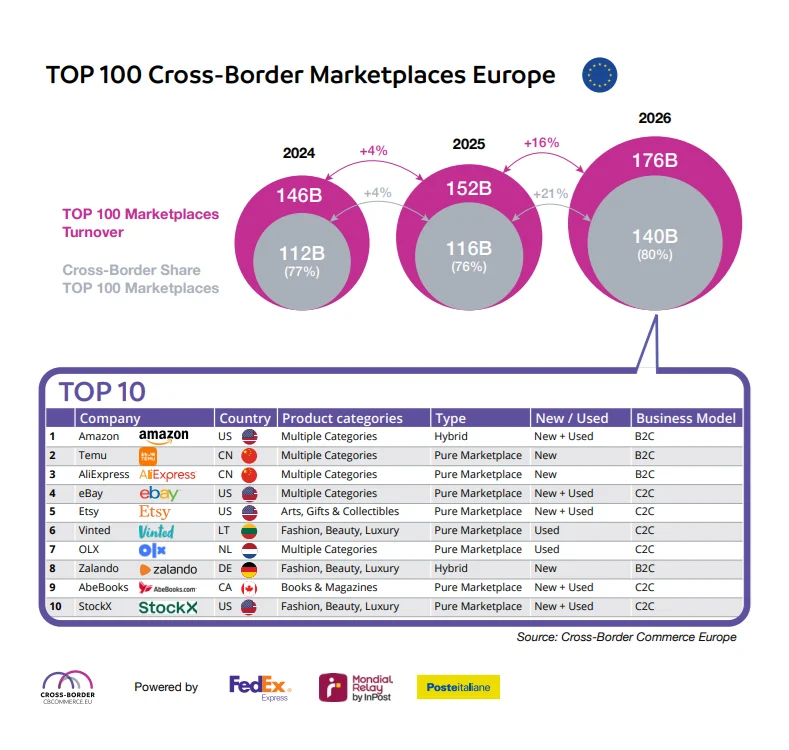
The European e-commerce landscape is undergoing a profound structural shift, as the dominance of cross-border trade becomes the new standard rather than an outlier. According to the seventh edition of the "Top 100 Cross-Border Marketplaces Europe" report, published by Cross-Border Commerce Europe (CBCommerce), the continent’s most influential platforms are cementing their reliance on international transactions. With a projected Gross Merchandise Volume (GMV) of 175.8 billion euros for the top 100 players, the data underscores a digital economy that is increasingly indifferent to national boundaries.
Currently, 79.5 percent of the total GMV generated by these top-tier marketplaces is derived from cross-border sales—a figure that is not merely holding steady but is poised for continued acceleration. As consumer behavior shifts and digital infrastructure matures, the European market is entering an era where the "local" platform is rapidly losing ground to agile, globalized, and technologically advanced digital ecosystems.
Main Facts: The Rise of the Transnational Platform
The core findings of the CBCommerce report reveal a market in flux. The top 100 marketplaces are no longer just hubs for domestic transactions; they are sophisticated logistical networks that bridge the gap between global supply chains and the European consumer.
The report establishes several critical benchmarks:
- Current GMV: The collective gross merchandise volume of the top 100 marketplaces stands at 175.8 billion euros.
- Cross-Border Dominance: Nearly 80 percent of this volume—approximately 139.8 billion euros—is generated through cross-border trade.
- Projected Growth: By 2026, total GMV for this cohort is expected to grow by 8 percent annually, with cross-border sales projected to outpace total growth, reaching 154 billion euros by 2027.
- The Market Leaders: Amazon, Temu, and AliExpress currently occupy the top three positions. Their rankings were determined by a rigorous methodology involving SEO performance, cross-border sales volume, geographic footprint, and total website traffic.
These figures illustrate that for the top 100 players, the European Union is not viewed as a collection of fragmented national markets, but as a singular, albeit complex, economic entity.
Chronology: The Evolution of European Marketplace Commerce
To understand the current state of European e-commerce, one must look back at the trajectory of the market over the last decade. The evolution can be divided into three distinct phases:
Phase 1: The Domestic Monopoly (2010–2015)
In the early 2010s, European e-commerce was largely dominated by local champions. Consumers preferred platforms that operated within their native language, currency, and logistical framework. Cross-border shopping was limited to niche luxury goods or specialized hobbyist markets, hampered by high shipping costs and complex VAT regulations.
Phase 2: The Infrastructure Revolution (2016–2021)
This period saw the aggressive expansion of major global platforms. By investing heavily in regional distribution centers, localized payment gateways, and multilingual customer service, giants like Amazon paved the way for seamless cross-border shopping. During this phase, the concept of "European-wide logistics" began to take shape, enabling delivery times that could compete with domestic shipping.
Phase 3: The Era of AI and Aggressive Expansion (2022–Present)
We are currently in the third phase, characterized by the meteoric rise of platforms like Temu and AliExpress. These platforms have utilized AI-driven product discovery to bypass traditional retail barriers. By leveraging direct-to-consumer models from manufacturing hubs in Asia, they have changed the consumer expectation for price, speed, and variety. The current report marks the beginning of a period where regulation—both at the EU and member-state level—is being forced to catch up with the speed of digital commerce.
Supporting Data: Analyzing the Growth Trajectory
The quantitative outlook provided by CBCommerce offers a clear roadmap for stakeholders. The transition from 79.5 percent cross-border reliance today to an expected 81 percent by 2027 may seem incremental, but in the context of a 190-billion-euro market, it represents a multi-billion-euro shift in consumer spending.
| Metric | Current Estimate | 2027 Projection |
|---|---|---|
| Total Top 100 GMV | €175.8 Billion | €190 Billion |
| Cross-Border GMV | €139.8 Billion | €154 Billion |
| Cross-Border % Share | 79.5% | 81% |
This data suggests that the "local" retail model is struggling to retain market share against platforms that can optimize supply chains on a continental scale. Furthermore, the reliance on AI-driven algorithms to curate products means that these platforms are no longer just storefronts; they are curators of consumer desire, constantly refining their offerings based on real-time data from millions of users across different European countries.

Official Responses and Industry Sentiment
While the report highlights the dominance of international giants, the industry response is a mix of admiration and apprehension.
Trade associations across Europe have pointed out that while the growth of these marketplaces provides consumers with unprecedented choice, it places immense pressure on local small-to-medium enterprises (SMEs). A spokesperson for a leading European retail advocacy group noted: "The data from the CBCommerce report is a wake-up call. When 80 percent of a market’s volume is cross-border, the local tax base, employment figures, and regional supply chain resilience are at risk. We are not advocating for isolationism, but we are advocating for a level playing field where European businesses can compete with the subsidized logistics of global players."
Conversely, the platforms themselves emphasize the benefits of the "Borderless" approach. In various statements, representatives from the top-tier marketplaces have argued that they are merely responding to the European consumer’s demand for price transparency and global variety. By integrating local fulfillment centers, they argue they are actually helping the European economy by creating thousands of warehouse and logistics jobs within the EU.
Implications: The New Realities of European E-commerce
The shift toward a cross-border-first economy has several profound implications for the future of the European digital space.
1. The Regulatory Burden
The European Union’s Digital Services Act (DSA) and the Digital Markets Act (DMA) are direct responses to the trends identified in the CBCommerce report. As these 100 marketplaces grow, they are increasingly categorized as "Very Large Online Platforms" (VLOPs). The implication is clear: the larger the marketplace, the greater the scrutiny. Companies must now navigate a labyrinthine regulatory environment that includes mandatory sustainability reporting, data privacy standards, and strict consumer protection laws.
2. The Technological Arms Race
The report highlights that AI-driven product discovery is the new frontier. Traditional search-based e-commerce is being supplanted by recommendation-based commerce. Platforms that fail to invest in high-level AI capabilities—capable of analyzing cross-cultural trends and language nuances in real-time—will find themselves relegated to the bottom of the rankings.
3. Logistical Decentralization
To maintain their competitive edge, international platforms are moving away from centralized, far-off distribution centers toward "hyper-local" fulfillment. By utilizing micro-fulfillment centers in major European cities, these companies are aiming to offer same-day or next-day delivery, effectively stripping local brick-and-mortar stores of their last remaining advantage: immediacy.
4. Sustainability and Circularity
As cross-border trade increases, so too does the carbon footprint of the e-commerce sector. The European Commission is already signaling that future regulations will place the burden of "circularity" on marketplaces. This means that these top 100 platforms will eventually be held responsible for the entire lifecycle of the products they sell, from production to disposal.
Conclusion: A Future Without Borders
The seventh edition of the "Top 100 Cross-Border Marketplaces Europe" report confirms that the European e-commerce market is no longer a collection of distinct national sectors. It is a unified, highly competitive, and technology-driven landscape that favors scale and efficiency.
As we look toward 2027, the trend toward cross-border dominance appears irreversible. While this brings undeniable benefits to the consumer—in the form of lower prices, greater variety, and faster delivery—it also poses significant challenges to the European economic model. The next few years will be defined by the tension between the global efficiency of these platforms and the need to maintain a sustainable, competitive, and regulated local market.
For retailers, logistics providers, and policymakers, the message of the report is clear: the borders have effectively dissolved. The challenge now is to navigate the new, borderless reality without losing the core values of the European market.


 Reynand Wu

 Iffa Jayyana

 Azzam Bilal Chamdy

 Ali Ikhwan

 Nana Wu

 Ammar Sabilarrohman
