
 Evan Lee Salim

In the rapidly fragmenting landscape of modern media, the metric of "total watch time"—long the gold standard for measuring TV supremacy—is being challenged by a more granular, commercially focused alternative: share of ad exposure. As audiences continue to migrate from traditional cable and broadcast toward a dizzying array of streaming platforms, the question for advertisers has shifted from "Who is watching?" to "Who is actually seeing the ads?"
This week, Comscore unveiled its new "Score Report," a sophisticated measurement tool designed to track exactly how much time viewers spend exposed to advertising across broadcast, cable, and streaming ecosystems. By leveraging Comscore’s proprietary TV measurement currency and advanced automatic content recognition (ACR) technology, the report offers a stark, data-driven look at which platforms are successfully holding the attention of the modern consumer.
The Streaming Giant: YouTube’s Unrivaled Dominance
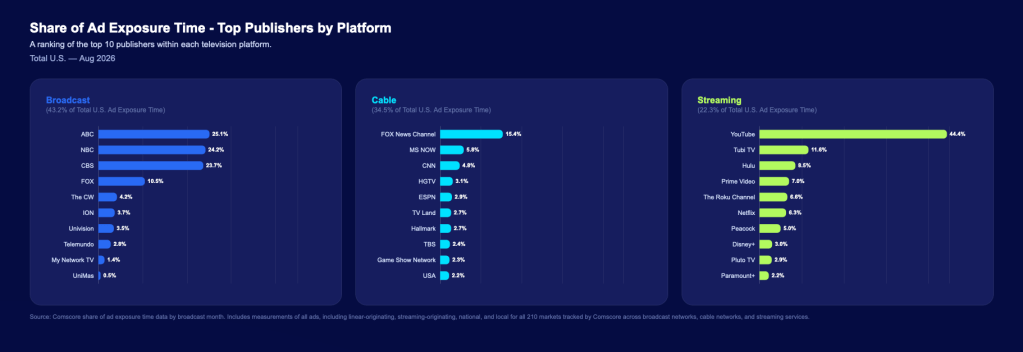
The data for August 2026 confirms what many industry observers have long suspected: YouTube is the undisputed king of the living room screen. Beyond its status as the most-watched streaming service, YouTube (excluding YouTube TV) commanded a staggering 44% of ad exposure time among streaming platforms. When viewed against the backdrop of the entire television landscape—including traditional broadcast and cable—YouTube still captured roughly 10% of all ad exposure time.
Tubi, the ad-supported streaming powerhouse, secured the second-place position, claiming a 12% share among streamers and roughly 3% of the total television market. These figures highlight a clear divide in the streaming hierarchy, where platforms with massive content libraries and established ad-insertion infrastructure are successfully converting watch time into ad impressions.
Chronology of a Shift: How We Got Here
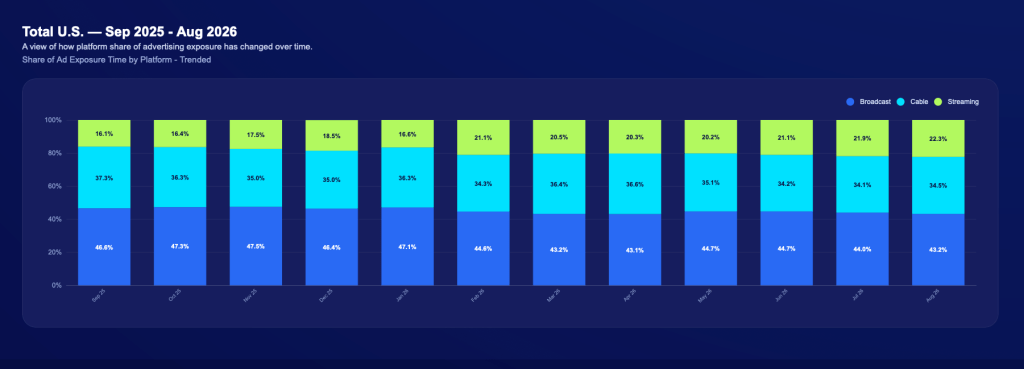
The ascent of streaming within the ad-exposure ecosystem has been a slow, calculated climb. Just one year ago, streaming accounted for only 16% of total ad exposure time, while broadcast TV dominated with 47% and cable held 37%.

For several months following that period, streaming’s share plateaued at 19%. The inflection point, however, arrived in what industry insiders dubbed "Legendary February"—a month defined by the confluence of the Super Bowl, the Winter Olympics, and the NBA All-Star Game. While these mega-events traditionally lived on broadcast networks, their simultaneous distribution across streaming platforms signaled a shift in viewing behavior. The result? Streaming’s share of ad exposure climbed to 21%, a threshold from which it has continued to build.
Sports, in particular, has proven to be the primary engine of this growth. In June, the World Cup served as a catalyst for significant share increases across Peacock, Tubi, and Fox One. As live sports increasingly migrate to digital environments, the platforms that host these events are seeing immediate, tangible spikes in their ad exposure metrics.
Supporting Data: The Volatility of the Third Slot
While YouTube and Tubi have maintained a stranglehold on the top two positions, the third-place spot remains a volatile, highly contested space. Over the past several months, the leaderboard has seen a revolving door of occupants:
- May: Amazon Prime Video held the third-largest share of ad exposure.
- June: Netflix surged into the third spot.
- July: Peacock seized the position.
- August: Hulu claimed the third-place ranking.
This fluidity suggests that while the dominant players are solidified, the mid-tier streaming market is currently in a state of flux, driven heavily by content release cycles, seasonal sporting events, and shifting ad-load strategies.
Official Responses and the "Scorekeeper" Philosophy
When asked about the intent behind The Score Report, Kevin Burns, chief of staff and interim chief revenue officer at Comscore, was quick to distance the company from the role of industry critic.
"Our goal is not to declare winners or declare this is the one right thing to do," Burns stated during an interview. "We’re a measurement company. We like to think of ourselves as the scorekeeper and not a commentator in the booth. The goal really is to present the data and allow folks to draw their own conclusions."
Despite this neutral positioning, the report inherently invites a new kind of competition. By quantifying "share of ad time," Comscore is providing advertisers with a roadmap to reach audiences in environments where they are demonstrably captive. For the platforms, however, this metric creates a delicate balancing act: how to maximize ad exposure without alienating a user base that has grown accustomed to the premium, ad-light experience of early streaming.
Implications: The Looming Threat of "Juiced" Ad Loads
The introduction of this report raises a critical question for the industry: Will this data incentivize platforms to "juice" their ad loads to climb the rankings?
While a high ranking on The Score Report is undoubtedly an attractive sales pitch for a streaming service’s ad-sales team, it carries a potential long-term risk. If platforms prioritize quantity of ad exposure over user experience, they risk replicating the very dynamics that drove audiences away from cable TV.
Furthermore, the data suggests that traditional TV still leads in total ad exposure, a fact that reflects the heavy ad loads inherent in linear programming. As viewers continue to "cord-cut," the irony remains that the platforms vying for the largest share of ad time may eventually face the same viewer fatigue that currently plagues the broadcast and cable networks they are seeking to replace.
Industry Snapshot: Trends and Shifts
As we look toward the remainder of 2026, several key industry developments are shaping the broader media environment:
- The Netflix Transition: Netflix, once the sanctuary of ad-free viewing, is now navigating the complexities of its ad-supported tier. With expected ad revenue of $2.7 billion for 2026—a downward revision from the initial $3 billion forecast—the company is undergoing internal restructuring, including a 6% staff layoff and a major change in its content leadership.
- The Rise of the Creator Economy: The Small Business Administration’s recent classification change—recognizing 27 million creator-led businesses as eligible for small business loans—is a seismic shift that could further decentralize advertising budgets.
- Regulatory Scrutiny: As the Supreme Court begins oral arguments on the Video Protection Privacy Act, the future of how data is shared between streaming services and advertisers remains in legal limbo, potentially complicating the tracking mechanisms that make reports like Comscore’s possible.
- The Tech Pivot: Companies like Fox are already leaning into the future by integrating AI agents into their ad-buying processes, working with partners like Omnicom and Stagwell to refine audience targeting in real-time.
Conclusion: The Future of Measurement
Comscore’s "Score Report" is more than just a list of winners and losers; it is a barometer for the health of the television industry in an age of total digital transformation. By focusing on ad exposure, the industry is acknowledging that the "attention economy" is the new reality.
Whether this leads to a healthier, more sustainable advertising ecosystem or merely encourages a race to the bottom in terms of viewer tolerance, remains to be seen. What is clear is that the "scorekeeper" has arrived, and for the first time, the competition for the viewer’s time has been explicitly tethered to the viewer’s patience for commercials. As we move into the next upfront season, this data will likely play an outsized role in where the billions of dollars in television ad spend ultimately land.


 Iffa Jayyana

 Ammar Sabilarrohman

 Azzam Bilal Chamdy

 Ali Ikhwan

 Nana Wu
 Sagoh
