
 Nana
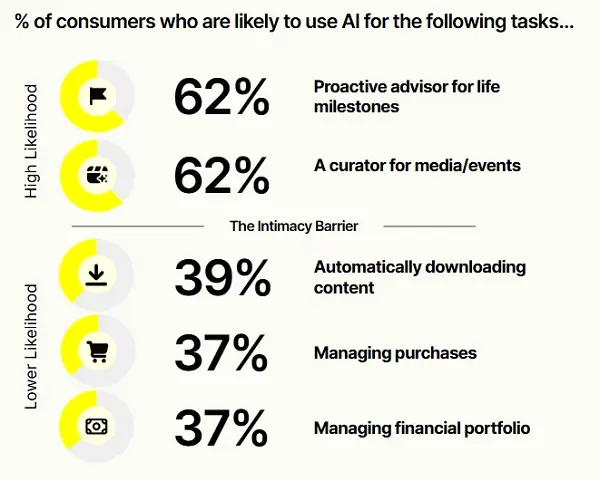
In the rapidly evolving landscape of consumer technology, artificial intelligence has moved from a speculative, futuristic novelty to a cornerstone of daily human interaction. A comprehensive new report from Snapchat, titled “Navigating the Age of AI,” provides a granular look at this transition. By surveying over 4,200 AI users in partnership with Ipsos and WPP, the social media giant has mapped the contours of how we integrate silicon-based assistants into our most intimate decision-making processes.
The findings paint a picture of a populace that is increasingly comfortable with—and reliant upon—AI, yet remains deeply protective of the boundaries between “helpful utility” and “intrusive corporate exploitation.” As AI becomes a ubiquitous presence in the pockets of millions, the implications for businesses, creators, and the general public are profound.
The Rapid Ascent of AI Integration
The primary takeaway from the Snapchat report is the sheer velocity of AI adoption. The data suggests that we have moved past the “early adopter” phase into a period of mainstream saturation. According to the survey, 48% of consumers are now utilizing AI tools on a daily basis. Even more telling is the professional landscape: 50% of creators and marketers now categorize AI as a fundamental component of their daily workflow, marking a permanent shift in the creative and professional economy.
This isn’t merely a matter of using a chatbot to write an email; it is a fundamental shift in how individuals navigate their personal and social lives. The report highlights that AI is increasingly functioning as a "trusted partner" for users, guiding everything from product recommendations to the nuances of interpersonal communication.
Chronology of Adoption: From Curiosity to Utility
To understand the current state of AI, one must look at the trajectory of the last few years.
- 2022: The Awakening: Generative AI tools became publicly accessible at scale. Initial adoption was driven by novelty and curiosity, with users experimenting with basic text generation and image creation.
- 2023: The Integration Phase: Social media platforms began embedding AI directly into their interfaces—Snapchat’s own “My AI” being a prime example. This moved AI from a standalone website to a feature within the social ecosystems users already inhabited.
- 2024: The Utility Pivot: The current era, as documented by this report, is defined by utility. Users are no longer just "playing" with AI; they are using it as a diagnostic and coaching tool. The focus has shifted toward how these machines can solve real-world problems, from managing social anxiety to planning physical outings.
Supporting Data: Why Users are Turning to Algorithms
The data provided by Snapchat and its research partners offers a fascinating look at the psychological comfort users now derive from AI.
The Conversational Bridge
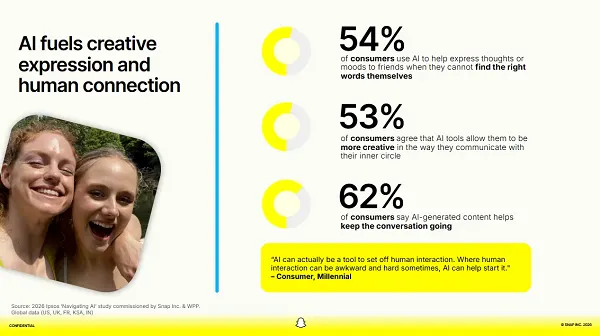
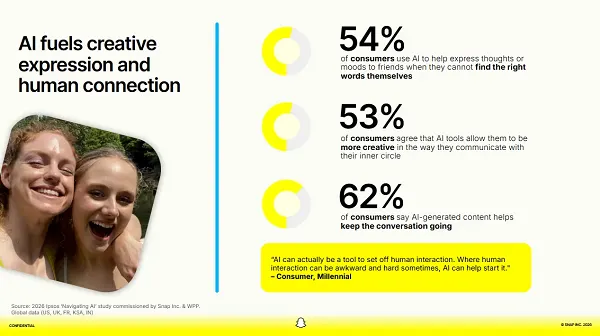
Perhaps the most striking metric is that 62% of users report that AI tools help them maintain and improve their conversations. This suggests a significant reliance on AI to bridge gaps in social confidence. By acting as a "judgment-free space," AI allows users to practice articulating complex feelings or difficult messages before they commit to sending them to a real human peer.
Social and Real-World Impact
Snapchat users, specifically, show a marked propensity for using AI in their physical lives. The report notes that these users are 2.2 times more likely to agree that AI bolsters their social life and 1.6 times more likely to use these tools to plan real-world activities. This challenges the long-held fear that AI usage leads to increased isolation; instead, for many, it serves as a catalyst for social engagement.
The Perception of Personality
The emotional framing of AI is also shifting. Over 80% of those surveyed described their AI interactions as “friendly and collaborative.” This anthropomorphization is key to the technology’s success. When users perceive the AI as a peer rather than a machine, the friction of adoption disappears, allowing for deeper, more sustained usage.
The Privacy Paradox: The "Value vs. Surveillance" Trade-off
The most controversial aspect of the report lies in its candid assessment of data privacy. Snapchat posits that for the modern consumer, privacy is no longer a binary "on/off" switch but a sliding scale.
Is It Worth It?
The report argues that the central question for today’s user is not, “Is my data private?” but rather, “Is this worth it?” This represents a maturation of the digital consumer. Users are increasingly aware that data collection is the "price of admission" for personalized experiences. They are willing to trade personal information for immediate, tangible value—such as highly accurate recommendations or personalized coaching—provided the exchange feels balanced.
The Boundary of Trust
However, this willingness has limits. While users are happy to share data for the sake of utility, they remain deeply wary of commercial intrusion. The report reveals a stark dichotomy:
- 70% of consumers find the use of personal data for hyper-personalized AI advertising to be intrusive.
- 56% view content that is 100% AI-generated as “soulless” or lacking in human essence.
This creates a significant hurdle for businesses. While brands can use AI to build better tools, the moment those tools are perceived as “salesy” or “inauthentic,” they lose the user’s trust.
Official Perspectives and Industry Implications
Snapchat’s decision to publish this report is not merely an act of transparency; it is a strategic move to position itself as a bridge between AI utility and user comfort. By framing AI as a "private coach" and a "collaborative partner," Snapchat is attempting to steer the narrative away from the dystopian "surveillance" concerns that have plagued other social media companies.
The Business Strategy
For businesses and marketers, the implications are clear: the future of AI marketing is not in overt, data-heavy targeting, but in providing genuine utility. If a brand can offer an AI tool that helps a user plan a trip or draft a difficult text, they gain the user’s trust. If they immediately attempt to monetize that relationship through intrusive ads, they risk immediate abandonment.
The Ethical Dilemma
Critics argue that this "sliding scale" of privacy is a dangerous justification for the ongoing erosion of personal data rights. By normalizing the idea that users must trade their privacy for utility, companies like Snapchat are essentially legitimizing a status quo where data extraction is the inevitable cost of a functional digital life. The report implicitly acknowledges this, suggesting that the industry must be careful not to overreach, lest they provoke a consumer backlash that could dampen the current enthusiasm for AI tools.
Future Outlook: Navigating the Dichotomy
As we move forward, the relationship between humans and AI will continue to be defined by this push-and-pull dynamic. Users are clearly seeking the benefits of advanced machine learning—better communication, clearer decision-making, and more efficient planning—but they are simultaneously demanding a level of authenticity that AI, by its very nature, struggles to provide.
The challenge for the next generation of tech developers will be to reconcile these opposing forces. We are moving toward a future where AI is a constant, invisible assistant, but one that must learn to respect the "human" boundaries of its users. If companies can navigate this, AI will continue to grow as an essential pillar of human society. If they fail to respect the line between utility and intrusion, the "Age of AI" could face a significant, if not fatal, trust deficit.
In conclusion, Snapchat’s report confirms that we are no longer in the experimental phase of AI. The technology has been woven into the fabric of our social lives. The question is no longer whether we will use it, but how we will manage the delicate balance between the immense value it provides and the personal cost of the data we sacrifice to obtain it. The winners in this new era will be those who prioritize the user’s autonomy and emotional comfort over the raw extraction of data for profit.


 Lina Irawan
 Nila Kartika Wati

 Ammar Sabilarrohman

 Asep Darmawan

 Asro

 Layla Zulfa


 Muslim
