
 Lina Irawan
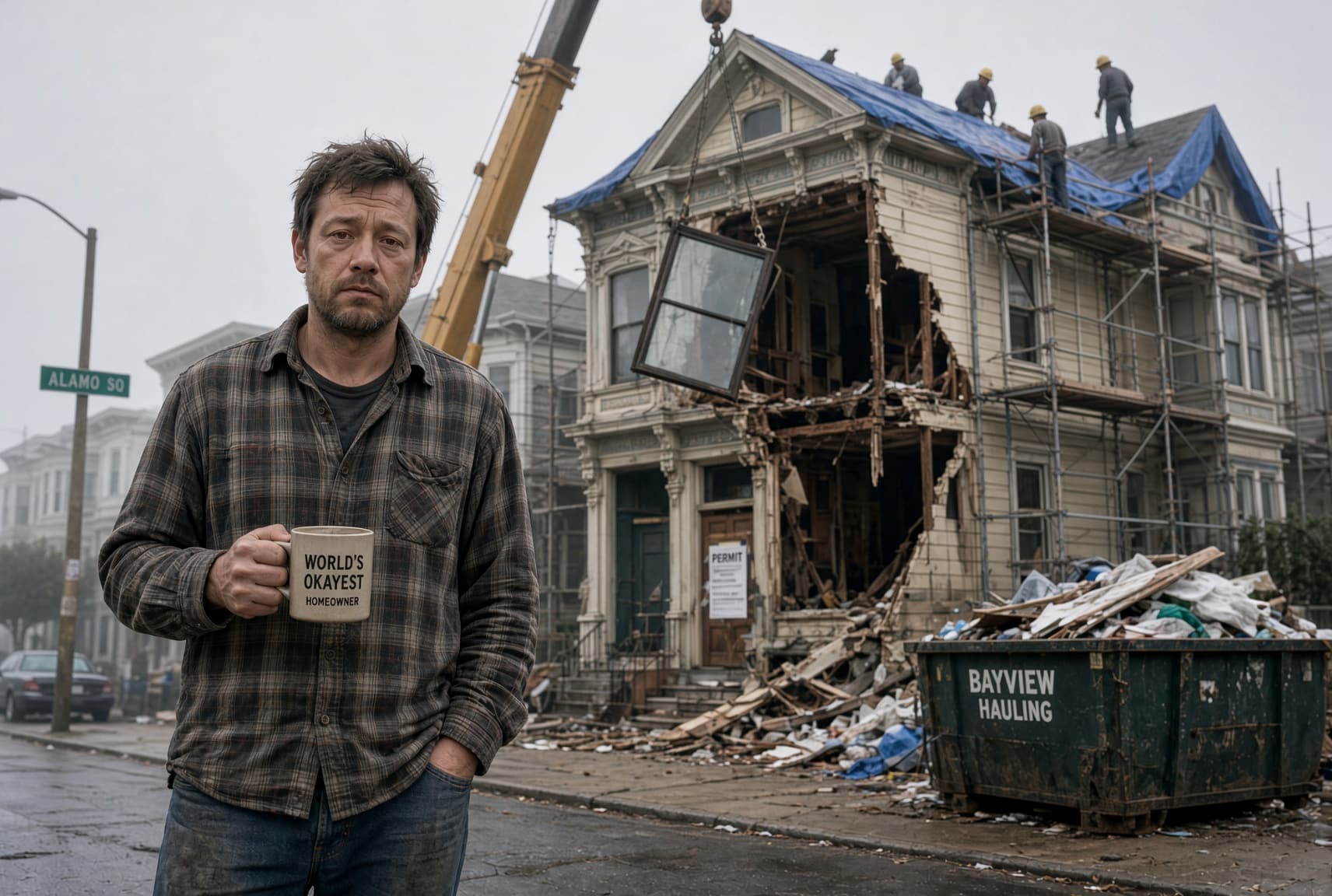
At nearly 50 years old, I have reached a definitive conclusion: I am never doing a gut remodel again. There is a specific, haunted look shared by anyone who has survived the gauntlet of a major home renovation. It is the "thousand-yard stare" of a person who spent two years debating the precise shade of grout, only to be ghosted by inspectors and sidelined by contractors who operate on a timeline that defies the laws of physics.
Remodeling is perhaps the most unpleasant endeavor one can voluntarily choose to undertake. No one forces homeowners to strip a property to its studs, yet every year, thousands of people line up to hand over hundreds of thousands of dollars for the distinct privilege of being miserable. The reality of modern construction is defined by two constants: cost overruns and time delays. If you are bold—or perhaps foolish—enough to undertake a gut remodel, the golden rule is to budget for the project to cost at least 50% more and take 50% longer than the initial estimate. If you follow this rule, you might emerge only slightly bloodied. If you trust the contractor’s initial quote, you are inviting a level of silent stress that will likely detonate your finances and your closest relationships.
The Chronology of a Construction Nightmare
The lifecycle of a modern home renovation rarely follows the neat Gantt chart presented during the bidding phase. Instead, it follows a chaotic arc of hope, disillusionment, and eventual resignation.
My own experience since purchasing San Francisco property in 2003 has been a masterclass in frustration. My last gut remodel, which commenced in mid-2019, was not fully completed until the end of 2022. While the COVID-19 pandemic certainly contributed to the delays, the project, originally slated for a one-year completion, dragged into a three-year ordeal.
The chronology typically looks like this:
- Months 1-6 (The Honeymoon Phase): You spend time with architects and interior designers, selecting high-end finishes and visualizing the "dream home." You pay the deposit with optimism.
- Months 7-18 (The Permitting Abyss): Reality sets in. You realize that your local planning department is a black hole. Applications sit in queues for months, and once they are processed, any minor deviation triggers a "Correction Required" notice, resetting the clock.
- Months 19-30 (The Physical Build): The construction begins. You discover structural issues that were hidden behind the drywall. Costs balloon. You find yourself texting your general contractor at 10:00 PM on a Tuesday, begging for an update on why the plumbing rough-in hasn’t been inspected.
- Months 30+ (The Punch List Purgatory): The house is "mostly" done, but the final 5%—the light fixtures, the baseboards, the final paint touch-ups—takes months to resolve as the contractor moves on to more lucrative jobs.
Permitting Durations: A Growing National Crisis
The speed at which a home can be built or remodeled varies wildly depending on geography. A report by professors from the University of Chicago and Princeton, titled Where Is It Slow To Build, And Is It Getting Slower?, highlights a staggering disparity in construction efficiency.
San Francisco currently ranks at the top of the list for inefficiency, averaging 1.1 years just to obtain a permit and an additional 3.8 years to complete a single-family home. By the time a resident in San Francisco finishes a single house, a developer in Indianapolis, El Paso, or Colorado Springs—where projects can often be completed in six months—could have theoretically built seven homes.
The national average for permit-to-completion time is approximately 8.8 months, but the trend line is ominous. Nationally, the time required to permit a single-family home has roughly tripled, rising from 1.6 months in 2000 to 4.9 months in 2023. This bureaucratic bloat acts as a hidden tax on every homeowner, inflating the cost of housing and discouraging necessary renovations.
The True Cost: More Than Just the Invoice
Most buyers make the fatal mistake of viewing the construction invoice as the total cost. In reality, the construction bill is merely the tip of the iceberg.
Consider a scenario where you purchase a $1.6 million fixer-upper and budget $400,000 for an 18-month gut remodel. If the project runs 50% over budget, you are suddenly looking at a $600,000 spend. If the timeline extends to 2.5 years, you must also account for:
- Rental Costs: At $6,500 a month, you are spending $195,000 just to have a roof over your head while your house is under construction.
- Property Taxes: You are paying roughly 1.2% in annual taxes on a property you cannot inhabit—totaling $48,000 over 30 months.
- Opportunity Cost: The $850,000 or more in capital tied up in a non-productive asset could have been compounding in the S&P 500 or private equity markets.
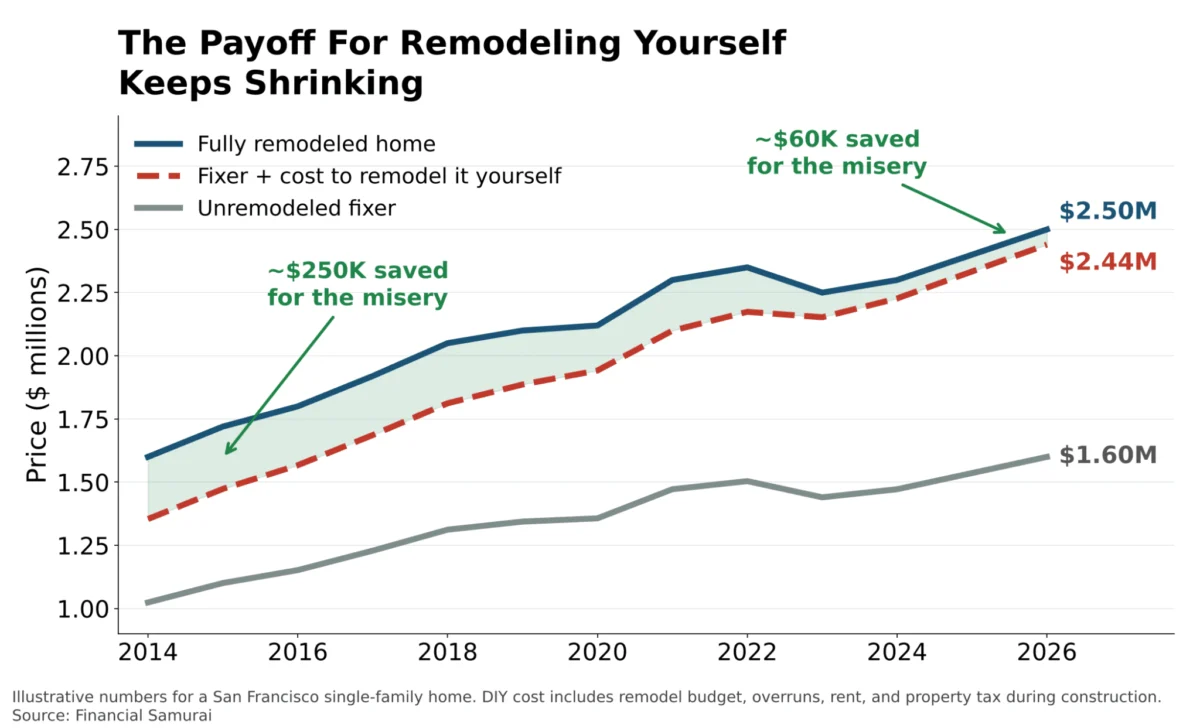
When you aggregate these figures, that $1.6 million purchase effectively costs you $2.44 million. Furthermore, there is the intangible cost of life: if you have children, the years you spend living out of boxes are years you do not get back.
Implications for the Housing Market
Given the volatility and expense, the logical choice for anyone over the age of 40 is to purchase a fully remodeled home. In many markets, particularly in high-cost cities like San Francisco, the market significantly undervalues move-in-ready properties. Because remodeling is so painful, finished homes should command a massive premium; yet, often, they do not.
Ten years ago, buying a fixer-upper and remodeling it yourself might have saved you $250,000. Today, due to the rapid inflation of labor and materials, those savings have often shrunk to as little as $60,000. When you amortize that $60,000 over a 2.5-year construction project, you are effectively earning a meager $2,000 a month to act as a part-time project manager, inspector-chaser, and stress-absorber. One bad subcontractor or a single permit delay, and that margin evaporates entirely.
Why Do People Still Do It?
If the math is so clearly against it, why does the behavior persist? The answer is twofold:

1. The Overconfidence Bias
Many homeowners believe they are more efficient than the average person. They assume that if they hire a "good" architect and a "reputable" GC, the process will be seamless. They fail to realize that their degree, their professional success, and their ability to command a boardroom mean nothing to a building inspector or a plumber who is juggling five different sites.
2. The Desire for Self-Expression
The second reason is more emotional: people have eclectic taste. Developers generally design homes to appeal to the "average" buyer—white quartz countertops, gray accent walls, and neutral flooring. If you have a vision for a jade-green kitchen or a custom Japanese soaking tub, no developer is going to build that for you. While I sympathize with the desire to express oneself, I argue that furniture, art, and high-end lighting can provide 80% of that unique aesthetic for a fraction of the cost. Your "dream home" is often just a "gut job" waiting for the next owner to tear it down.
If You Must Remodel: A Survival Guide
For those who choose to ignore this advice, there is a strategic way to mitigate the damage:
- Secure a Fixed-Price Contract: While hard to find, a contract with a strict cap on cost overruns is your only protection.
- Build a Contingency Fund: Double the amount you think you need. If you expect the unexpected, you will be less likely to suffer a mental breakdown when the foundation repair costs triple.
- Prioritize Function Over Fashion: Focus on the structural integrity, electrical, and plumbing first. Cosmetic upgrades can be done later, often by yourself, without needing permits.
- Hire an Owner’s Representative: If the project is large, pay an independent professional to oversee the GC. It is an extra expense, but it provides a buffer between you and the inevitable conflict.
Conclusion: The Peace of Passive Investment
The silver lining of a renovation is the profound relief you feel when it is finally over—akin to the pleasure of stopping after hitting yourself in the head with a hammer. However, for those who want real estate exposure without the drama of contractors and building departments, passive investment is a superior alternative.
As the economy shifts, we are seeing massive capital inflows into data centers and industrial infrastructure to support the AI revolution. Platforms like Fundrise allow investors to gain exposure to real estate without ever having to worry about a permit or an inspector. By investing passively, you can enjoy the potential returns of real estate while maintaining your peace of mind—and, perhaps more importantly, your sanity.
When it comes to home improvement, the most profitable decision is often the one you choose not to make. Buy the finished home, embrace the beige, and spend your time living your life rather than managing a construction site.

 Nana Wu

 Sagoh

 Raul Delapena Setiawan

 Reynand Wu



 Azzam Bilal Chamdy

 Ali Ikhwan
