
 Nana
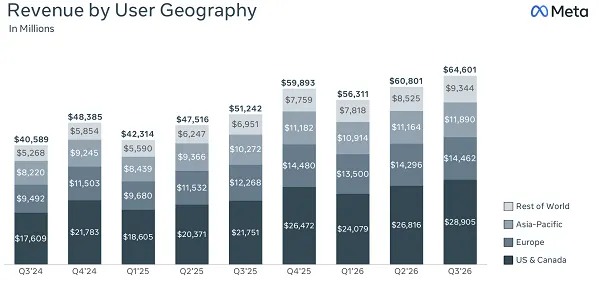
Meta Platforms Inc. has released its Q3 2026 earnings report, painting a complex picture of a company at a critical crossroads. While the tech giant continues to demonstrate remarkable resilience in its core advertising business—posting a 26% year-over-year revenue increase to $64.6 billion—the narrative is increasingly dominated by the massive, mounting costs associated with its aggressive pivot toward artificial intelligence. As Meta pours billions into infrastructure, it faces a mounting paradox: its legacy business has never been stronger, yet its future-facing bets are struggling to find a clear path to profitability.
Main Facts: A Tale of Two Business Models
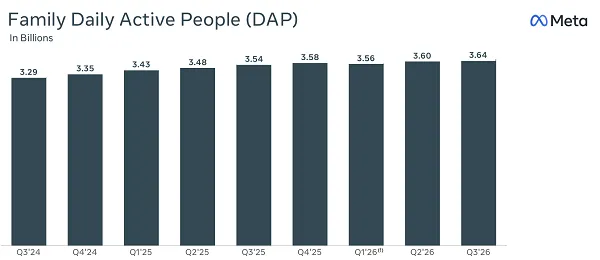
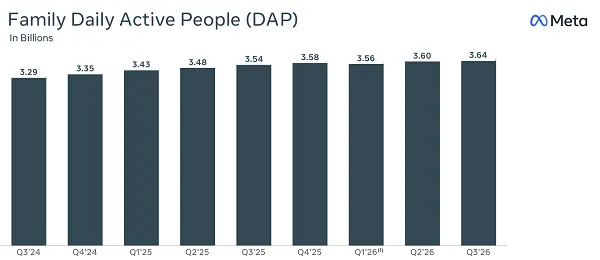
The headline figures from Meta’s latest filing reveal a company managing a massive global ecosystem. The "Family of Apps"—comprising Facebook, Instagram, Messenger, WhatsApp, and Threads—continues to expand its reach. Meta reported a total of 3.64 billion daily active users, an increase of 40 million compared to the previous quarter. This growth underscores the enduring relevance of Meta’s platforms, even as the digital landscape grows increasingly fragmented.
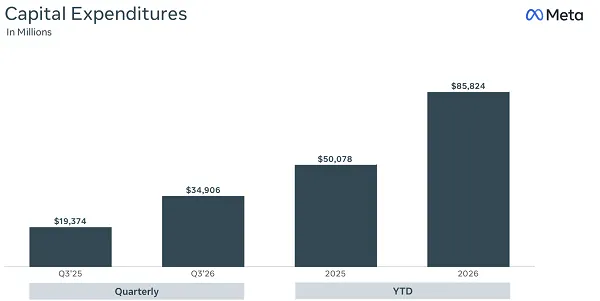
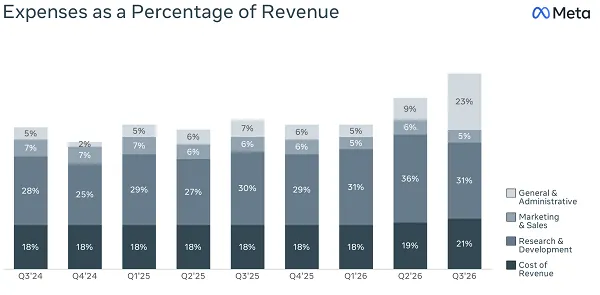
However, beneath the hood of this user growth lies a significant financial shift. Meta’s expenses surged by 68% year-over-year in the third quarter. This sharp uptick is almost entirely attributable to capital expenditures (CapEx) aimed at building out the immense computing infrastructure required to support its next-generation AI models. While the ad business remains a reliable engine, the sheer scale of investment in AI is beginning to weigh heavily on the balance sheet, forcing analysts to ask: when will these investments translate into tangible, bottom-line returns?
Chronology of Strategic Evolution
To understand where Meta currently stands, one must look at the progression of its strategic pivot over the last several quarters:
- Early 2026: Meta intensified its commitment to AI infrastructure, publicly earmarking over $600 million for specialized data centers and hardware.
- Mid-2026: The company ramped up the integration of AI tools across its advertising suite, claiming that enhanced targeting capabilities would justify higher ad prices for marketers.
- Late Q3 2026: The launch of "Muse" personal AI agents marked a significant move into consumer-facing conversational AI, intended to act as both a utility and a gateway for e-commerce transactions.
- Current State: Meta is currently grappling with public trust issues regarding its AI safety, including data exposure incidents and privacy concerns surrounding its smart hardware.
Supporting Data: Ad Strength vs. AI Expenditure
Meta’s advertising performance in Q3 provides a fascinating case study in market dynamics. Total ad impressions rose by 10% year-over-year, a figure that—while positive—suggests a slight deceleration in growth compared to previous quarters. This is particularly noteworthy given that Meta has consistently introduced new ad placements, most notably within the rapidly growing Threads platform.
Threads has officially overtaken X (formerly Twitter) in monthly active users, a milestone confirmed by CEO Mark Zuckerberg. Despite this massive user influx, ad revenue growth is not scaling linearly, suggesting that Threads may be hitting a saturation point or that advertisers are still determining the platform’s long-term ROI.
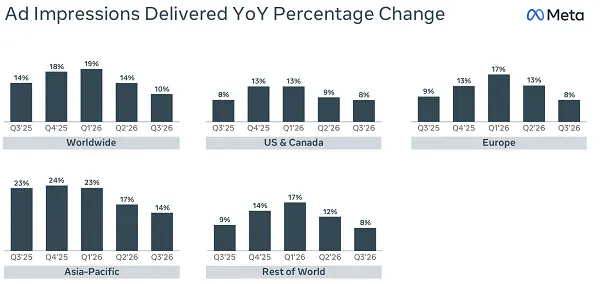
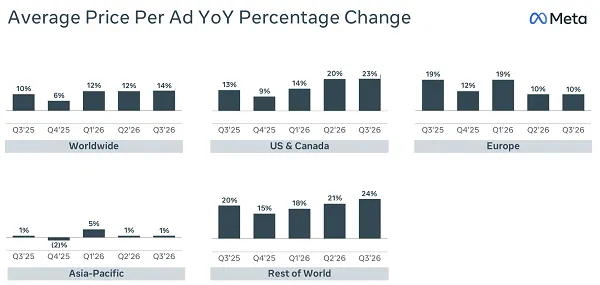
To compensate for the slowing growth in impressions, Meta has pivoted to pricing power, raising average ad prices by 14%. While this has successfully protected revenue, it places additional pressure on marketers. Meta argues that these price hikes are justified by the superior performance of AI-driven targeting, which allows for more efficient ad spend. However, for many small-to-medium businesses, the rising costs are becoming a point of contention.
The most concerning data points, however, involve the "Reality Labs" division and AI-related spending. Reality Labs revenue remains stagnant, showing only negligible growth quarter-over-quarter. With the recent backlash regarding the misuse of Meta’s AI-integrated glasses—where public privacy concerns have dampened consumer enthusiasm—the company’s hardware-based monetization strategy faces a significant uphill battle.
Official Responses and Strategic Pivot
Meta leadership has been vocal in its defense of the current expenditure levels. During the earnings call, executives emphasized that the $600 billion commitment to AI infrastructure is a long-term play, designed to secure a competitive moat against rivals like Google, Microsoft, and OpenAI.
Regarding the "Muse" AI agents, the company maintains that the platform is safe and built with "privacy-first" principles. This stance has been tested recently by reports from Ars Technica and others, which revealed that third-party security researchers were able to extract sensitive user information from Muse queries. Meta has responded by launching a series of security patches and a public relations campaign aimed at rebuilding user trust.
A major, often overlooked, aspect of Meta’s efficiency strategy is its aggressive workforce reduction. The company reported a total headcount of 66,775 as of September 30, 2026, representing a 15% decline year-over-year. This reduction is not merely a cost-cutting exercise; it is a fundamental restructuring. Meta is actively replacing human moderation and support staff with AI-driven tools, betting that automated systems can scale more effectively than human teams while simultaneously lowering operational overhead.
Implications: The Road Ahead
The implications for investors and the tech industry at large are profound. Meta is effectively using its lucrative social media empire to subsidize a massive, unproven experiment in AI. If the Muse AI agents gain traction, Meta stands to capture a significant percentage of e-commerce transactions conducted through its platforms, creating a new, high-margin revenue stream.
However, the current trajectory is fraught with risks:
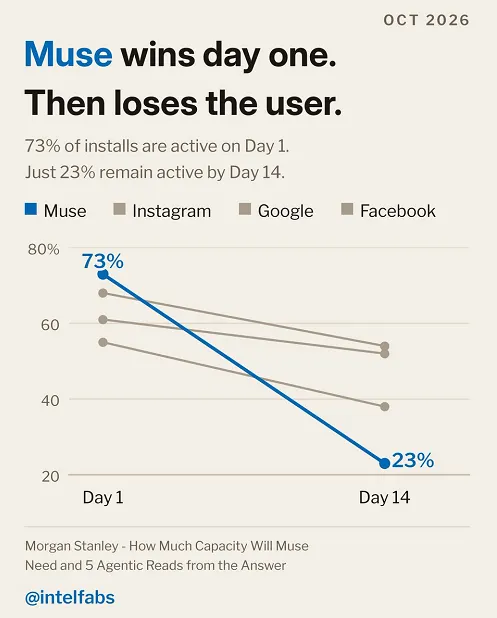
- Retention Hurdles: Data suggests that Muse, like many other AI chatbots, suffers from a significant "cliff" in user retention after the first two weeks. If Meta cannot find a way to make these agents indispensable to daily life, the massive infrastructure cost may never be recouped.
- Privacy and Brand Equity: The repeated incidents of data exposure and unintended AI behavior—such as the bot sharing a user’s home address—damage Meta’s brand equity. If the public perceives these tools as liabilities rather than assets, adoption will stall.
- Market Saturation: With ad prices already rising to compensate for volume stagnation, there is a theoretical limit to how much more revenue Meta can extract from its existing user base before experiencing churn.
Ultimately, Meta’s Q3 2026 earnings report serves as a warning and an opportunity. The company is currently "too big to fail" in the short term, supported by a juggernaut of advertising revenue that continues to exceed expectations. However, the widening gap between its astronomical AI spending and the lack of corresponding revenue growth from those initiatives is a ticking clock.
Investors are currently willing to overlook the expense, provided that the ad business continues to grow. But as the "AI hype cycle" gives way to a demand for concrete financial results, Meta must prove that its shift from a social network to an "AI-first" company is a viable business model. For now, the company is successfully holding the line, but the sustainability of this strategy depends entirely on whether Muse and its associated AI ecosystem can evolve from a speculative project into a dominant, revenue-generating utility.


 Ammar Sabilarrohman
 Sagoh

 Raul Delapena Setiawan

 Reynand Wu



 Azzam Bilal Chamdy

 Ali Ikhwan
