
 Nila Kartika Wati
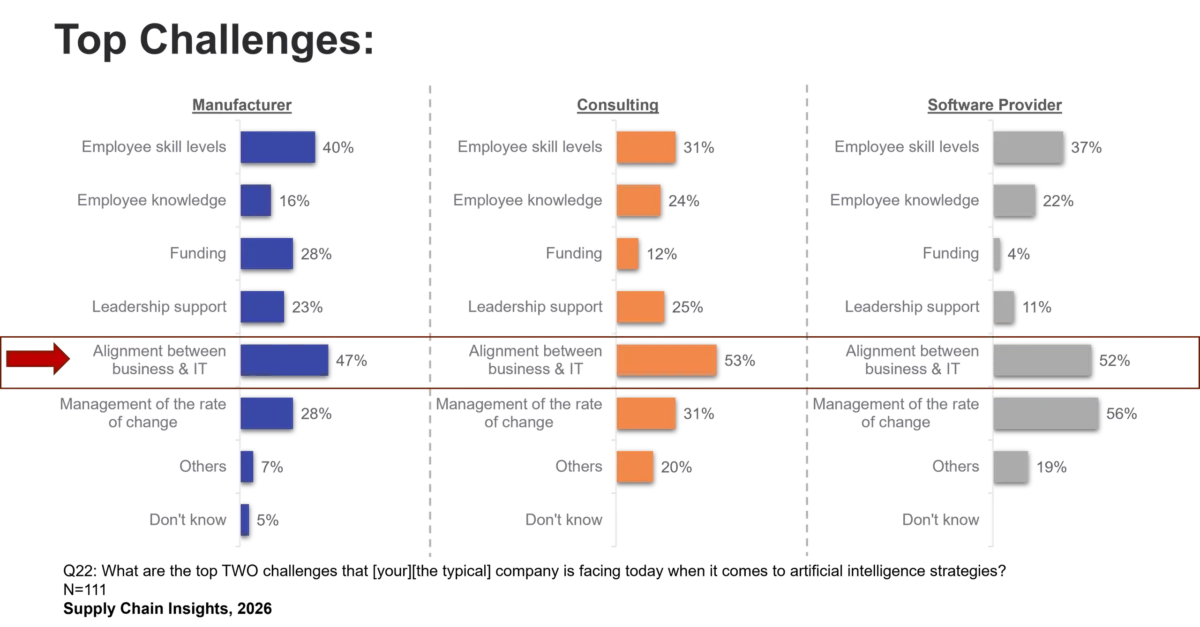
The landscape of supply chain planning is undergoing a seismic shift, driven by the seductive promise of Artificial Intelligence and advanced analytics. Yet, beneath the veneer of "AI-cool" marketing and high-tech implementation roadmaps, a troubling trend is emerging: technology is being prioritized over the fundamental, gritty realities of process, data hygiene, and organizational alignment.
As companies race to modernize, they are increasingly falling into the trap of "technology-first" thinking, where the tool is treated as a panacea for deep-seated structural issues. To understand the current crisis in supply chain planning, one must look beyond the feature lists and into the disconnect between the boardroom, the IT department, and the frontline of operational reality.
The Widening Chasm: IT vs. The Business
At the heart of the current dysfunction is a widening gap between business leadership and Information Technology (IT) departments. Business leaders, often mesmerized by the latest industry buzzwords, frequently lobby for "best-in-breed" solutions that fail to account for the actual technical debt of their organization.
Conversely, IT teams are increasingly burdened by a lethal combination of shrinking budgets, rising maintenance costs, and a fundamental misunderstanding of the business challenges they are meant to support. In this environment, data science teams are often caught in the crossfire. They are frequently pushed to build custom solutions—often utilizing Python or proprietary code—to bridge the gap between legacy systems and modern expectations, yet they rarely possess the context to define the underlying business problem they are attempting to solve.
Chronology of a Failed Integration
To visualize this, consider the typical journey of a multinational corporation:
- The M&A Era: Through years of mergers and acquisitions, the company inherits a chaotic ecosystem of 100+ ERP systems.
- The "Patchwork" Phase: IT struggles to maintain legacy engines (e.g., Oracle Demantra) while simultaneously being pressured to integrate new, trendy planning platforms like Kinaxis without a proper "backcasting" test.
- The Customization Trap: When out-of-the-box software fails to account for idiosyncratic legacy architectures, the organization pivots to building custom, fragile applications to sit on top of their existing stack.
- The Analytics Myopia: The internal analytics group, infatuated with modern toolsets, prioritizes feature-rich "error reduction" over the more vital, long-term goals of prediction and system stability.
The Bullwhip Effect and the Risk Management Paradox
While risk management was a recurring theme at industry forums like the recent CSCMP Edge conference, the conversation remains largely superficial. Professionals obsess over external risks while ignoring the systemic risks they build into their own supply chains.
The most glaring omission in current discourse is the impact of bad inputs on the "bullwhip effect"—the phenomenon where small fluctuations in demand at the retail level cause progressively larger fluctuations in demand at the wholesale, distributor, and manufacturer levels.

The Data Inputs Failure
Risk management must start with the integrity of the data stream. Organizations are currently crippled by:
- Negative Forecast Value Added (FVA): Making decisions that actually reduce the accuracy of the baseline forecast.
- "Set-it-and-Forget-it" Policies: Relying on outdated lead-time assumptions that fail to account for current market volatility.
- Inside-Out Processes: Using only internal enterprise data while ignoring external market signals.
- Increased Demand Latency: The growing gap between when a product leaves the shelf and when the order reaches the manufacturer.
Surprisingly, while supply chain professionals are trained on the "Beer Game"—a classic simulation used to demonstrate the bullwhip effect—few companies measure the bullwhip impact in real-world scenarios. By failing to test and learn from actual plan performance, organizations are effectively hard-coding instability into their own processes.
Forecasts vs. Plans: The Precision Fallacy
A pervasive myth in the industry is that a "better" forecast—measured by marginal improvements in Mean Absolute Percentage Error (MAPE)—is equivalent to a better plan. This is a fundamental misunderstanding of operational reality.
Astute implementers distinguish between accuracy (how close the forecast is to actual demand) and precision (the consistency and repeatability of the forecast). A model can be mathematically precise but operationally useless if it is consistently inaccurate. Furthermore, focusing solely on MAPE, WAPE, or other common metrics often blinds teams to the actual feasibility of the plan.
A forecast is merely a single input. A plan, by contrast, is a strategic commitment that accounts for optionality and business judgment. When companies prioritize the "perfect" forecast, they ignore the necessity of building a resilient plan that can withstand the inevitable variances of the global market.
The Architecture of Failure: Planning Master Data
The average enterprise operates with seven to nine disparate planning systems. Each carries its own assumptions—lead times, run rates, and conversion cycles—yet these assumptions are rarely synchronized.
This lack of synchronization creates a "siloed reality" where the system of record does not match the system of planning. To move forward, organizations must prioritize:

- A Unified Planning Master Data Layer: A single source of truth for planning assumptions that is accessible across all platforms.
- System-of-Record Documentation: The simple, yet frequently overlooked, practice of saving plans for future comparison and post-mortem analysis.
Without a record of what was planned versus what actually occurred, there is no organizational learning—only a recurring cycle of guessing and reacting.
Official Responses and Industry Shifts: The Need for Root Cause Analysis
The emergence of tools like Continuous Directed Acyclic Graph (DAG) learning and context graphs offers a potential path forward, but only if the culture shifts alongside the technology.
At the recent o9 AIM10X event, industry leaders highlighted the importance of "after-action review" capabilities. This is the missing link in supply chain planning: the ability to objectively analyze why a prior-period plan failed, what specific variables would have improved it, and what value was lost due to the error.
Organizations must stop viewing technology as a "plug-and-play" solution and start using it to conduct rigorous root cause analysis. If the software is not enabling a deep dive into the "why" behind the numbers, it is not an improvement; it is merely a more expensive way to make the same mistakes.
Implications for the Future: Redefining Work
The implication for the modern supply chain professional is clear: technology is not a substitute for strategy. As we continue to integrate advanced AI and machine learning, the competitive advantage will not go to the company with the most expensive software suite, but to the company that is willing to redefine its underlying work processes.
Key Strategic Takeaways:
- Question the Tool: Never purchase technology without first testing it against real-world business scenarios.
- Kill the "APES": Move away from narrow, misleading metrics like MAPE and toward more holistic measures of reliability and business impact.
- Institutionalize Learning: Implement formal after-action reviews to ensure that today’s planning mistakes become tomorrow’s process improvements.
- Prioritize Data Synchronization: Treat planning master data as the foundation of the entire technical stack.
The pace of technology change is breathtaking, and there is genuine room for marvel at the capabilities we have today. However, companies that are unable or unwilling to roll up their sleeves and challenge historic, legacy-driven practices will find themselves in a precarious position. In an increasingly volatile world, the goal should not be to build a perfect system, but to build an intelligent, self-correcting process that prioritizes business reality over the shiny allure of the next technological trend.
Success lies in the marriage of human judgment and disciplined process—an area where, despite the hype, we have only just begun to scratch the surface.

 Reynand Wu



 Lina Hope

 Rifan Muazin

 Asep Darmawan


 Basiran
