
 Nila Kartika Wati
In an era where corporate reputations are often built on marketing narratives and glossy sustainability reports, a quiet revolution is taking place in the boardrooms of the world’s most efficient organizations. For over a decade, Lora Cecere, founder of Supply Chain Insights, has spearheaded an ambitious research initiative known as Supply Chains to Admire. This project seeks to strip away the industry jargon and anecdotal praise that typically define "excellence," replacing them with a rigorous, data-driven standard that measures what companies actually achieve versus what they claim.
The premise is deceptively simple: supply chain performance should be judged by measurable financial and operational outcomes, not by the amount spent on digital transformation or the subjective opinions of industry analysts. As global supply chains face unprecedented volatility, the need for an objective, longitudinal assessment of performance has never been more critical.
The Core Problem: A Lack of Objective Standards
For years, the industry has suffered from an identity crisis regarding what constitutes a "best-in-class" supply chain. Companies frequently tout their internal initiatives as groundbreaking, yet these claims often lack a consistent, cross-industry validation framework.
The Supply Chains to Admire research was born out of a necessity to replace these narratives with empirical evidence. Cecere argues that in 85% of industry sectors, aggregate performance is currently in decline, a trend that many executives remain oblivious to because they lack the proper benchmarking tools to view their performance against industry potential. By shifting the conversation from "Who has the best reputation?" to "Which companies are consistently outperforming their peers on a balanced scorecard?" the research provides a roadmap for leaders to navigate the complexities of modern logistics and procurement.
A Chronology of Methodological Rigor
The evolution of this benchmarking methodology reflects a decade of refining how we view enterprise value.
- 2012: The Foundation. Supply Chain Insights was established with the explicit intent of moving beyond descriptive analysis to predictive, data-driven performance modeling.
- 2013–2014: Developing the Framework. The most arduous phase involved creating a credible peer-group methodology. By 2014, the first Supply Chains to Admire list was published, setting a new bar for transparency.
- 2016–Present: Systematic Expansion. The scope of the research widened to include multi-industry analysis, specifically looking at the correlation between supply chain improvement and long-term shareholder value.
- 2027: The Celebration. After twelve years of intensive data collection, the methodology has moved from a research paper to a cornerstone of modern supply chain strategy, culminating in the upcoming ISCEA Awards & Networking Reception in Las Vegas.
The Balanced Scorecard: Measuring True Value
A common trap for supply chain leaders is the obsession with "functional cost reduction." While cutting costs is vital, it often comes at the expense of inventory health or revenue growth. To counter this, Cecere partnered with Georgia Tech to develop a balanced scorecard that evaluates performance across four critical vectors:
- Revenue Growth: Ensuring the supply chain acts as a growth engine rather than a bottleneck.
- Operating Margin: Measuring the efficiency of the supply chain in converting operations into profit.
- Inventory Turns: Assessing the speed and agility of material flow.
- Return on Capital Employed (ROCE): The ultimate test of whether supply chain decisions are translating into meaningful shareholder returns.
This methodology forces executives to confront a difficult reality: successful individual projects—such as a new software implementation or a regional logistics optimization—do not always equate to sustained, enterprise-wide excellence. The Supply Chains to Admire data frequently reveals that the companies beating their peer groups do so by mastering the delicate intersection of these four pillars over a sustained 4-to-5-year period.
Supporting Data: The Case of Monster Beverage
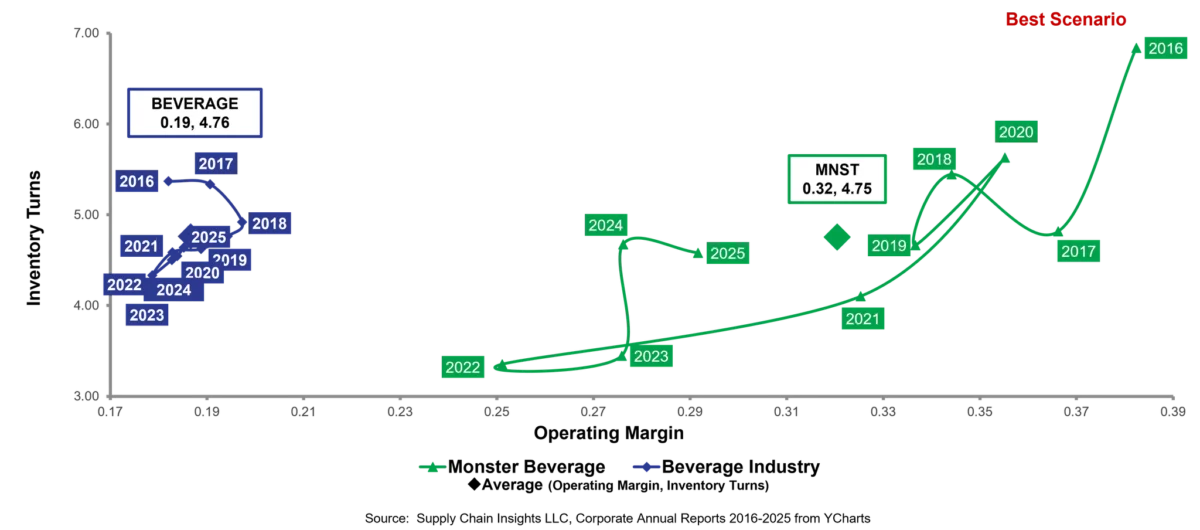
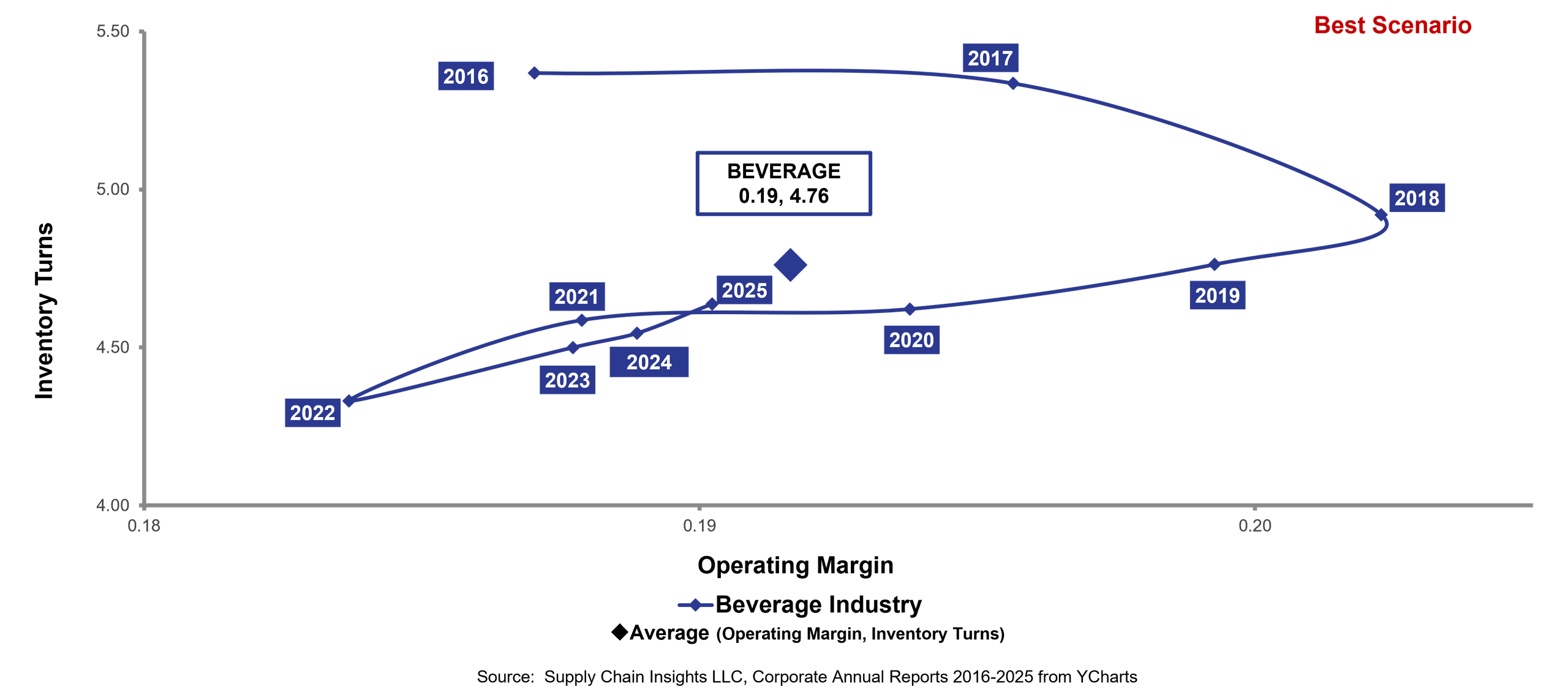
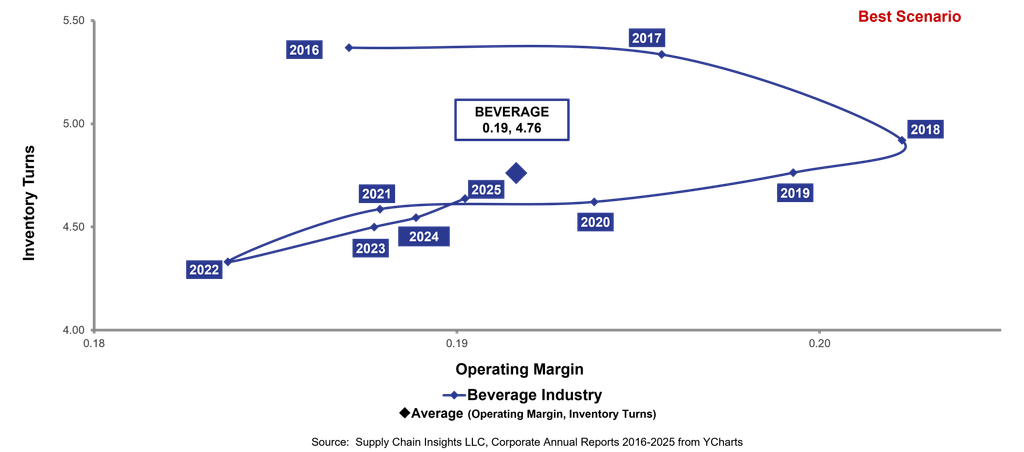
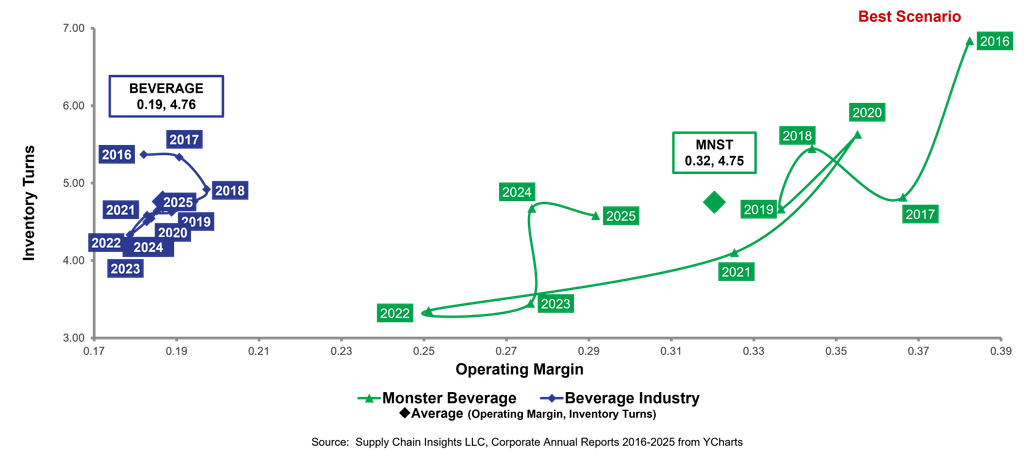
To illustrate the effectiveness of this methodology, consider the performance of Monster Beverage within the beverage industry. Orbit charts—a visual representation of how a company moves through the performance landscape over time—reveal a stark contrast between market leaders and the broader peer group.

In the 2016–2025 analysis, Monster Beverage demonstrates a distinct trajectory compared to its competitors. While many companies in the beverage sector struggle with the trade-off between operating margin and inventory turns, Monster’s data reflects a consistent ability to outperform the sector. These visual tools allow leaders to see their "industry potential," providing a clear, objective look at whether they are gaining ground or merely treading water in a competitive, capital-intensive environment.
Implications: The Role of AI and "Ask Lora"
The integration of artificial intelligence represents the latest chapter in this journey. The Supply Chains to Admire methodology is now embedded into ASKLORA.ai, an interactive, chat-based Large Language Model (LLM) that synchronizes 15 years of industry research.
This tool is not merely a search engine; it is a strategic advisor. It allows users to:
- Benchmark against over 5,000 public companies: Using historical data to build orbit charts that track progress over a decade.
- Perform Maturity Assessments: Evaluating organizational design and technology satisfaction against benchmarks set by winners of the Supply Chains to Admire and Gartner Top 25 awards.
- Generate Strategic Reports: Transforming raw data into actionable, boardroom-ready insights in minutes.
For the modern executive, the implications are clear: the era of "gut-feeling" supply chain management is over. With platforms like ASKLORA.ai, organizations can now pressure-test their strategic plans against elite-level data before they commit capital.
Celebrating Excellence: The 2027 ISCEA Awards
Recognizing the need for a collaborative dialogue, the International Supply Chain Education Alliance (ISCEA) and Supply Chain Insights are hosting an inaugural awards reception on February 9, 2027, in Las Vegas. This event serves as a platform to honor those who have successfully navigated the complexities of their respective industries.
More importantly, it provides a forum for these "winners" to share their secret sauce. When interviewed, many of these leaders are humble, often remarking, "We don’t think that we are winners." Yet, the data tells a different story. The recurring patterns in their performance—agility, balance, and long-term vision—provide a masterclass for any organization seeking to elevate its supply chain operations.
Conclusion: A New Standard for the Future
The Supply Chains to Admire initiative is more than a list of high-performing companies; it is a movement toward accountability. By focusing on measurable, comparable, and actionable data, Lora Cecere has provided the industry with a compass.
As supply chain leaders look toward the challenges of the late 2020s, the ability to discern the difference between "reputation" and "results" will be the defining trait of the successful executive. Whether through the annual benchmarking reports or the newly launched AI-driven maturity models, the focus remains the same: ensuring that supply chain decisions serve the enterprise, the shareholder, and the bottom line with absolute, data-backed precision.
For those interested in exploring these benchmarks or learning how to pressure-test their own performance, the tools are now open and accessible. The question remains: is your organization ready to be measured against the standard of excellence?
For more information on the upcoming ISCEA Awards or to engage with the ASKLORA.ai platform, visit asklora.ai.

 Reynand Wu


 Rifan Muazin

 Asep Darmawan


 Basiran

 Nana Wu

 Nana
