
 Lina Hope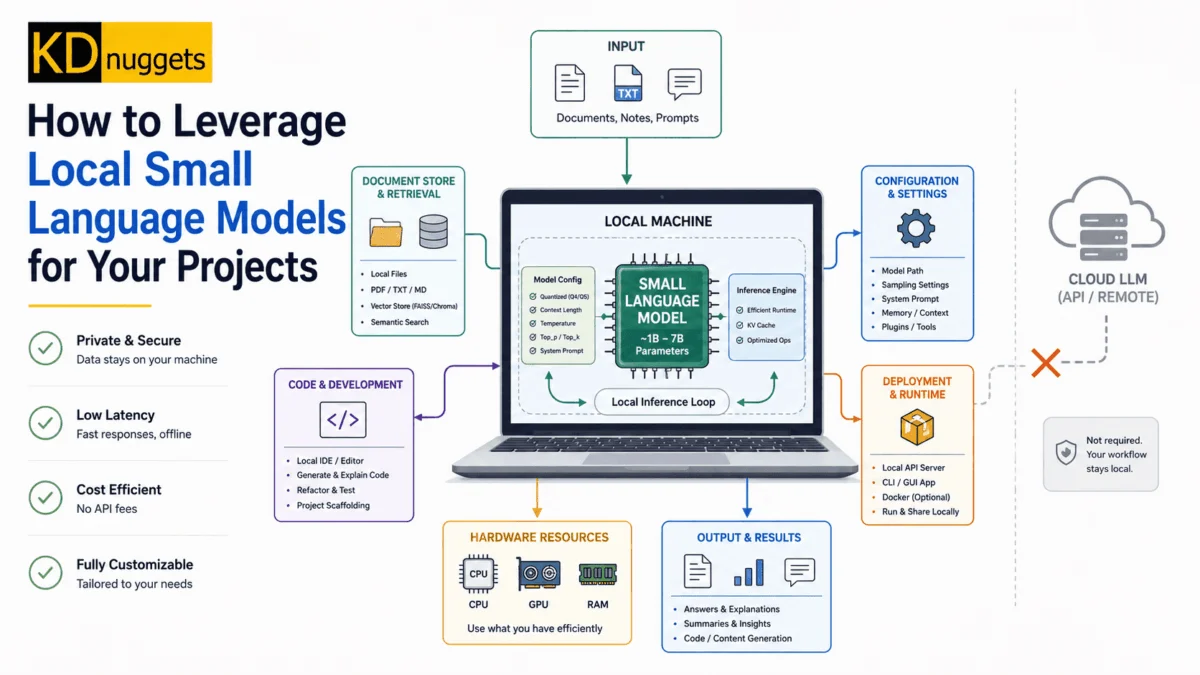
For years, the narrative surrounding Artificial Intelligence was dictated by the "bigger is better" mantra. If you wanted a model capable of nuanced reasoning, code generation, or complex document analysis, you were expected to route your data through gargantuan cloud-based APIs. This approach, while powerful, forced developers into a restrictive trade-off: accepting high latency, recurring usage costs, and, perhaps most critically, the surrender of data privacy to third-party providers.
However, the industry has reached an inflection point. Small Language Models (SLMs)—compact, highly efficient, and increasingly capable systems—are fundamentally shifting the AI landscape. With parameter counts typically ranging from 1 billion to 13 billion, these models are proving that you don’t need a supercomputer to build a sophisticated AI application; often, a modern laptop or a single consumer-grade GPU is enough.
The Shift: Moving from Cloud-Dependent to Local-First
The transition to local SLMs represents a move toward decentralization. In the early days of the GenAI boom, cloud-based Large Language Models (LLMs) were the only viable path for performance. Today, that assumption is being dismantled by a new generation of models like Llama 3, Mistral, Gemma 2, and Qwen 2.5.
Core Advantages of Local Inference
- Privacy and Sovereignty: When an application runs locally, data never exits the user’s environment. For industries governed by strict regulations—such as healthcare, finance, or legal services—this eliminates the liability of transmitting sensitive information to third-party servers.
- Cost Predictability: API-based models operate on a "pay-per-token" model, which can lead to unpredictable scaling costs. Local models, by contrast, carry a fixed hardware investment. Once the infrastructure is in place, the marginal cost of a query is effectively zero.
- Latency and Real-time Interaction: By eliminating network round-trips to remote data centers, local inference provides near-instantaneous response times. This "snappiness" is a critical requirement for interactive applications, such as real-time coding assistants or personal AI companions.
- Offline Capability: Local SLMs operate independently of internet connectivity, making them the only viable choice for edge computing, remote field operations, or mission-critical systems that require 100% uptime regardless of network stability.
Chronology of the SLM Ascent
The evolution of the SLM market has been rapid, driven by advancements in both hardware efficiency and quantization techniques.
- Early 2023: The "Bigger is Better" era dominated, with GPT-4 setting the standard for performance.
- Late 2023: The release of open-weights models like Mistral-7B demonstrated that smaller, optimized models could punch above their weight class, outperforming much larger legacy models.
- Early 2024: Tools like Ollama emerged, lowering the barrier to entry by abstracting away the complexities of GPU acceleration and model management.
- Late 2024 to Present: The market has shifted toward "specialization." We are now seeing models specifically fine-tuned for coding (Qwen-Coder), reasoning, and RAG (Retrieval-Augmented Generation) tasks, allowing developers to pick the right "scalpel" for the job rather than a blunt instrument.
Technical Foundations: The Role of Quantization
A primary driver behind the viability of local SLMs is the advancement in quantization. Because raw models are often too large for consumer hardware, developers use quantization—a technique that reduces the precision of a model’s weights (e.g., from 16-bit to 4-bit)—to shrink the file size.
Using the GGUF (GPT-Generated Unified Format), these models can be compressed significantly with only a negligible loss in accuracy. For most enterprise applications, a 4-bit or 5-bit (Q4/Q5) quantized model provides the optimal "sweet spot," balancing memory efficiency with high-fidelity outputs. This allows a 7-billion-parameter model, which would otherwise require massive VRAM, to run comfortably on a standard laptop with 8GB of RAM.
Strategic Implementation: Architecting with Local SLMs
Transitioning to local models requires a shift in architectural thinking. Rather than relying on a single, monolithic "brain" in the cloud, developers are moving toward modular, agentic workflows.
1. Retrieval-Augmented Generation (RAG)
Local SLMs are particularly effective in RAG pipelines. By coupling a local model with a vector database, developers can ground the model’s responses in private, proprietary documentation. Because the synthesis happens locally, the entire RAG pipeline—from retrieval to generation—stays within the corporate firewall.
2. Specialized Agentic Workflows
The industry is moving toward multi-agent systems where small, specialized models perform specific tasks. For example, one model might be tuned for document extraction, while another handles summarization. Because these models are small, they can be deployed in parallel without overwhelming system resources, creating a modular and scalable AI architecture.
3. The "Local Coding Assistant" Paradigm
Integrating SLMs directly into the Integrated Development Environment (IDE) allows for code completion and debugging without sharing proprietary source code with cloud vendors. This has become the gold standard for enterprises concerned about intellectual property leakage.
Evaluating Performance: Beyond Leaderboards
A common pitfall for organizations is relying solely on generic benchmarks. When choosing an SLM for a project, the "real-world" test is paramount.
Recommended Evaluation Framework:
- Define a Gold Standard: Curate 20 to 50 representative inputs and outputs specific to your domain.
- Manual Rubric Review: Rather than chasing high scores on standardized datasets, have domain experts evaluate the quality of the model’s output.
- Stress Test Failure Modes: Identify where the model fails. In many production environments, a model that performs at 85% accuracy consistently is more valuable than a model that performs at 95% but exhibits unpredictable "hallucinations" in critical edge cases.
- Context Length Testing: Always test the model at your actual expected context window. A model that performs well with a two-sentence prompt may degrade significantly when provided with a 10-page document.
Implications for the Future
The widespread adoption of local SLMs has profound implications for the future of AI.
First, it democratizes AI development. By lowering the barrier to entry, smaller startups and individual developers can compete with large tech incumbents, as the "compute moat" is no longer the sole arbiter of performance.
Second, it forces a change in data ethics. As the "data-hungry" era of AI faces scrutiny, local inference offers a blueprint for "Privacy by Design." By ensuring that data stays local, organizations can mitigate the risks of model inversion attacks and unauthorized data harvesting.
Finally, we are entering the era of AI modularity. As models become smaller, more efficient, and more specialized, the industry will move away from "one-size-fits-all" foundation models. We will instead see a thriving ecosystem of "boutique" models—each tuned for specific workflows, industries, and hardware constraints.
Conclusion: A Pragmatic Path Forward
The move to local SLMs is not merely a cost-saving measure; it is a strategic shift toward reliability, privacy, and sovereignty. For the professional developer, the path forward is clear: start small. Define a narrow, well-scoped task, select a model that fits your hardware constraints, and build your evaluation rubric.
As tooling continues to mature, the gap between cloud performance and local capability will continue to shrink. Those who begin building with local-first architectures today are not just avoiding the pitfalls of API dependency—they are positioning themselves at the forefront of the next, more resilient phase of the AI revolution.
About the Author:
Vinod Chugani is an AI and data science educator specializing in bridging the gap between emerging technology and practical enterprise application. With a background in quantitative finance and a focus on agentic AI, he mentors professionals on building secure, efficient, and scalable AI workflows.

 Neng Nana
 Evan Lee Salim
 Raul Delapena Setiawan
 Reynand Wu
 Sagoh
Sagoh

 Azzam Bilal Chamdy
 Ali Ikhwan