
 Layla Zulfa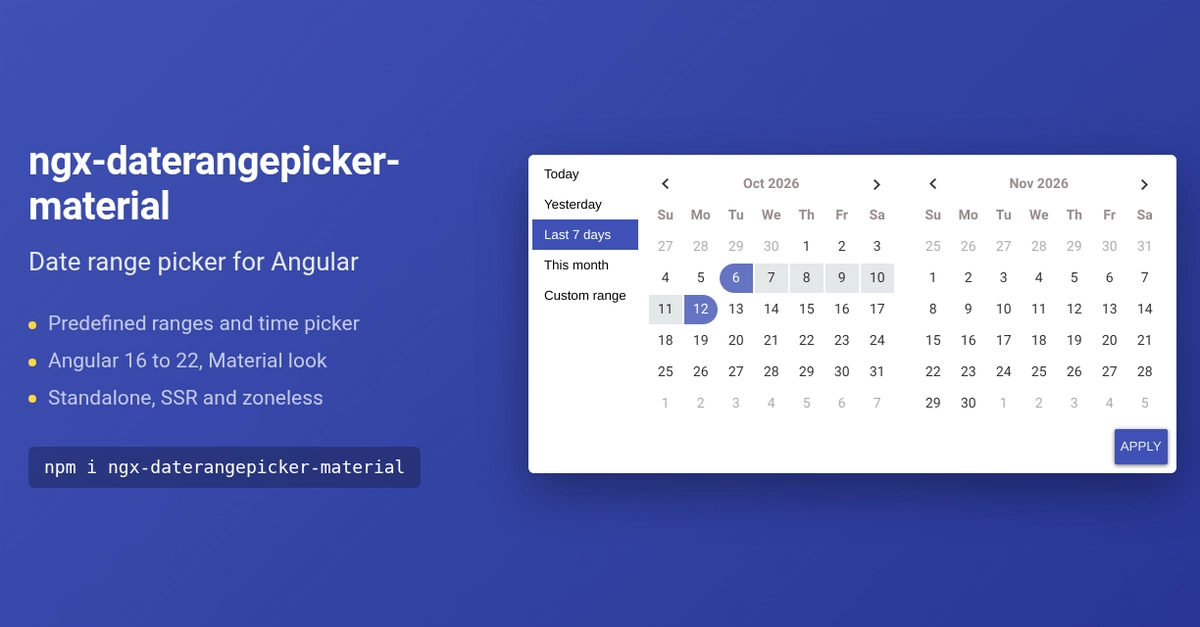
In the fast-paced ecosystem of frontend development, open-source projects often live or die by the momentum of their maintainers. When a project hits a wall, the community usually migrates elsewhere, leaving behind a graveyard of unmaintained dependencies. However, ngx-daterangepicker-material—a staple for thousands of Angular developers—has bucked this trend. After a three-year hiatus that left nearly 200 issues unresolved, the library has undergone a remarkable revitalization. This is the story of how a critical tool for Angular developers was pulled back from the brink, the technical challenges of modernizing legacy code, and what the future holds for this essential UI component.
The Vital Statistics: Why This Matters
For those building enterprise-grade dashboards, financial reporting tools, or complex data-filtering interfaces, a robust date-range picker is non-negotiable. ngx-daterangepicker-material has long been the go-to solution for Angular developers, boasting a consistent 250,000 downloads per month on npm.
The library’s appeal lies in its specific feature set: it offers the aesthetic of Google’s Material Design without forcing a hard dependency on the full @angular/material suite. It provides intuitive "preset" ranges (like "Last 30 Days" or "This Month") and an integrated time picker—features that are often cumbersome to implement from scratch. Given its widespread adoption, the "silent years" between October 2022 and 2026 caused significant friction for teams relying on the component, leading to a mounting backlog of nearly 200 open issues and a growing chorus of developers asking, "Is this project still alive?"
A Chronology of Stagnation and Recovery
The story of the library’s dormancy is not one of dramatic failure or conflict, but rather the quiet, grinding reality of maintainer burnout. As the maintainer candidly shared, the decline began with a simple lack of time. In the world of open source, issues act as a form of "technical debt." When a maintainer falls behind, the list grows, and each unaddressed ticket feels heavier than the last, eventually leading to a paralysis of will.
The situation was exacerbated by "environmental rot." As Angular, Chrome, and the broader web ecosystem evolved, the library’s infrastructure—its CI/CD pipeline, build scripts, and testing suites—began to fail. A project that works perfectly in 2022 can be broken by a simple dependency update or a change in browser behavior by 2024. For a long time, the barrier to fixing these foundational issues felt too high, creating a cycle of postponement.
The turning point came this year when the maintainer shifted focus from feature requests to the "boring" but vital infrastructure. By prioritizing the stability of the build process, the automated testing suite, and the demo deployment, the maintainer lowered the friction required to tackle the backlog. Once the "engine" was running again, the task of answering issues transitioned from an overwhelming burden into a manageable, incremental process.
The Technical Landscape: Why Not Use Alternatives?
A common question faced by developers is why they should bother with a dedicated library when Angular Material itself offers a date range picker. The maintainer’s assessment provides a clear breakdown of the trade-offs:
- Angular Material: Excellent for standard use, but it lacks native support for predefined ranges (requiring custom development) and does not support time selection on ranges.
- Alternative UI Kits (ngx-bootstrap, ng-zorro, PrimeNG): These are powerful and feature-rich, but they come with the "bloat" of an entire design system. If a project is not already using these frameworks, installing them just for a date picker is poor architectural practice.
- The "Specialist" Approach:
ngx-daterangepicker-materialserves a specific niche: providing a high-quality, standalone component that looks like Material Design but doesn’t force a framework lock-in.
This positioning has solidified its role as a "plug-and-play" utility, making its maintenance vital for the health of the broader Angular ecosystem.
Catching Up: The Path to Modernization
The journey from version 6.0.4 to the current iteration was not merely a version bump; it was a rigorous process of alignment with the modern Angular lifecycle. The library now follows a strict versioning convention: version 16 matches Angular 16, 17 matches 17, and so on.
The migration strategy was painstaking. To ensure compatibility, the maintainer performed a manual "sanity check" for every major Angular release. This involved building the library, spinning up a fresh Angular application, installing the package, and verifying core functionality in a real browser. This process uncovered numerous bugs that would have remained hidden in the library’s isolated repository, demonstrating the disconnect that often exists between isolated unit testing and real-world integration.
Furthermore, the latest versions have been optimized for the modern Angular era:
- Standalone Components: Full support for the modern component architecture.
- SSR (Server-Side Rendering): Improved compatibility for SEO-friendly and performant applications.
- Zoneless Support: Embracing the future of high-performance Angular.
Addressing the Backlog: From 200 Issues to Stability
The cleanup of the GitHub repository was a Herculean task. The maintainer revisited issues dating back to 2018, categorizing them into manageable segments. Many of these legacy bugs—ranging from timezone-induced date shifts to display issues with mat-form-field—have now been resolved.
Crucially, the library’s testing infrastructure has been overhauled. Previously, the project had almost no test coverage; it now boasts roughly 140 tests. This shift from manual verification to automated regression testing is the single most important step in preventing the library from falling back into its previous state of disrepair. Today, the backlog sits at a manageable 13 open issues, and the community is once again receiving active support.
Implications for the Community
The return of ngx-daterangepicker-material sends a strong signal to the Angular community about the resilience of open-source maintenance. It proves that even projects that seem abandoned can be revitalized if the maintainer is willing to focus on fundamental engineering.
For developers still running version 6.0.4, the message is clear: upgrade. The maintainer has explicitly stated that older versions are no longer supported. By running npm install ngx-daterangepicker-material@22 (or the version corresponding to your Angular major), users can regain access to modern features and stability. Importantly, the API remains largely familiar, minimizing the migration cost for existing projects.
Looking Ahead: The Roadmap to v23 and Beyond
The future of the library is no longer a question of "if," but "what’s next." The roadmap for version 23 is already taking shape, focusing on the cutting edge of Angular development:
provideDaterangepicker(): Streamlining configuration for standalone applications.- Signal Inputs: Moving toward reactive, signal-based data flow.
- Angular CDK Overlay: A critical update that will solve the long-standing issue of calendars being clipped by container boundaries (like
mat-form-field). - Keyboard Accessibility: Ensuring the component meets modern standards for WCAG compliance.
A Lesson in Open Source Sustainability
The most profound takeaway from this resurgence is a philosophical one. The maintainer notes that they initially thought the project required a massive, top-down rewrite to be "saved." They were wrong. What it actually required was the discipline of steady, incremental progress.
Open-source users are remarkably patient and forgiving, provided there is a visible, consistent heartbeat from the maintainer. By shipping small, frequent updates and engaging with the community, the project has regained its status as a reliable piece of the Angular puzzle. The revitalization of ngx-daterangepicker-material serves as a reminder that the health of our digital infrastructure depends not just on code, but on the human capacity to show up, one issue at a time. For those using this tool in their daily work, the call to action is simple: upgrade, report bugs, and continue to support the maintainers who keep these essential building blocks alive.


 Reynand Wu
 Jia Lissa
 Basiran
 Neng Nana
 Nana Muazin

 Laily UPN
 Asep Darmawan