
 Nana Wu
The integration of artificial intelligence into our daily lives has reached a pivotal juncture. As we transition from screen-based interaction to ambient computing, the form factor of the future is increasingly looking like a pair of standard glasses. By leveraging wearable technology, AI can see what we see and hear what we hear, providing a level of context that a smartphone simply cannot match. However, this level of intimacy introduces a profound architectural challenge: how to build an AI capable of understanding the nuances of a human life without compromising the sanctity of personal privacy.
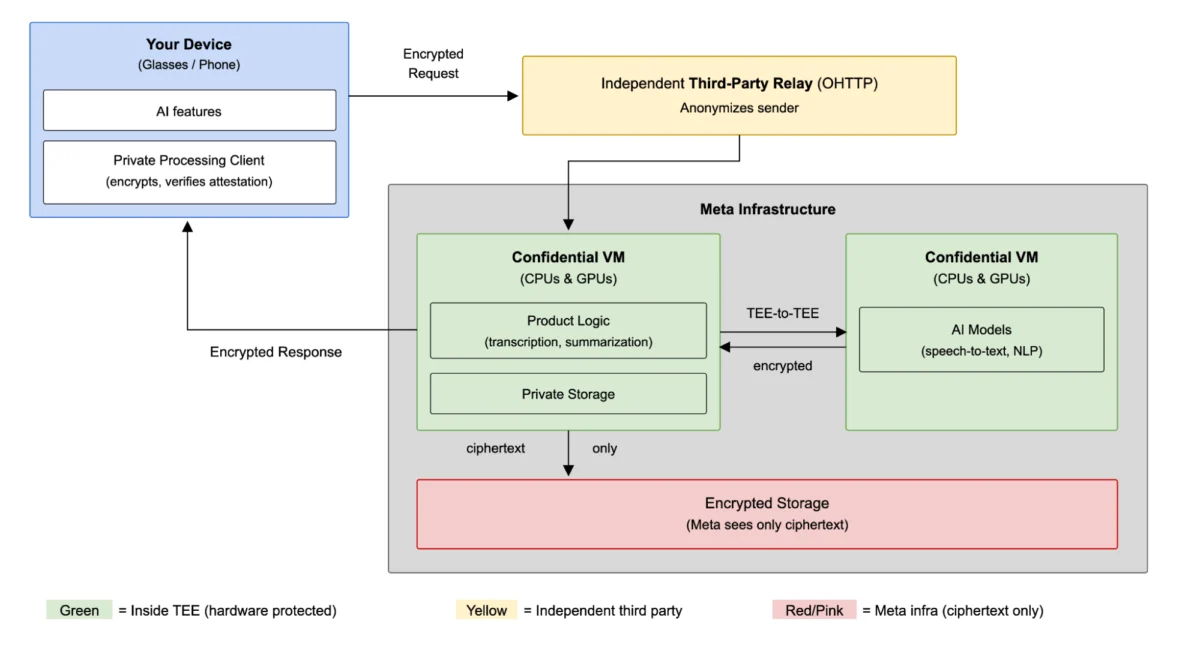
Meta’s answer to this challenge is "Private Processing"—a confidential computing infrastructure designed to extend the trust boundary of AI glasses directly into the cloud. By executing AI models within hardware-encrypted virtual machines, Meta aims to create a future where AI assistants are hyper-personalized and proactive, yet remain entirely inaccessible to the company that provides the underlying technology.
Main Facts: The Architecture of Confidentiality
At its core, Private Processing represents a shift in how cloud computing handles sensitive data. Historically, cloud providers have protected data "at rest" (on disk) and "in transit" (over the network). The "in use" state—where data must be decrypted in memory to be processed by a CPU or GPU—has remained a persistent vulnerability. In standard cloud environments, this memory is technically accessible to the host operating system, the hypervisor, and the infrastructure administrators.
Private Processing closes this gap through the use of Trusted Execution Environments (TEEs). A TEE is a hardware-based security primitive that encrypts the memory of a special virtual machine, known as a Confidential Virtual Machine (CVM). The encryption keys for these environments are held by dedicated security hardware within the chip itself and are never exposed to the host system or the cloud operator. Consequently, even Meta’s own engineers cannot "see" the data as it is being processed by the AI.
To ensure this is not merely a theoretical security measure, the system utilizes "Remote Attestation." Before a pair of AI glasses sends any data to the cloud, it demands a hardware-signed report from the server. This report verifies that the code running inside the TEE is identical to a version that has been publicly audited and registered on an independent, append-only transparency ledger. If the software has been tampered with or does not match the public record, the connection is severed immediately.
Chronology: From WhatsApp to Wearables
The path to Private Processing for AI glasses did not begin with hardware, but with a need to secure messaging.
- April 2025: Meta introduced "Private Processing for WhatsApp" and the Meta AI app. This marked the first large-scale deployment of confidential computing for user-facing AI, allowing individuals to engage in complex, AI-driven chats while ensuring that the data remained encrypted from end-to-end—even within the server environment.
- July 2025: During his presentation on "Personal Superintelligence," Mark Zuckerberg signaled a shift in the company’s strategic focus. He posited that personal devices like glasses, which interact with our real-world context throughout the day, would become our primary computing devices.
- September 2026: Building on the learnings from the WhatsApp deployment, Meta expanded the Private Processing infrastructure to support its wearable AI glasses. This expansion required solving significantly more complex challenges, including the need for "stateful" memory—the ability for the AI to "remember" context over weeks and months without exposing that memory to external eyes.
Supporting Data: Engineering a Trust Boundary
To support the demands of a wearable AI that can summarize meetings, translate languages in real-time, and provide proactive reminders, Meta’s engineering team established five core requirements for their cloud runtime:
- Non-Targetability: By using blind-signed tokens and third-party OHTTP relays, the system decouples the user’s identity from the request. When a request hits the cloud, it is routed to a TEE node based on anonymous heuristics, ensuring that no single operator can correlate a specific piece of data with a specific user profile.
- Verifiable Attestation: The system relies on hardware-enforced remote attestation. If the TEE’s binary hashes do not align with the public transparency ledger, the device refuses to transmit information.
- Isolated Execution: AI models are contained within the TEE. If a model needs to communicate with another, both must attest to each other via strict RA-TLS (Remote Attestation over Transport Layer Security) protocols.
- Encrypted Storage: Recognizing that stateful AI requires persistent memory, Meta built a storage engine directly inside the TEE. Data stored in the cloud is encrypted with user-provided keys, ensuring that even if the storage layer were compromised, the data would remain ciphertext.
- Operational Observability without Visibility: Because the system is cryptographically locked to prevent operator access, Meta had to reinvent how to monitor service health. Engineers now rely on "aggregate health signals"—such as CPU utilization and latency—rather than inspecting logs or data packets.
Official Responses and Transparency Efforts
The efficacy of these security claims rests on the ability of third parties to verify them. Meta has adopted a policy of "Verifiable Transparency," acknowledging that in an adversarial environment, trust should not be granted based on reputation.
"Security claims are meaningless if they depend on trusting the provider," the company noted in its technical documentation. To back this up, Meta is providing researchers with the tools, CVM binaries, and documentation necessary to audit their implementation. They have also expanded their bug bounty program to include Private Processing on AI glasses, inviting the global security research community to probe the limits of their isolation model.
By partnering with external security firms like NCC Group, Meta seeks to ensure that the "adversarial" design of their data centers—where the infrastructure itself is treated as a potential threat—is sound. This approach moves the security boundary inward, effectively placing the hypervisor and the system administrator outside the trust circle.
Implications: The Future of Agentic AI
The implications of this technology extend far beyond simple note-taking or translation. We are moving toward an "agentic" future, where AI assistants will have the capacity to take actions on our behalf, manage schedules, and navigate complex, multi-day tasks.
As AI on glasses becomes more multimodal—understanding sights, sounds, and physical interactions—the need for robust privacy protections will only increase. The challenge of maintaining a stateful, personalized AI while simultaneously preventing data leakage is perhaps the most significant engineering hurdle of the decade.
By anchoring this functionality in Private Processing, Meta is attempting to solve the "personalization-privacy paradox." If they succeed, the result could be a fundamental shift in how we view the cloud. Rather than a repository of our most intimate data, the cloud may evolve into a "blind" engine—a powerful, invisible force that provides us with superpowers while remaining fundamentally incapable of seeing who we are or what we are doing.
However, the burden of proof remains high. As these devices begin to capture our lives in high definition, the scrutiny on Meta’s transparency ledgers, TEE attestation, and the integrity of their third-party audits will only intensify. For the "agentic future" to be accepted by the public, the technology must not only be secure; it must be demonstrably, verifiably, and permanently private. Whether this "confidential computing" model becomes the industry standard or remains a niche solution for wearables will depend on the continued rigor of these security measures in the face of an evolving threat landscape.


 Jia Lissa

 Nila Kartika Wati

 Raul Delapena Setiawan

 Reynand Wu

 Sagoh


 Azzam Bilal Chamdy

 Ali Ikhwan
