
 Nana
Nana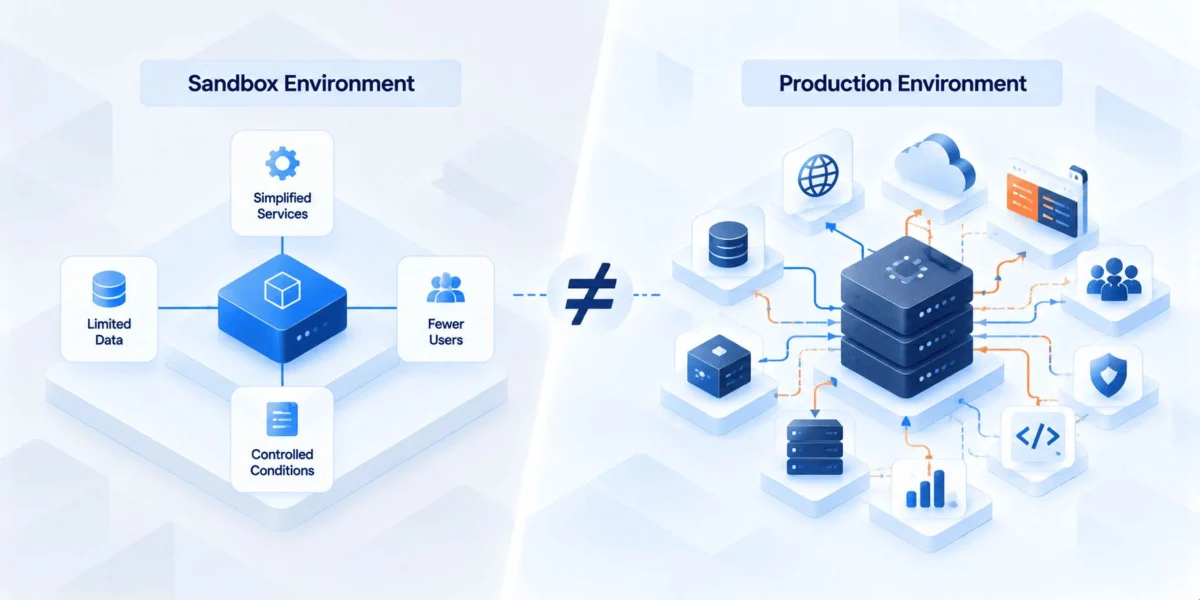
For decades, the engineering "holy grail" has been the perfect environment. Developers and DevOps teams have poured countless man-hours, cloud credits, and architectural resources into the pursuit of an elusive goal: the exact replica of production. We call it the "sandbox," the "staging environment," or the "pre-prod cluster." Yet, despite the sophisticated tooling at our disposal, the sandbox remains fundamentally disconnected from the reality of production.
The gap is not a temporary oversight; it is a structural reality. It is an inherent friction point that comes with the territory of distributed systems. When organizations accept that this gap is inevitable, they can finally shift their focus from the futile pursuit of total infrastructure parity to the high-value work of behavioral contract maintenance.
Main Facts: The Structural Nature of Drift
The sandbox has never matched production. It is a configuration variable set differently; it is a database seed that ignores the legacy record formats real users actually interact with; it is an upstream service that deployed a breaking schema change last Thursday without a corresponding update to the simulation. These are not edge cases—they are systemic constants that manifest across every team, at every scale.
The primary driver of this disparity is the asynchronous nature of change. Production evolves at a frenetic pace, driven by CI/CD pipelines, hotfixes, database migrations, and third-party API updates. Conversely, the sandbox environment is often a static, manually curated island. Drift accumulates because production and the sandbox exist on different schedules and are governed by different triggers. Unless an organization deliberately synchronizes these environments, drift is the default, mathematical outcome.
Chronology: The Lifecycle of a "Stale" Sandbox
To understand why sandboxes fail, one must look at the lifecycle of a typical service integration:
- The Inception Phase: At the moment of creation, the sandbox is perfectly accurate. Developers have meticulously studied the upstream service, mapped the request-response cycles, and built simulations that reflect the current state of the world. The tests pass, and the team feels confident.
- The Drift Phase: As time passes, the upstream service continues to evolve. A developer adds a new required field to a JSON schema; an API endpoint is restructured; an error code is retired. Crucially, the downstream team—the one relying on the sandbox—is never notified.
- The Silent Failure: The simulation continues to run against the outdated schema. Because the tests are "green," they are deemed trustworthy. The team proceeds to deploy, confident that their integration is sound.
- The Production Collision: The code reaches production. It encounters the actual upstream service, which returns the new, unexpected format. The application crashes or produces corrupted data.
- The Post-Mortem: The team discovers that the test suite was not just failing to catch the bug—it was actively providing a false sense of security. The suite was not "flaky"; it was "systematically wrong."
Supporting Data: Infrastructure vs. Behavioral Contracts
Not all drift is created equal. A significant portion of the time and money spent on sandboxes is wasted on "infrastructure parity"—ensuring that the sandbox uses the same instance types, networking rules, and replica counts as production. While satisfying to track on a dashboard, this type of parity is largely irrelevant to integration testing.
Whether a test runs on a t3.medium or a high-performance production instance does not fundamentally change whether the application correctly handles a payment gateway response. The logic remains the same.
The category that actually breaks systems is Behavioral Contract Drift. When the simulation of an upstream service contradicts the reality of the live endpoint, the test becomes a liability. The challenge is that while infrastructure parity is measurable (via diffing configuration files), behavioral contract accuracy is invisible. It requires ongoing, real-time knowledge of what the upstream service actually produces today, rather than what the documentation claims it produces.
Official Perspectives: The Trigger Determines Success
Industry leaders in DevOps are shifting their perspective on maintenance. The most successful teams do not necessarily build the most complex simulations; they build the most responsive ones. The differentiator is the trigger.
- The "Test-Failure" Trigger (The Lagging Approach): Teams that update simulations only when tests fail are perpetually behind. In this model, the sandbox is guaranteed to be wrong from the moment an upstream service deploys until the next breaking change surfaces in production. The drift window here is measured in weeks or months.
- The "Deployment-Event" Trigger (The Leading Approach): Elite teams connect simulation updates directly to upstream deployment events. When an upstream service pushes a change, the sandbox simulation is updated concurrently. This shrinks the drift window from weeks to hours.
The Role of Observability
Modern tooling has begun to solve this by automating the capture of "reality." Rather than relying on developers to manually author simulations based on documentation—which is notoriously prone to becoming outdated—teams are turning to observation-based approaches.
Tools like Keploy, which captures real HTTP traffic at the kernel level via eBPF, allow simulations to be generated from live interactions. Because these simulations are derived from actual traffic, they start from a baseline of truth. When a diff between the old simulation and the new one appears, it provides developers with an immediate, actionable view of exactly which fields changed, allowing them to adjust their code long before a production deployment.
Implications: Reframing the Sandbox Strategy
The goal of a sandbox should not be to achieve perfect production parity. Such a goal is a financial and operational trap. Instead, the goal should be targeted accuracy for specific behavioral contracts.
1. Define the Boundary
Organizations must be explicit about what the sandbox covers. It does not need to replicate production’s data volume, traffic patterns, or hardware scale. It needs to replicate the logic of the interactions: request/response structures, error conditions, and state transitions.
2. Move from "Setup" to "Maintenance"
Design questions are answered at setup, but maintenance questions are answered throughout the service’s lifetime. The teams that get "burned" by production failures are rarely those with bad designs; they are those with static sandboxes. If the sandbox is not evolving at the same cadence as the upstream services it simulates, it is a liability.
3. Acceptance of the "Boundary of Knowledge"
We must view the gap between sandbox and production as a boundary to be understood, not a problem to be solved. The sandbox provides a high-fidelity environment for testing core integration logic. Production provides the "emergent behavior"—the load, the weird user data, the edge-case race conditions that no simulation can perfectly capture.
By offloading the "easy" integration failures (the ones caused by simple contract mismatches) to the sandbox, teams can reserve their most expensive testing resources for the emergent behaviors that only production can reveal.
Conclusion: The Path Forward
Environment drift is not the enemy. The true enemy is undetected drift in the behavioral contracts that define our systems. When we stop obsessing over identical hardware configurations and start focusing on the freshness of our behavioral contracts, we build more resilient software.
The sandbox will never be production. But by synchronizing our simulations with upstream deployments and leveraging observability-driven data, we can ensure that our sandbox tells us the truth about our code. In a distributed, rapidly evolving ecosystem, that truth—even if limited in scope—is the only foundation upon which reliable software can be built.

 Nana Muazin

 Ali Ikhwan
 Raul Delapena Setiawan

 Muslim
 Asep Darmawan
 Neng Nana