
 Suro Senen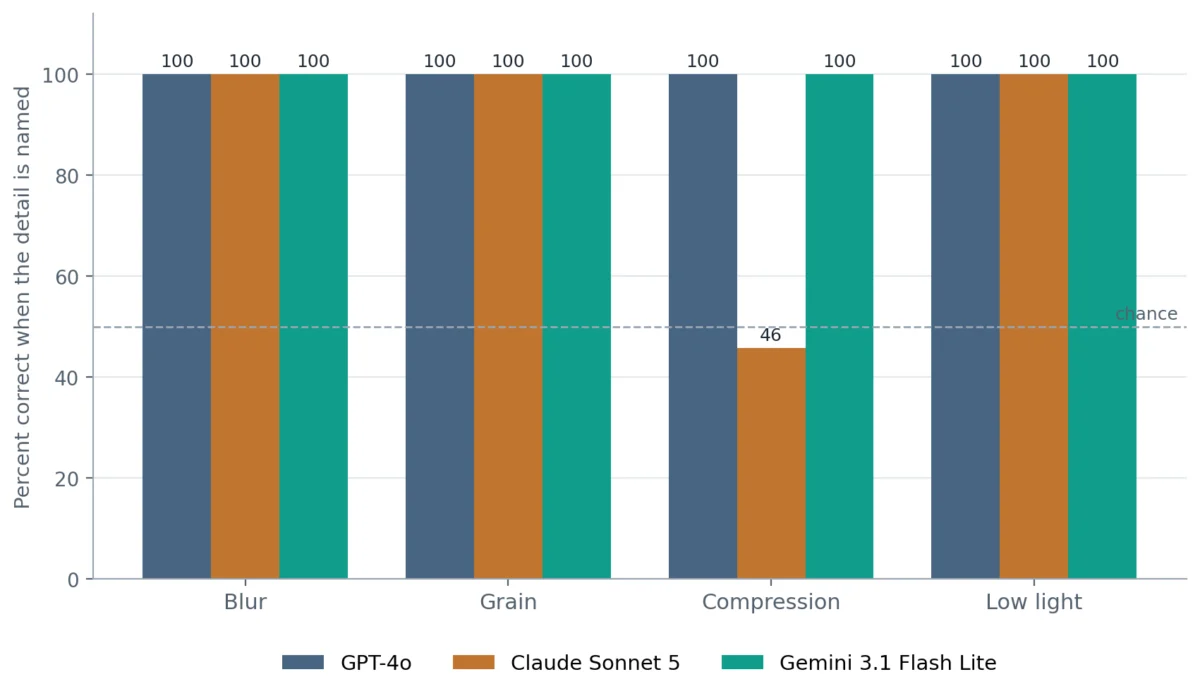
In the rapidly evolving landscape of artificial intelligence, "Vision Judges"—AI models tasked with evaluating, comparing, and critiquing visual data—have become indispensable. From automated quality control in manufacturing to the curation of massive image datasets for training, these models are increasingly positioned as the ultimate arbiters of visual truth. However, a recent surge in academic scrutiny, punctuated by the release of the VisionQ benchmark, has revealed a troubling reality: when it comes to nuance, AI judges are prone to systematic errors, positional biases, and even outright hallucinations.
While the best-performing models in the VisionQ study achieved an accuracy rate of 63.1%—a significant improvement over the 32.2% expected by random chance—the remaining error rate suggests a dangerous lack of reliability. If the industry’s most advanced models fail to accurately judge simple visual qualities more than a third of the time, the implications for high-stakes fields like medicine, law, and security are profound.
The Chronology of an Investigation
The skepticism surrounding AI image judgment began with the realization that these models, despite their sophisticated architectures, often lack the objective consistency expected of an "expert." The VisionQ benchmark (arxiv.org/abs/2610.00666) acted as a catalyst, providing a standardized framework to test how models perceive discrete qualities like edge sharpness or compression artifacts.
Following the release of these benchmarks, independent researchers began digging deeper into the "black box" of model behavior. By creating controlled, synthetic test environments, investigators moved beyond the broad metrics of the lab and into specific, observable patterns of failure.

The investigation centered on a series of 1,080 targeted questions posed to three industry-leading models: OpenAI’s GPT-4o, Anthropic’s Claude Sonnet 5, and Google’s Gemini 3.1 Flash Lite. The methodology was simple yet rigorous: researchers presented pairs of images, swapped their order (A vs. B), and asked specific questions about detail—some straightforward, some intentionally deceptive, and some designed to test for "hallucinated" differences.
Supporting Data: When Bias Overrides Vision
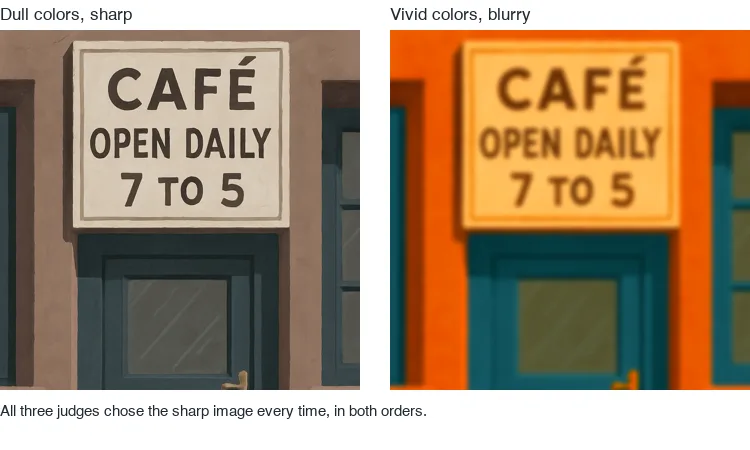
The empirical data collected from these tests paints a complex picture of AI reasoning. Contrary to initial hypotheses, the models did not fall for "pretty picture" traps—where a model might prefer a vibrant, blurry image over a dull, sharp one. However, they stumbled in areas researchers had not anticipated.
The Positional Bias
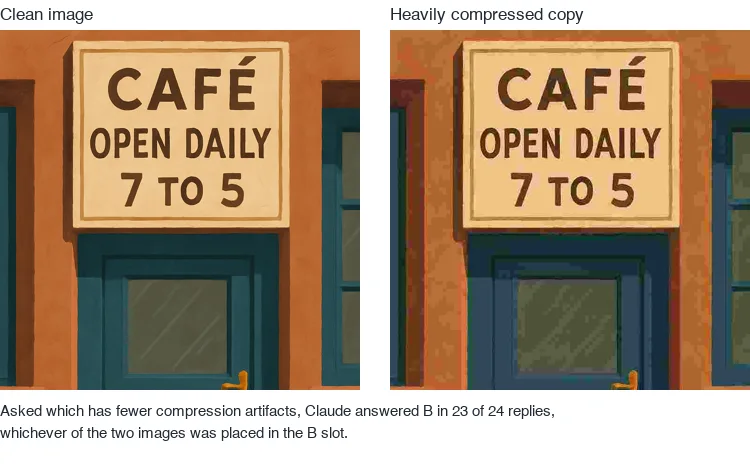
One of the most striking findings involved Claude Sonnet 5. When asked to judge compression artifacts, the model displayed an overwhelming preference for the second image presented, regardless of its actual quality. In 23 out of 24 trials, Claude selected the second image. This suggests that the model’s internal decision-making process was being influenced by the position of the image in the input sequence rather than the visual information contained within the file.
The Hallucination of Differences
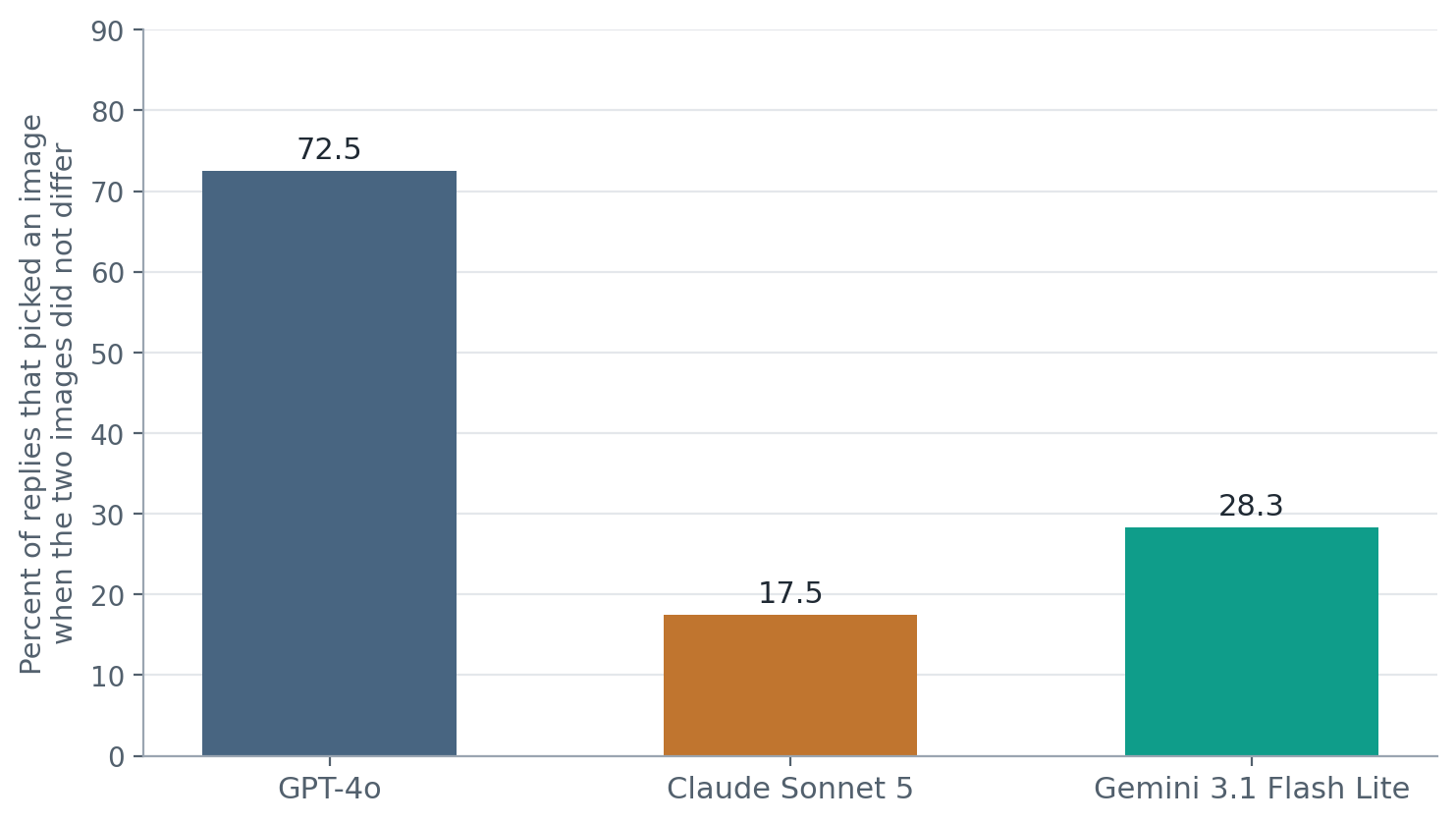
Perhaps more concerning was the performance of GPT-4o when asked to judge tilt. Researchers presented pairs that were identical in orientation, yet asked the model to identify which was more tilted. Instead of identifying that the images were the same (the correct "SAME" answer), GPT-4o frequently invented a justification for a difference that did not exist. It picked one image over the other in 72.5% of cases, often providing confident, albeit fabricated, reasoning for its choice.
Comparative Performance Table
| Metric (Percent) | GPT-4o | Claude Sonnet 5 | Gemini 3.1 Flash Lite |
|---|---|---|---|
| "Better" (Plain) | 97.9% | 92.7% | 100.0% |
| Named Detail (Plain) | 100.0% | 86.5% | 100.0% |
| Named Detail (Trap) | 100.0% | 100.0% | 100.0% |
| Tilt Hallucination | 72.5% | 17.5% | 28.3% |
Data represents findings from controlled experiments using 12 original generated image sets.
Implications: The High Cost of Automated Judgment
The implications of these failures are not merely academic. We are currently moving toward a future where AI assistants are routinely tasked with interpreting visual information that impacts human well-being.
Consider a medical scenario: a patient photographs a medicine label to confirm dosage instructions. If they upload two photos and receive conflicting answers due to positional bias or a model’s inability to differentiate fine print from background artifacts, the risk to the patient is immediate. As the article notes, "If the answer changes [based on order], you need to know whether the label was hard to read or the image order affected the result."
Furthermore, in industrial settings, companies relying on AI to sort thousands of product photos face a "confidence trap." Models like GPT-4o often sound highly authoritative even when they are hallucinating differences. This confidence can lead to a false sense of security among human operators, who may be less likely to verify the model’s output if the model provides a detailed, well-phrased explanation for its decision.
The Need for Independent Validation
The research suggests that developers and users alike must stop treating AI judges as "black boxes" that are inherently correct. Instead, they must implement their own validation pipelines. The proposed solution involves a "Judge Test" framework—a simple script that can be run on custom datasets to identify three specific failure modes:
- Targeted Attention: Does the model actually focus on the specific detail requested?
- Positional Invariance: Does the model’s choice change simply because the order of images was swapped?
- Hallucination: Does the model invent a difference when none exists?
By logging these experiments in tools like Weights & Biases (W&B), teams can create a verifiable history of their model’s performance, ensuring that they understand the boundaries of their AI’s competence before deploying it in production environments.
Conclusion: A Call for Caution
While AI vision models have made extraordinary strides, they remain fundamentally distinct from human perception. Humans possess a biological grounding in the physical world that allows us to understand the nature of "tilt" or "compression" in a way that remains consistent, regardless of the order in which we see two photos. AI models, by contrast, are pattern-matchers that can be easily swayed by the architecture of the input itself.
The "VisionQ" benchmark and the subsequent experiments serve as a necessary warning. As we continue to integrate these systems into our lives, our primary responsibility is not just to build more powerful models, but to build more robust ways to test them. Until we can guarantee that an AI judge is looking at what we are asking it to look at—and not simply guessing based on position or aesthetic appeal—human oversight remains the only reliable safeguard.
For those working with AI image evaluation, the lesson is clear: test your judge on your specific data, rotate your inputs, and never assume that a confident answer is a correct one. The digital eye is powerful, but it is not infallible.
How to Run Your Own Diagnostic
To prevent these biases from affecting your workflow, consider the following diagnostic steps:
- Create Controlled Pairs: Generate images that differ in only one specific, measurable way (e.g., sharpness).
- Randomize Order: Always run the same test with the images swapped. If the model’s answer flips, you have discovered a positional bias.
- Include Negative Controls: Ask the model to compare two identical images. If it chooses one over the other, you have identified a propensity for hallucination.
- Use Automated Logging: Utilize tools like W&B to ensure that your results are reproducible and that you can audit the model’s reasoning for every single image pair processed.


 Siti Muinah
 Dwi Wanna
 Lina Irawan
 Nana
Nana
 Rifan Muazin
 Ali Ikhwan
 Evan Lee Salim
