
 Lina Hope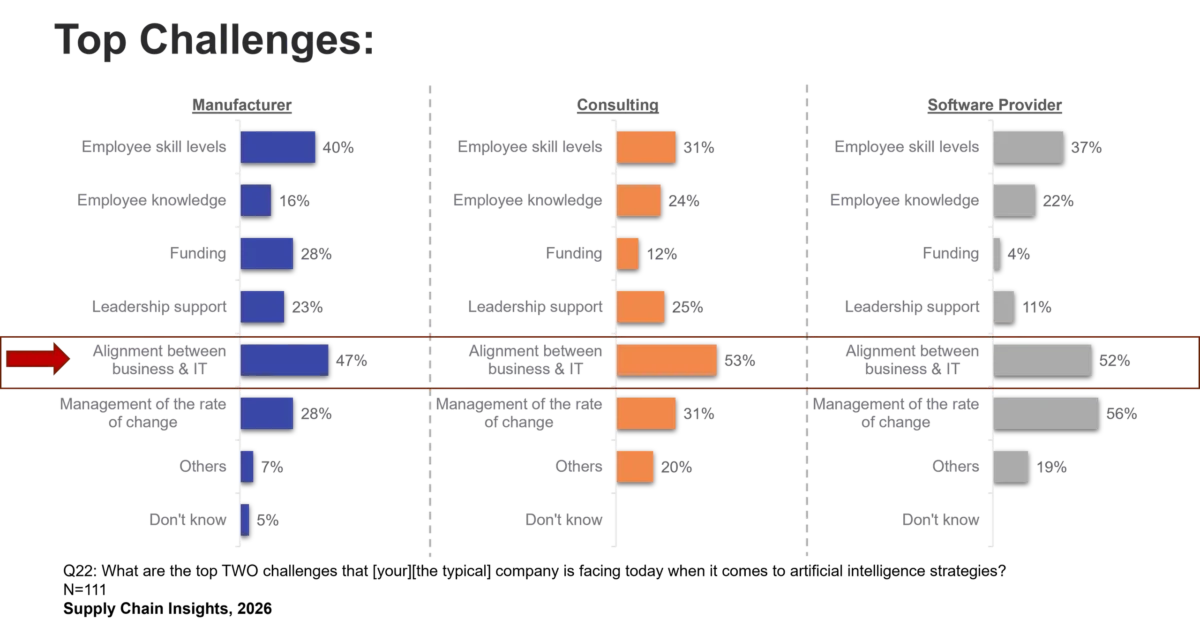
In the rapidly evolving landscape of global logistics, the promise of Artificial Intelligence and advanced analytics has created a "technological gold rush." Yet, beneath the veneer of sophisticated algorithms and predictive modeling, a fundamental structural crisis is brewing. Supply chain planning, once defined by the delicate balance of operational rigor and human intuition, is increasingly being cannibalized by "tech-first" mentalities that prioritize feature sets over functional reality.
As we navigate an era of unprecedented volatility, the gap between the tools we deploy and the processes we actually execute is widening. For many organizations, the result is not efficiency, but a complex, high-tech version of the same failures that have plagued supply chains for decades.
The Technological Mirage: Why Strategy is Taking a Backseat
The modern supply chain boardroom is often dominated by a fascination with "AI-cool" features. This phenomenon has created a dangerous inversion: technology is now the primary driver of strategy, while process design is relegated to an afterthought.
The IT-Business Divide
The discord between Information Technology (IT) departments and business units has never been more pronounced. IT teams, often hamstrung by ballooning maintenance costs for legacy architectures and the mounting pressures of cybersecurity, struggle to reconcile the demands of business leaders who lobby for the latest shiny software solutions.
Caught in the middle are data science teams, frequently pushing for custom, "home-grown" solutions in languages like Python, often failing to articulate the underlying business problem they are attempting to solve. This "jelly on bread" positioning results in a landscape where software is chosen for its buzzword compliance rather than its architectural compatibility.
Case Studies in Disconnection
The disconnect is best illustrated through real-world scenarios. Consider a large multinational manufacturer attempting to integrate over 100 disparate ERP systems—a common legacy of aggressive M&A activity. The internal IT team, exhausted by the day-to-day upkeep of antiquated systems like Oracle Demantra, finds itself forced to implement top-tier solutions like Kinaxis. Without the foundational "backcasting" tests required to ensure the software fits the existing IT architecture, these multi-million dollar implementations often require massive, costly augmentations, ultimately yielding diminished returns.
Similarly, we see organizations attempting to build bespoke applications on top of existing platforms like OMP. Driven by an obsession with custom code, these teams often prioritize simple error reduction over true predictive accuracy, ignoring the long-term systemic risks of maintaining a custom-built, "Frankenstein" IT stack.
Rethinking Risk: The Silent Bullwhip Effect
While risk management has become a staple of industry conferences, it remains largely performative. Discussions often center on macroeconomic trends, yet they conveniently ignore the most immediate source of supply chain instability: the quality of data inputs.
The Missing Measurement
We continue to play the "Beer Game" in training modules to illustrate the dangers of the bullwhip effect—the amplification of demand variability up the supply chain. Yet, in the real-world operational environment, the bullwhip effect is rarely measured.

The industry is plagued by "inside-out" processes that rely on enterprise data while ignoring external market signals. Negative Forecast Value Added (FVA) and static "set-it-and-forget-it" lead time policies are the primary engines of modern volatility. True risk management must start by redefining our relationship with data. It requires moving toward high-frequency updates, challenging the validity of the plan at every node, and actively measuring how our own internal policies contribute to the amplification of demand distortion.
Decoding the Planning Paradox: Forecasts vs. Plans
A common source of executive frustration is the conflation of a "forecast" with a "plan." This is a category error that leads to systemic failure.
Accuracy vs. Precision
Most planning departments are caught in a cycle of chasing perfection, celebrating a 2% improvement in Mean Absolute Percentage Error (MAPE). This focus is not only shortsighted; it is arguably detrimental.
Astute supply chain leaders distinguish between accuracy and precision:
- Accuracy: How close the forecast is to actual demand.
- Precision: The consistency and repeatability of the forecast outcomes.
A forecast can be highly precise—providing a tight range of numbers—yet remain fundamentally inaccurate. Conversely, a plan that is "accurate on average" may be highly volatile, increasing risk. Mature organizations shift the focus away from traditional metrics like MAPE toward more holistic measures such as the TPE (Total Planning Error), acknowledging that a demand forecast is merely an input—an educated hypothesis—rather than an immutable plan of action.
The Infrastructure Crisis: Master Data and Systems of Record
The average enterprise currently operates between seven and nine distinct planning systems. While this may sound like a robust "best-of-breed" strategy, it is often a recipe for disaster.
The Need for Synchronization
Each of these systems carries its own set of assumptions—lead times, run rates, and conversion cycles—that are rarely synchronized across the enterprise. To achieve true end-to-end visibility, companies must invest in a centralized Planning Master Data layer.
Equally critical is the existence of a "system of record" for the plan itself. It is a recurring shock to find that many organizations do not store their previous plans. Without a historical repository of what was planned versus what actually occurred, there is no foundation for the kind of Root Cause Analysis (RCA) that drives institutional learning.
The Future of Improvement: After-Action Reviews
The final hurdle in modernizing supply chain planning is the lack of a structured "post-mortem" culture. While technologies like Continuous Directed Acyclic Graph (DAG) learning and context graphs are promising, they are useless without a commitment to understanding why a plan succeeded or failed.

Companies must transition toward "after-action review" capabilities. This means systematically analyzing the previous period’s plan to determine:
- What would have improved the outcome?
- What value was lost due to poor assumptions?
- How can the system be tuned to prevent a repeat of the error?
Platforms that facilitate this type of post-event evaluation represent the next frontier of competitive advantage.
Implications for Leadership
The current "AI-first" trend is not a panacea; it is an accelerant. If applied to broken, un-synchronized processes, it will simply accelerate the production of bad outcomes.
Redefining the Work
The challenge for leadership is not merely selecting the right vendor from a Gartner Magic Quadrant. The challenge is the willingness to "roll up sleeves" and redefine the underlying work. Historic practices are being mistaken for best practices, creating a dangerous inertia that prevents companies from adapting to a volatile world.
A Call to Rationality
As we look toward the remainder of the decade, the winners will be those who balance technological enthusiasm with operational pragmatism. This requires:
- Testing business scenarios before signing software contracts.
- Prioritizing data integrity over algorithm complexity.
- Abandoning the obsession with "perfect" forecasts in favor of "resilient" plans.
- Mandating accountability by measuring the bullwhip impact of internal policies.
Innovation is not found in the software license alone; it is found in the rigorous, often difficult, process of cleaning up master data, aligning cross-functional teams, and building a culture that views every supply chain plan as a learning opportunity rather than a final verdict.
In conclusion, the tools at our disposal have never been more powerful, but they are only as effective as the logic that guides them. It is time to move past the "AI-cool" hype and return to the fundamentals of process engineering. The supply chain of the future will not be built by the companies with the most features, but by those with the most discipline.


 Pevita Pearce
 Raul Delapena Setiawan
 Ali Ikhwan

 Nana
Nana
 Muslim
 Asep Darmawan
 Neng Nana