
 Laily UPN
As the geopolitical landscape shifts and the Strait of Hormuz becomes a flashpoint of global instability, the United Kingdom has found itself in a precarious position. Yet, amidst the volatility of international energy markets, a quiet revolution in the nation’s power grid has provided a vital buffer. New analysis from Carbon Brief reveals that record-breaking generation from wind and solar power has saved the UK from the need for £5.9bn worth of gas imports since the outbreak of the Hormuz crisis in February 2026.
This milestone marks a significant turning point in the UK’s transition toward energy independence. While the nation remains vulnerable to global fossil-fuel price spikes, the expansion of renewables is fundamentally altering the domestic energy narrative, providing a shield against the most severe economic shocks of the current conflict.
The Anatomy of the Crisis: A Chronology of Volatility
The current energy squeeze began in early 2026, following the outbreak of hostilities between the United States and Iran. The resulting instability in the Strait of Hormuz—a vital artery for global oil and gas transport—sent shockwaves through international commodity markets.
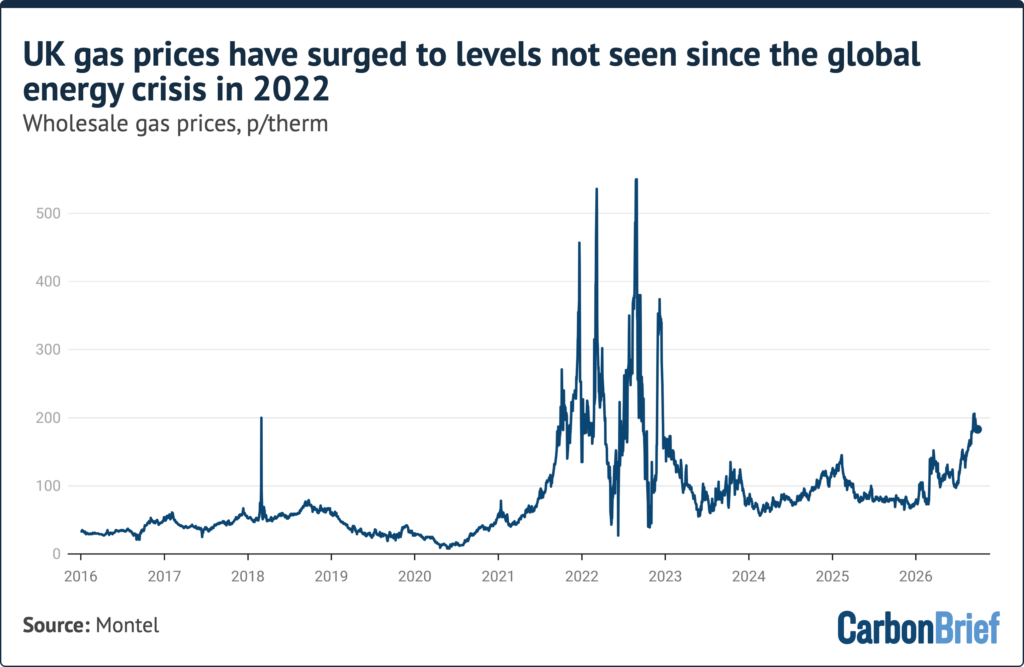
However, the UK’s energy journey began long before this year. The roots of the current price sensitivity trace back to the 2022 invasion of Ukraine, when Russia’s decision to curtail natural gas supplies to Europe fundamentally rewrote the rules of the energy market. For years, the UK operated under the assumption of cheap, abundant gas. Between 2023 and the start of 2026, gas prices averaged 90p per therm—roughly triple the levels seen in 2019.
When the Hormuz crisis erupted in February 2026, those already elevated prices surged again. By March, gas prices began a steady climb, averaging 134p per therm. By September 2026, the situation deteriorated further, with prices averaging 189p per therm—a level not seen since the height of the 2022 energy crisis. This volatility has been compounded by the approach of winter, as colder weather necessitates increased heating demand at a time when European gas reserves remain at historically low levels, forcing the continent into a fierce competition with Asian markets for limited Liquefied Natural Gas (LNG) cargoes.
Supporting Data: The Renewable Shield
The data underpinning the £5.9bn saving is a testament to the accelerating pace of the UK’s green transition. In 2026, wind and solar power have generated a record 41% share of the UK’s electricity needs. In contrast, gas-fired generation has accounted for only 25% of the mix, a nearly 10% year-on-year decline.
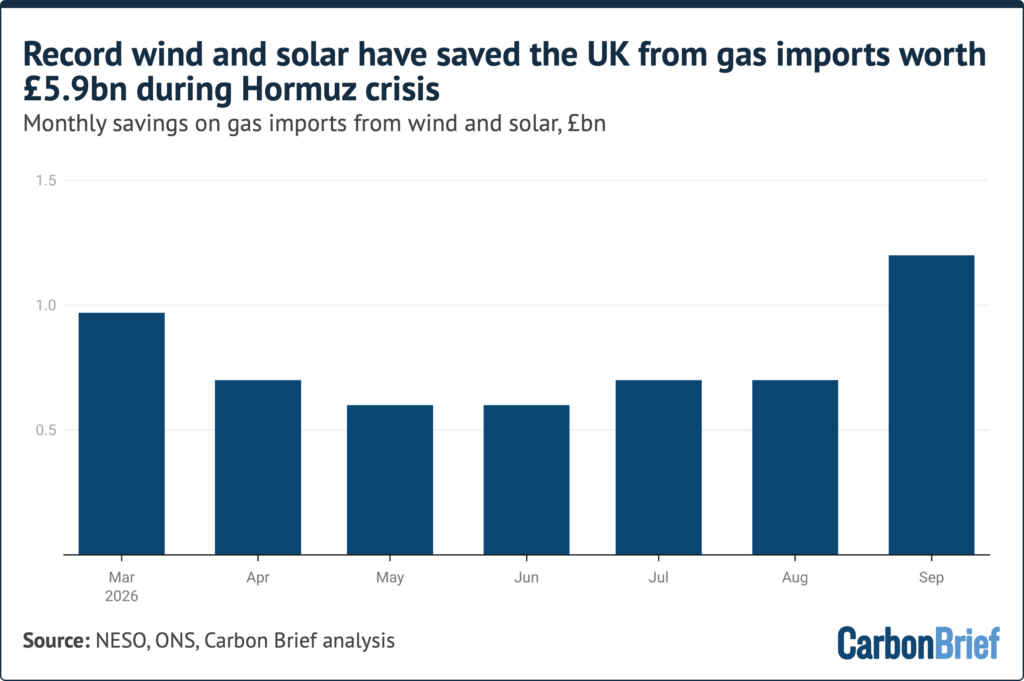
This shift in the energy mix is not merely an environmental achievement; it is a financial one. The reliance on gas-fired electricity has been slashed precisely when it matters most. Had the UK not achieved this record output from wind and solar, it would have been forced to secure an additional 100 tanker deliveries of LNG to meet domestic demand during the height of the current conflict.
The savings for September 2026 alone—estimated at £1.3bn—are a direct result of nearly 10 terawatt hours (TWh) of clean power output, coupled with the record-high market price of gas. This confirms that the UK’s investment in renewable infrastructure is not just a long-term climate strategy, but a tactical economic defense mechanism.
The Consumer Impact: Breaking the Price Link
The most immediate impact of this energy landscape is felt in the household budget. Under the current Ofgem price cap, high wholesale gas prices are hitting residential heating bills with significant force. As of October 1, typical household gas bills are set to rise by 33% compared to April—an increase of approximately £200 per year, according to the thinktank Nesta.
However, the story for electricity is starkly different. Household electricity bills have seen only a 4% rise, a modest increase that stands in sharp contrast to the soaring cost of gas. This divergence is the first tangible sign that the "link" between electricity and gas prices—a long-standing structural flaw in the UK market—is beginning to fracture.
Andrew Sissons, Director for Sustainable Future at Nesta, noted on social media that the dependency of electricity pricing on the gas market is waning. As wind and solar generation increases, the marginal cost of producing electricity becomes increasingly decoupled from the volatile price of imported natural gas. This decoupling is essential if the UK is to insulate its citizens from future global supply chain disruptions.
Official Responses and Policy Implications
The UK government has acknowledged the urgency of the situation, framing the energy transition as a matter of national security. During the recent Labour Party conference, Energy Secretary Miatta Fahnbulleh emphasized that the UK’s high energy bills are a consequence of being "exposed to global fossil-fuel markets."

Prime Minister Andy Burnham echoed these sentiments, framing the expansion of renewables as a core component of "taking control" of the national economy. "We are already taking more control of our electricity prices with a massive expansion of home-grown renewables and nuclear," Burnham stated. He further confirmed that he has tasked the Energy Secretary with accelerating the efforts to break the link between domestic power costs and the international gas market.
This policy shift represents a broader realization among policymakers: that the energy transition is no longer just about carbon targets, but about sovereign resilience. By reducing the demand for imported gas, the UK is not only meeting its climate obligations but is also protecting its economy from the whims of geopolitical rivals and the volatility of distant conflicts.
Broader Implications for Global Fossil-Fuel Importers
The challenges faced by the UK are being mirrored across the globe, though often with more devastating consequences. The European Union has reportedly incurred an additional €100bn in fossil-fuel import costs since the start of the current crisis. For low- and middle-income nations, these import bills have been catastrophic, leading to widespread energy poverty and fiscal instability.
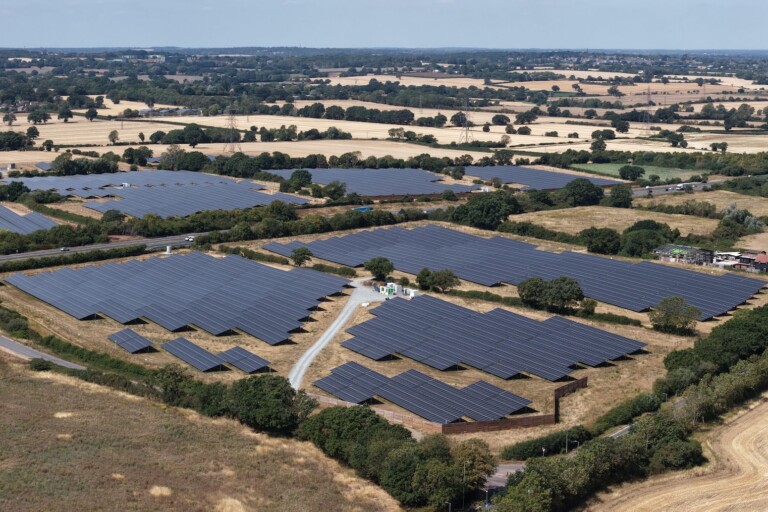
In the UK, the contrast between fuel sources is becoming impossible to ignore. While diesel prices have hit record levels of approximately £2 per litre, the cost of operating electric vehicles has remained relatively stable, with recent analysis indicating that driving an EV is now up to nine times cheaper than operating a traditional petrol or diesel car.
As winter approaches and the crisis in the Strait of Hormuz continues, the pressure on the government to sustain this momentum will only increase. The path forward appears clear: continue the rapid deployment of wind, solar, and nuclear capacity to further displace gas from the power sector.
Conclusion: Toward a More Resilient Grid
The £5.9bn in savings identified by Carbon Brief serves as a powerful reminder of the value of domestic energy production. While the transition away from fossil fuels is a complex, decades-long undertaking, the events of 2026 have provided a clear-eyed view of the benefits of a renewable-heavy grid.

The UK is currently navigating a period of profound uncertainty, characterized by high prices and global tension. However, the record performance of wind and solar has proven that the nation’s energy future does not have to be tethered to the volatility of global fossil-fuel markets. By continuing to prioritize the expansion of home-grown clean energy, the UK is not only working to lower household bills but is actively constructing a more secure and resilient foundation for its economy. The "breaking of the link" between gas and electricity is not just a policy goal; it is the cornerstone of the next chapter of the UK’s industrial and economic development.


 Raul Delapena Setiawan


 Reynand Wu

 Sagoh


 Azzam Bilal Chamdy

 Ali Ikhwan
