
 Layla Zulfa
For years, a pervasive narrative has dominated British political discourse: that the United Kingdom’s ambitious journey toward net-zero carbon emissions is the primary culprit behind the skyrocketing energy bills facing households today. However, groundbreaking new analysis from the thinktank Nesta provides a sobering corrective, revealing that the cost-of-living crisis in the energy sector is not a product of green policy, but a direct consequence of a fossil-fuel-dependent system exposed to volatile global markets.
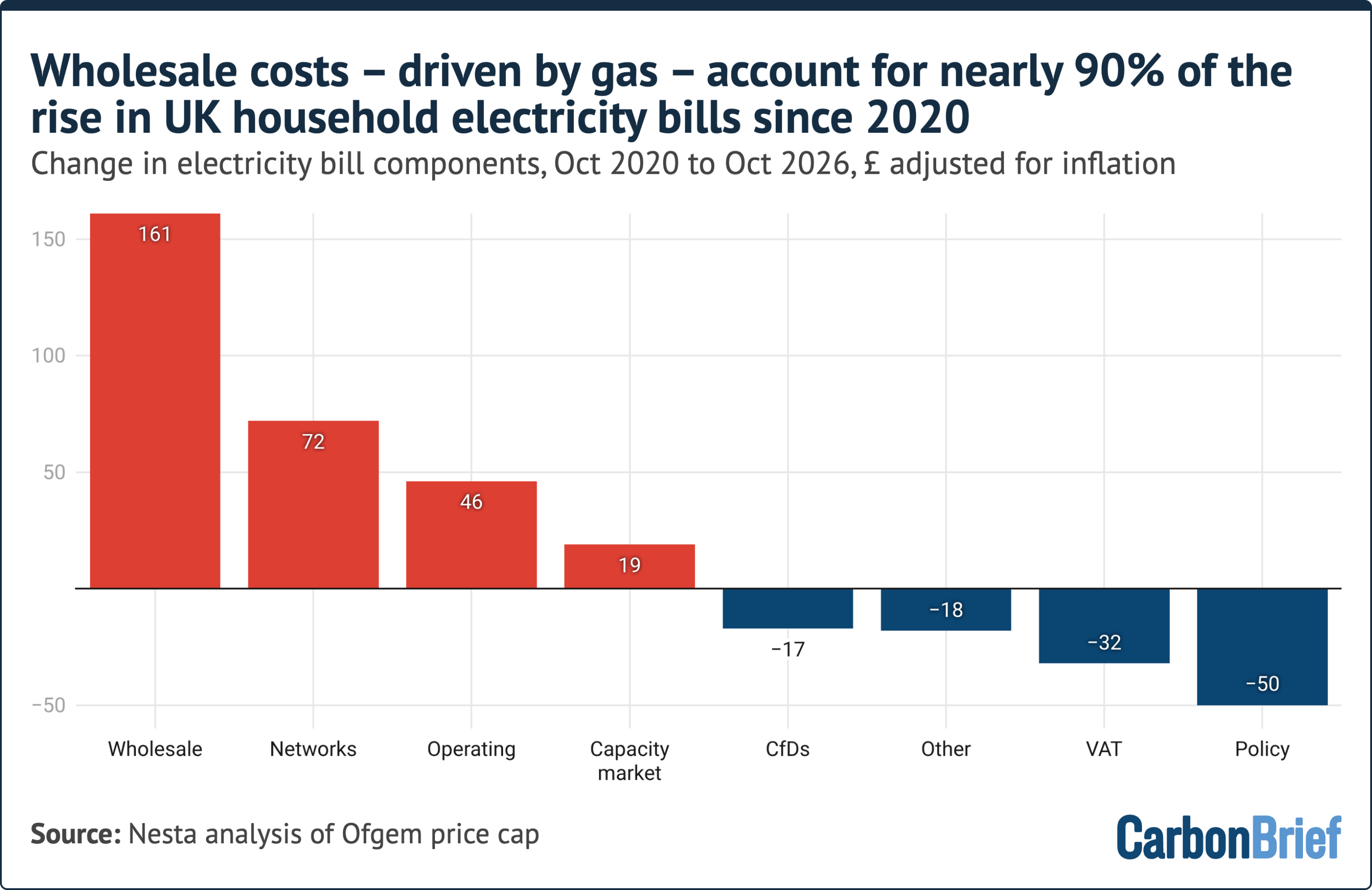
According to the report, a surge in wholesale costs—driven almost entirely by the exorbitant price of natural gas—is responsible for nearly 90% of the increase in UK household electricity bills since 2020. Far from being a burden, renewable energy is currently acting as a critical buffer, shielding consumers from the worst of the price shocks.
Main Facts: The Anatomy of a Bill
The Nesta analysis strips away the political rhetoric to reveal the cold, hard numbers behind the average household energy bill. Since 2020, the typical UK annual electricity bill has risen by £180 in real terms. Of that increase, a staggering £161 (90%) is directly attributable to wholesale costs, which are tethered to the price of gas.

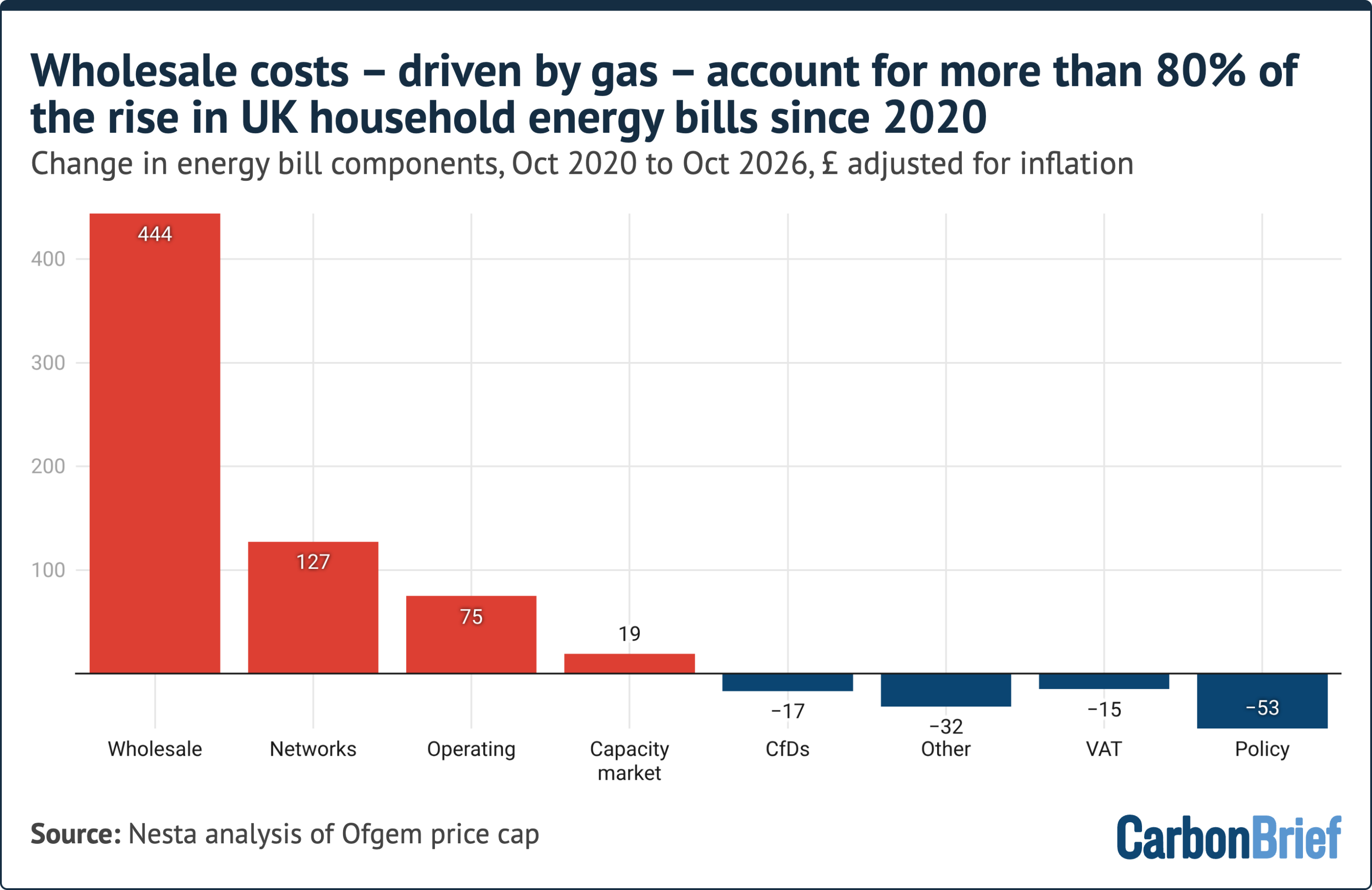
The impact on gas bills is equally stark. Since 2020, household gas costs have jumped by £368 in real terms, with 77% of that increase fueled by the same wholesale market volatility. When considering dual-fuel households, the total bill has risen by 47% since late 2020. Wholesale gas costs account for a massive £444 of this increase.
Contrary to the "green tax" narrative, renewable energy contracts—specifically "Contracts for Difference" (CfDs)—are actually reducing electricity bills by £17 under the current price cap. By contrast, network infrastructure costs and supplier operating costs, the latter largely driven by rising energy debt, represent the remaining, smaller slices of the financial pie.
A Chronology of Crisis
To understand the current predicament, one must look back at the cascade of events that dismantled the stability of the UK energy market.
- Pre-2022: The UK energy market operated under the assumption of relatively stable, low-cost gas imports, with a slow transition toward renewables.
- 2022 (The Ukraine Invasion): Russia’s full-scale invasion of Ukraine sent global gas prices into an unprecedented tailspin. Wholesale prices spiked, revealing the fragility of a system that relies on gas as the "marginal unit" for electricity generation.
- January 2026: Carbon Brief reported that two-thirds of the rise in electricity bills since the pre-crisis era was directly due to high gas prices.
- The Hormuz Crisis (2026): Ongoing geopolitical tensions in the Middle East have pushed wholesale gas prices to their highest levels since the initial 2022 invasion. As of late October 2026, UK wholesale gas prices hit 220p per therm, exceeding the 2022 average of 210p/therm.
- Present Day (October 2026): The UK government has approved the Jackdaw gas field development in the North Sea. Despite claims that this would help lower prices, energy analysts remain skeptical, noting that global market forces—not domestic extraction—dictate the prices paid by consumers.
Supporting Data: Debunking the "Green Tax"
The Nesta data provides a granular breakdown of what actually makes up a modern energy bill. When the government’s social and climate policies were accounted for in 2020, they made up £183 (16%) of a typical dual-fuel bill. As of the October 2026 price cap, that figure has fallen to £114, or just 7% of the total bill.
Network Costs: The "Motorways" of the Grid
Network costs have increased by £127 in real terms since 2020. Crucially, the analysis clarifies where that money is going. £72 is linked to electricity transmission and distribution—often referred to as the "motorways" of the grid—and £55 is for the gas grid.
A frequent talking point in the media involves "constraint payments"—the fees paid to wind farms to power down when the grid cannot handle the output. While these payments have received intense scrutiny, they represent a mere £35 (4%) of the typical £858 annual electricity bill. The vast majority of network investment is required simply to maintain aging infrastructure, with only a fraction dedicated to expanding capacity for a net-zero future.
Official Responses and Political Narratives
The narrative that net-zero is to blame for high bills has been a cornerstone of various political and media campaigns. Yet, experts argue this view is fundamentally detached from the technical reality of the energy market.
Andrew Sissons, Director for Sustainable Future at Nesta, is blunt in his assessment: "Rising gas prices, not net-zero, have driven most of the recent surge in Britain’s energy bills."
Sissons emphasizes that the UK is uniquely vulnerable because over 80% of households are connected to the gas grid, and the electricity system continues to rely on gas as the "marginal unit"—the price-setting fuel for the entire electricity market. "Net-zero is, in fact, helping to shelter Britain from the impact of expensive gas," Sissons adds. "By focusing on growing electricity demand, the government can spread upgrade costs more widely, which is the best path to stop global turmoil from showing up on winter energy bills."

The government remains in a difficult position. While they have approved new fossil fuel projects like Jackdaw, they have also taken steps to mitigate costs by moving 75% of legacy renewable support onto general taxation and temporarily removing VAT on energy, effectively acknowledging that the cost burden was becoming unsustainable for the average family.
Implications: The Road Ahead
The implications of this data are profound for the UK’s long-term energy strategy.
The Decoupling Trend
There is a silver lining. Since the onset of the recent Middle East energy crisis, household electricity prices have increased less rapidly than gas prices. This indicates that the increasing share of renewables in the UK energy mix is beginning to "break the link" between gas and electricity pricing. This is a critical development; if the UK can continue to accelerate its move toward wind, solar, and other clean power sources, it can insulate its economy from the boom-and-bust cycles of the global gas market.
Budgetary Challenges
With the upcoming budget on October 28, the Chancellor faces immense pressure. Reports suggest potential interventions to assist households as they brace for a projected sharp rise in the January 2027 price cap. Experts predict this rise could be as much as 25% if gas prices remain at current elevated levels.
A Call for Electrification
The Nesta report concludes with a clear policy direction: the solution to high energy bills is not to revert to fossil fuels, but to lean into electrification. By shifting from fossil-fuel-powered boilers and cars to heat pumps and electric vehicles, households can reduce their direct reliance on volatile gas prices.
"Going further will require British households to have clean electricity," says Sissons. "This can lock in the consistent investment in electrification that is Britain’s best path to stop global turmoil showing up on winter energy bills."
In summary, the evidence suggests that the UK is trapped not by its green ambitions, but by its historical and structural reliance on a commodity that is increasingly susceptible to global instability. The transition to net-zero is not the cause of the current economic pain; rather, it is the only viable long-term remedy for the energy insecurity that currently plagues the nation. As winter approaches, the debate in Westminster will likely shift from "blaming the transition" to "accelerating the transition" as the only logical path toward energy independence and price stability.


 Raul Delapena Setiawan

 Laily UPN

 Reynand Wu

 Sagoh


 Azzam Bilal Chamdy

 Ali Ikhwan
