
 Reynand Wu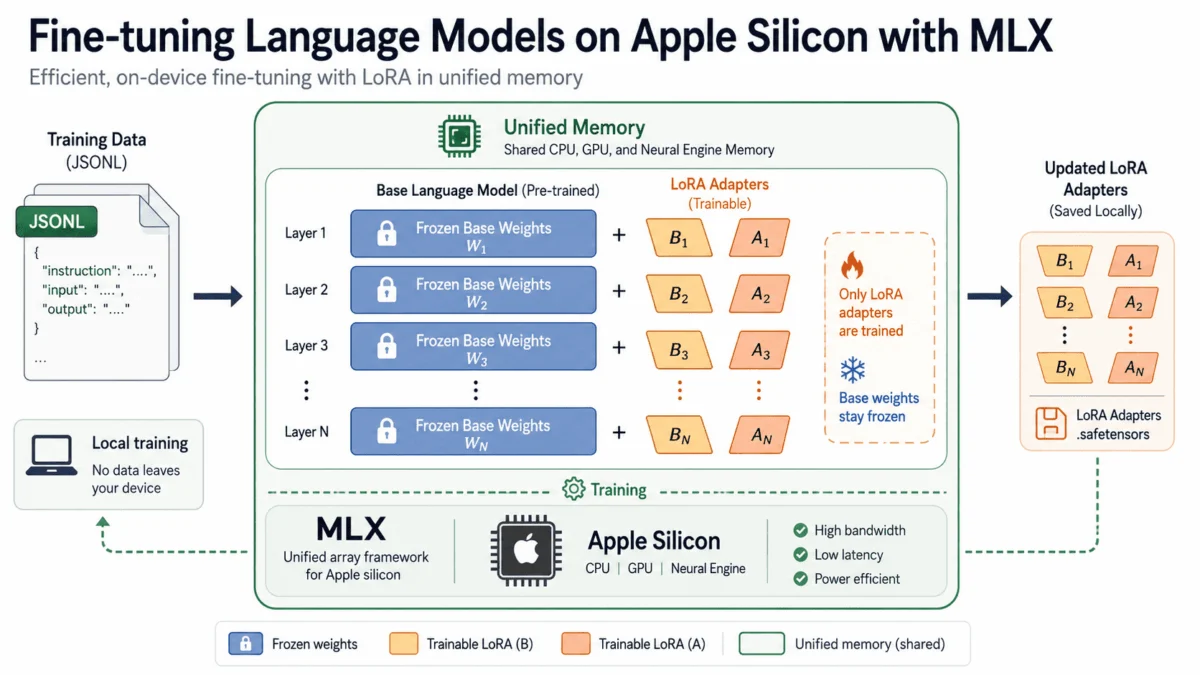
For years, the development of Large Language Models (LLMs) has been an arms race defined by massive capital expenditure. The standard industry pipeline—renting exorbitant cloud-based GPU clusters, managing complex network latency, and paying hourly fees—has effectively gated advanced AI experimentation behind a wall of high-tier enterprise resources. However, a seismic shift is underway. For the millions of professionals and developers utilizing Apple Silicon-powered Macs, the era of "cloud-only" AI training is effectively over.
Thanks to MLX, an open-source machine learning framework developed by Apple’s own research team, developers can now adapt sophisticated open-source models to their specific data requirements locally, at zero cost, and with complete data privacy. This development is not merely a technical novelty; it is a fundamental reconfiguration of the AI development landscape, moving the laboratory from the data center to the kitchen table.
The Core Innovation: Why MLX Changes Everything
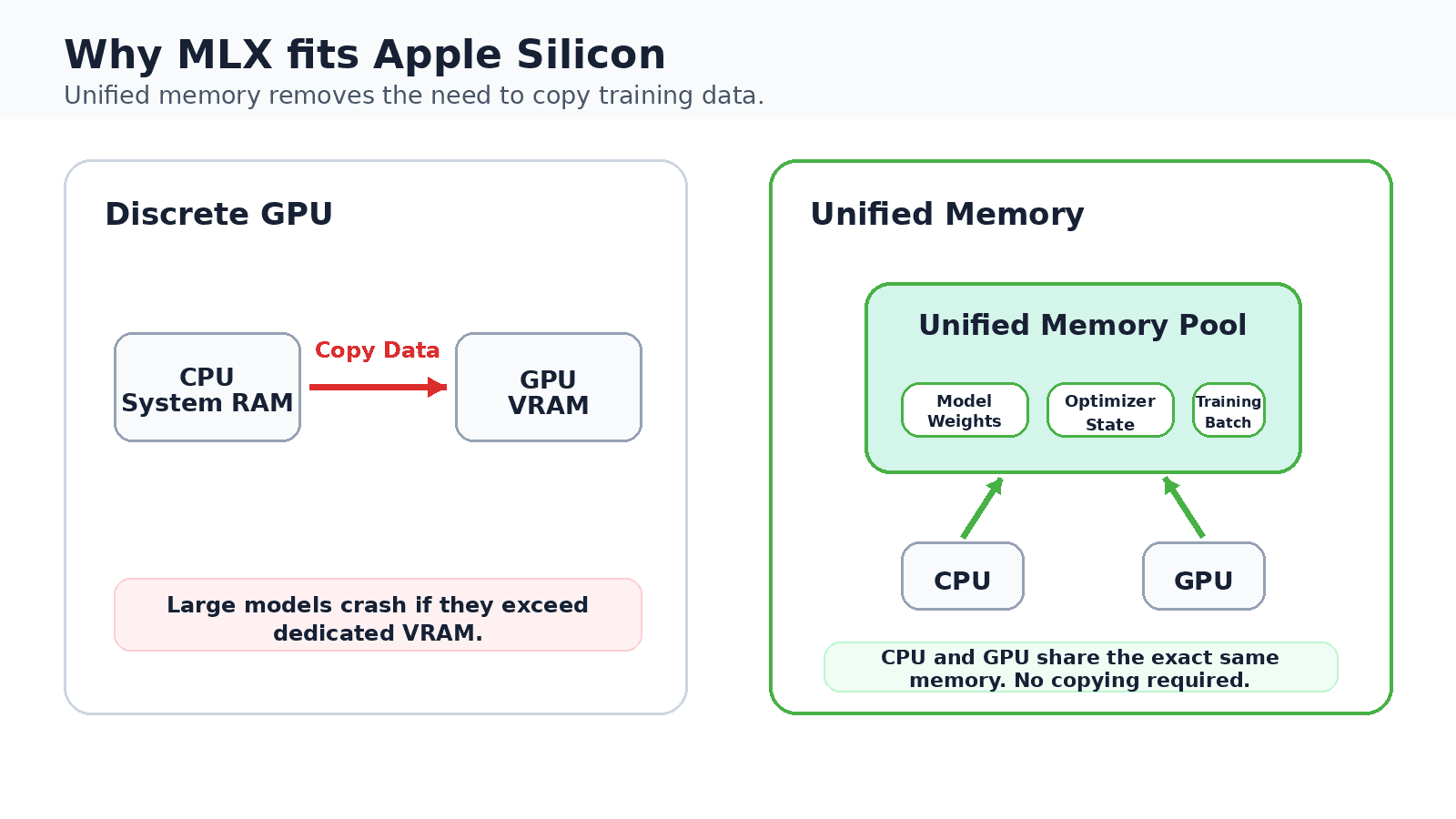
To understand the magnitude of this shift, one must first understand the architectural bottleneck of traditional AI training. Most mainstream machine learning frameworks—like PyTorch or TensorFlow—were built for discrete GPU architectures common in data centers (primarily NVIDIA’s H100s or A100s). In these systems, data must be continuously shuttled between the system RAM and the dedicated Video RAM (VRAM) of the GPU. This "copy step" creates significant latency and memory overhead.
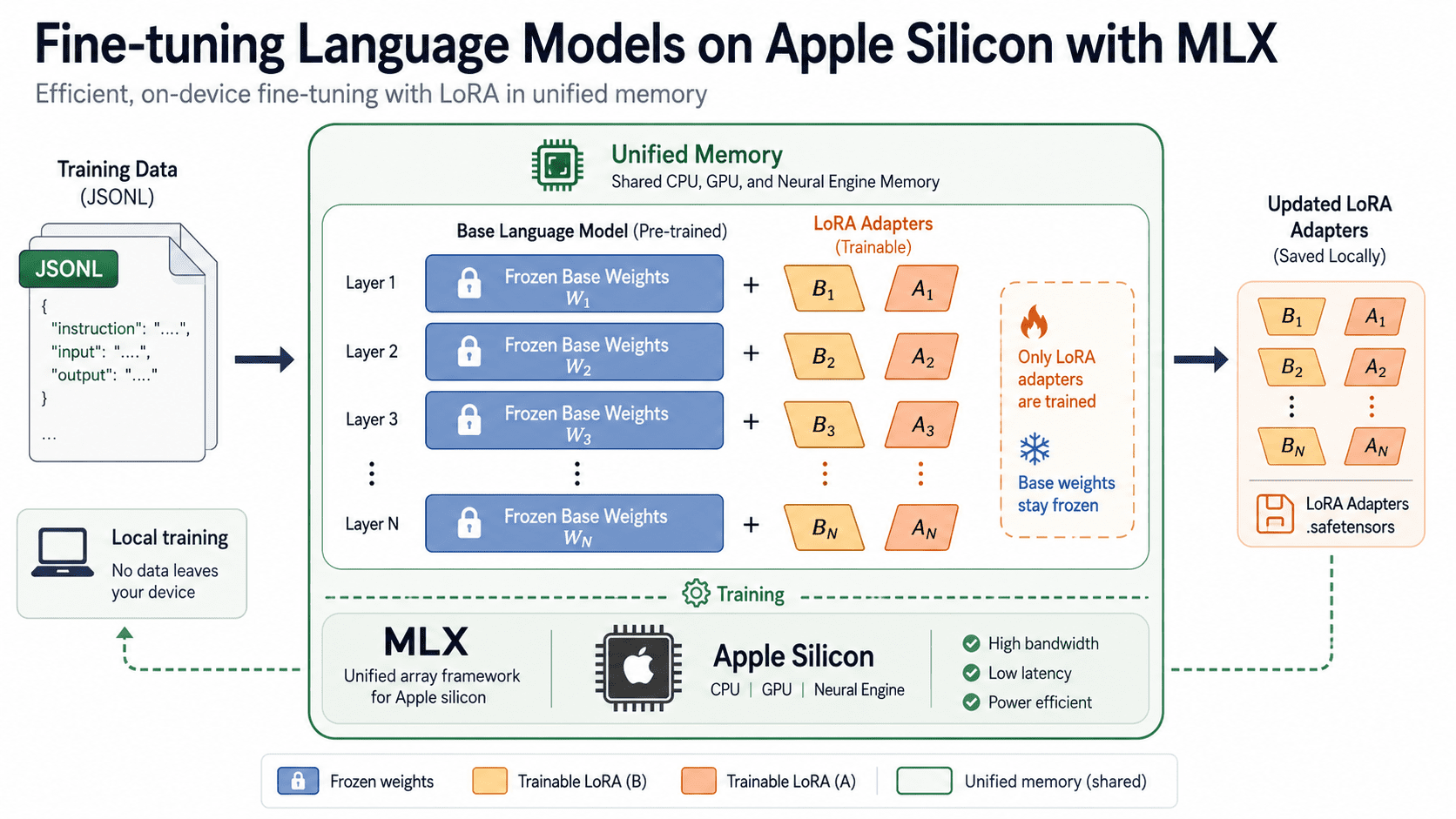
Apple Silicon, by contrast, utilizes a Unified Memory Architecture (UMA). In this design, the CPU and GPU share a single, high-bandwidth pool of memory. MLX was designed from the ground up to exploit this. By eliminating the need to copy data between distinct memory silos, MLX allows the model weights, optimizer states, and training batches to reside in the same physical space.
For a developer, this means a standard MacBook Pro with 16GB or 32GB of RAM can now perform tasks that previously required a server rack. The API is designed to feel familiar to those who have used NumPy, yet it is augmented with automatic differentiation and Metal-based GPU acceleration. This creates an environment where the hardware and software are so tightly coupled that on-device fine-tuning moves from the realm of "aspirational" to "standard practice."
A Chronology of the Local AI Revolution
The journey toward local model adaptation has been rapid and iterative. Here is how the landscape has evolved to reach this point:
- Pre-2023: The "Cloud Monopoly." Fine-tuning was reserved for large organizations with significant budgets to burn on AWS, GCP, or Azure instances.
- Early 2023: The Rise of Quantization. Techniques like GGUF and llama.cpp enabled local inference (running models), but fine-tuning (teaching them new things) remained cumbersome and often required Linux-based environments.
- Late 2023: The Release of MLX. Apple’s research team released the MLX framework, specifically targeting the M-series chips. This was the turning point for performance parity.
- 2024: The Ecosystem Matures. With the introduction of
mlx-lm, the process was simplified from complex coding projects to a few terminal commands. Today, a user can pull a model from Hugging Face, train it on proprietary data, and serve it via an OpenAI-compatible API in under an hour.
Establishing the Environment: A Practical Guide
The barrier to entry for local fine-tuning has been reduced to a simple terminal workflow. Prerequisites include an Apple Silicon Mac (M1 or newer), macOS Ventura 13.5 or later, and Python 3.10.
Step 1: Installing the Toolkit
The process begins with installing the mlx-lm library, which acts as the bridge between the raw hardware and high-level training commands:
pip install "mlx-lm[train]"Verification is handled by a quick generation test. By pulling a 4-bit quantized version of Mistral-7B from the mlx-community repository on Hugging Face, a user can confirm that the system is ready to process model weights.
Step 2: Preparing the Dataset
MLX expects data in a .jsonl (JSON Lines) format. The trainer requires a train.jsonl file, with optional valid.jsonl and test.jsonl files for tracking performance. Whether using the "chat" format—which preserves conversational role-tagging—or the "completions" format for simple instruction-following, the key is data hygiene. By utilizing the --mask-prompt flag, developers ensure the model focuses its learning efforts on the assistant’s response rather than the user’s prompt, leading to significantly higher-quality outputs.
Step 3: Training via LoRA
The secret sauce of modern local training is Low-Rank Adaptation (LoRA). Rather than retraining billions of parameters—which would require massive memory—LoRA freezes the core model and trains only a tiny set of adapter matrices. This process, documented in the foundational paper by Hu et al., allows for high-performance training with a footprint so small it fits comfortably on a standard consumer laptop.
Supporting Data and Technical Considerations
The effectiveness of local training is dictated by the relationship between memory, quantization, and batch size.
- Quantization (QLoRA): By training on 4-bit quantized models, the memory requirement for a 7B parameter model is slashed by approximately 70% compared to full-precision training. This is the difference between a system crash and a successful training run on a 16GB machine.
- Batching Strategy: On devices with limited RAM, a batch size of 1 is the standard starting point. For those with 64GB+ of memory, increasing the batch size or using
gradient-accumulation-stepscan significantly speed up convergence without inducing out-of-memory (OOM) errors. - Hyperparameter Tuning: A learning rate between 1e-5 and 5e-5 is typically the "sweet spot." If the model begins to output repetitive text, it is likely overfitting; the user should then reduce the number of training iterations or increase the size of the dataset.
Implications for Industry and Privacy
The implications of this technology reach far beyond the convenience of not paying for cloud compute.
1. Data Sovereignty and Privacy
For sectors like healthcare, law, or finance, the "cloud-only" model has been a major barrier to AI adoption. Sending proprietary or sensitive data to a third-party API is often a non-starter for compliance reasons. Local fine-tuning solves this by keeping all data, training logs, and model weights within the physical perimeter of the user’s hardware.
2. The Rise of the "Personalized" LLM
We are entering a phase of AI development where the "one-size-fits-all" model is being replaced by highly specialized adapters. A lawyer can train a local model on their specific contract templates; a developer can train one on their specific proprietary codebase. Because the cost of these experiments is effectively zero (aside from electricity), the threshold for innovation is drastically lower.
3. The Future of Edge Computing
As Apple Silicon continues to evolve, the distinction between "local inference" and "local training" will continue to blur. The ability to fine-tune on-device allows for continuous learning—the model can update itself based on new data arriving throughout the day without ever requiring a connection to a central server.
Conclusion: The Kitchen-Table Laboratory
The transformation of the MacBook into a capable AI workstation is a testament to the power of vertical integration. What began as an appreciation for Apple’s hardware-software synergy has blossomed into an open-source movement that empowers the individual.
As noted by AI educator Vinod Chugani, the path forward involves constant experimentation—swapping architectures, tweaking adapter layers, and testing different fine-tuning types like DoRA (Weight-Decomposed Low-Rank Adaptation). With the infrastructure now firmly in place, the only limit to AI development is the user’s ability to curate high-quality datasets and define their specific goals. The tools are on your desk; the cloud is no longer a requirement for intelligence. The laboratory is now wherever you are.

 Neng Nana
 Evan Lee Salim
 Raul Delapena Setiawan

 Sagoh
Sagoh

 Azzam Bilal Chamdy
 Ali Ikhwan