
 Reynand Wu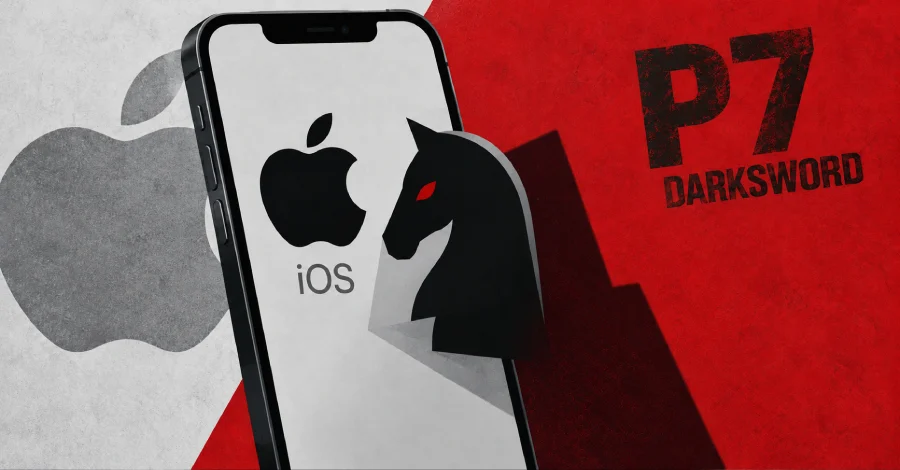
The mobile security landscape has been shaken by the emergence of "P7 DarkSword," a sophisticated and highly dangerous evolution of the previously identified DarkSword iOS exploit kit. First brought to light in March 2026, the original DarkSword toolkit represented a watershed moment in mobile threats: a commercial-grade exploit chain that had escaped the high-security environments of its origin and drifted into the hands of financially motivated cybercriminals and state-aligned actors.
Now, with the disclosure of the P7 variant, cybersecurity researchers at iVerify have confirmed that the threat has not only persisted but has matured, prioritizing stealth, data precision, and persistent command-and-control (C2) capabilities. This report breaks down the technical evolution, the geopolitical implications of its usage, and the growing ecosystem of exploit-as-a-service operations currently targeting Apple’s iOS ecosystem.
1. Main Facts: The P7 DarkSword Facelift
The P7 variant is named for a distinct variable prefix, p7_, observed in the modified source code of the original kit. While the underlying architecture remains consistent with the initial DarkSword findings—chaining multiple vulnerabilities to break out of the browser sandbox and elevate privileges to the kernel—the P7 iteration introduces significant operational refinements.
Key Technical Upgrades:
- Reduced Footprint: By eliminating verbose debug logging over HTTP and syslog, the malware minimizes its footprint on the device, making it significantly harder for security analysts or mobile device management (MDM) tools to flag its presence.
- On-Device Data Processing: Previous iterations of the kit would exfiltrate large, raw databases (such as the keychain) to the attacker’s server for processing. P7, however, parses and converts keychain data into JSON format directly on the victim’s device. This not only speeds up the exfiltration process but also makes the stolen data immediately actionable for the threat actor.
- Persistent C2 Communication: P7 implements a robust, two-way communication channel between the device and the attacker’s infrastructure. It polls for commands every 15 seconds, sending "heartbeat" signals to maintain persistence and ensure that the attacker can deploy new instructions or harvest specific files on demand.
- Browser-Based Persistence: The kit utilizes
localStoragewithin the browser to prevent re-exploitation cycles, ensuring that the initial infection is stable and that the payload does not inadvertently crash the device or trigger defensive mechanisms.
2. Chronology: A Timeline of Proliferation
The journey of the DarkSword kit from a specialized commercial product to a commodity tool for cyber-espionage is a case study in the dangers of weaponized software leaks.

- November 2025: DarkSword is first detected in the wild. Initial analysis suggests the kit was engineered to exploit iOS versions 18.4 through 18.7. It is believed to have been a commercial surveillance product that found its way into the second-hand market.
- March 2026: Google Threat Intelligence Group (GTIG), iVerify, and Lookout jointly document the kit. The public disclosure reveals its capability to inject payloads into SpringBoard, the core iOS process managing the home screen and app launches.
- Late 2025 – Early 2026: The kit is deployed globally. Attacks are identified in Saudi Arabia, Turkey, Malaysia, and Ukraine. Notably, Turkish surveillance vendor PARS Defense and the Russia-aligned threat actor Star Blizzard (COLDRIVER) are linked to campaigns using fake Snapchat and event-invitation lures.
- August 2026: Censys reports on a new, unknown Chinese-speaking threat actor utilizing the kit. This campaign is significant for its use of Apple ID decoy sign-in pages, marking a shift toward more targeted credential harvesting.
- September 2026: iVerify identifies multiple, likely LLM-assisted, attempts by various actors to port the framework to support iOS 26.x.
- October 2026: The disclosure of P7 DarkSword confirms that the code is being actively refined, optimized, and maintained by sophisticated operators.
3. Supporting Data: The Ecosystem of Exploitation
The threat posed by DarkSword is compounded by its association with "Coruna," a secondary, companion exploit kit. While DarkSword handles the initial breach and kernel-level elevation, Coruna functions as a payload delivery system.
Censys researchers have identified an alarming trend: operators are now managing these kits through open directories and centralized administration panels. A recovery of one such production server revealed a staggering cache of stolen intelligence, including 11 victim recovery phrases, 179 distinct device "loot" directories, and a control-plane roster listing 75 accounts.
The "Exploitation-as-a-Service" Model
The infrastructure discovered by Censys points to a mature, professionalized criminal model. The administrative panels found on these servers resemble standard SaaS platforms, complete with agent/reseller management capabilities.
- The Chinese-Speaking Cluster: Censys identified a specific operator utilizing a unique self-signed certificate authority, hosting their operations on Tencent and Shenyang infrastructure. This group is specifically targeting cryptocurrency wallets, including the BitKeep wallet, in addition to standard iOS data theft.
- Command-and-Control (C2) Capabilities: The current P7 toolkit is capable of mass data harvesting, including:
- Full iCloud Keychain exfiltration.
- System-wide application lists.
- Specific data extraction from Apple Notes and Photos.
- Cryptocurrency recovery phrase and balance harvesting.
4. Official Responses and Industry Context
The rapid iteration of these exploit kits has placed immense pressure on mobile security vendors. Because the kits are built on a modular architecture—utilizing unknown or unpatched CVEs—traditional signature-based detection often fails.

"The proliferation of these kits is a direct consequence of the commercial surveillance industry’s lack of oversight," says a senior researcher at iVerify. "When a tool designed to bypass the most secure mobile operating systems in the world is sold on the second-hand market, it doesn’t just disappear; it becomes a force multiplier for every threat actor with enough capital to acquire it."
Apple has consistently pushed security updates to patch the vulnerabilities leveraged by these chains, but the "cat and mouse" game continues. As the kits move toward LLM-assisted development, the time between a patch release and a corresponding exploit update is narrowing, posing a severe risk to users who do not update their devices immediately.
5. Implications: What This Means for Global Security
The rise of P7 DarkSword carries profound implications for both individual privacy and national security.
For the Individual User
The primary threat is the complete compromise of the digital identity. By gaining control over SpringBoard and extracting the iCloud Keychain, an attacker essentially gains the ability to "become" the user on their own device. This includes accessing two-factor authentication codes, private photos, and financial assets, rendering traditional password protections moot.

For Organizations and Governments
The use of DarkSword in Ukraine, Turkey, and Saudi Arabia underscores its role in geopolitical espionage. The ability to deploy such a kit via a simple "fake invitation" lure makes even high-profile targets vulnerable. As these tools become easier to use through the "reseller" model, the barrier to entry for state-sponsored and criminal actors to conduct high-level mobile surveillance is virtually eliminated.
The Future of Mobile Defense
The shift toward on-device processing and the removal of debug logs indicate that the "stealth" race is reaching a new phase. Security researchers are now advocating for:
- Behavioral Analysis: Rather than looking for specific malware signatures, security solutions must focus on the behavioral anomalies of processes like SpringBoard.
- Hardware-Level Attestation: Increasing the reliance on secure enclaves and hardware-backed identity verification.
- Strict Patching Regimes: The window of opportunity for attackers is directly tied to the user’s delay in updating iOS. In the era of P7, an unpatched device is not just at risk—it is essentially an open door.
The emergence of P7 DarkSword is a stark reminder that the security of mobile devices is never static. As threat actors refine their tactics and exploit the shadows of the commercial surveillance market, the responsibility falls on both manufacturers to harden their kernels and users to remain vigilant against even the most innocuous-looking digital invitations. The digital arms race has entered a new, more dangerous chapter, and the stakes for mobile users have never been higher.

 Layla Zulfa
 Rifan Muazin
 Lina Hope
 Jia Lissa
 Suro Senen
 Ali Ikhwan
 Pevita Pearce
 Siti Muinah