
 Nana
Nana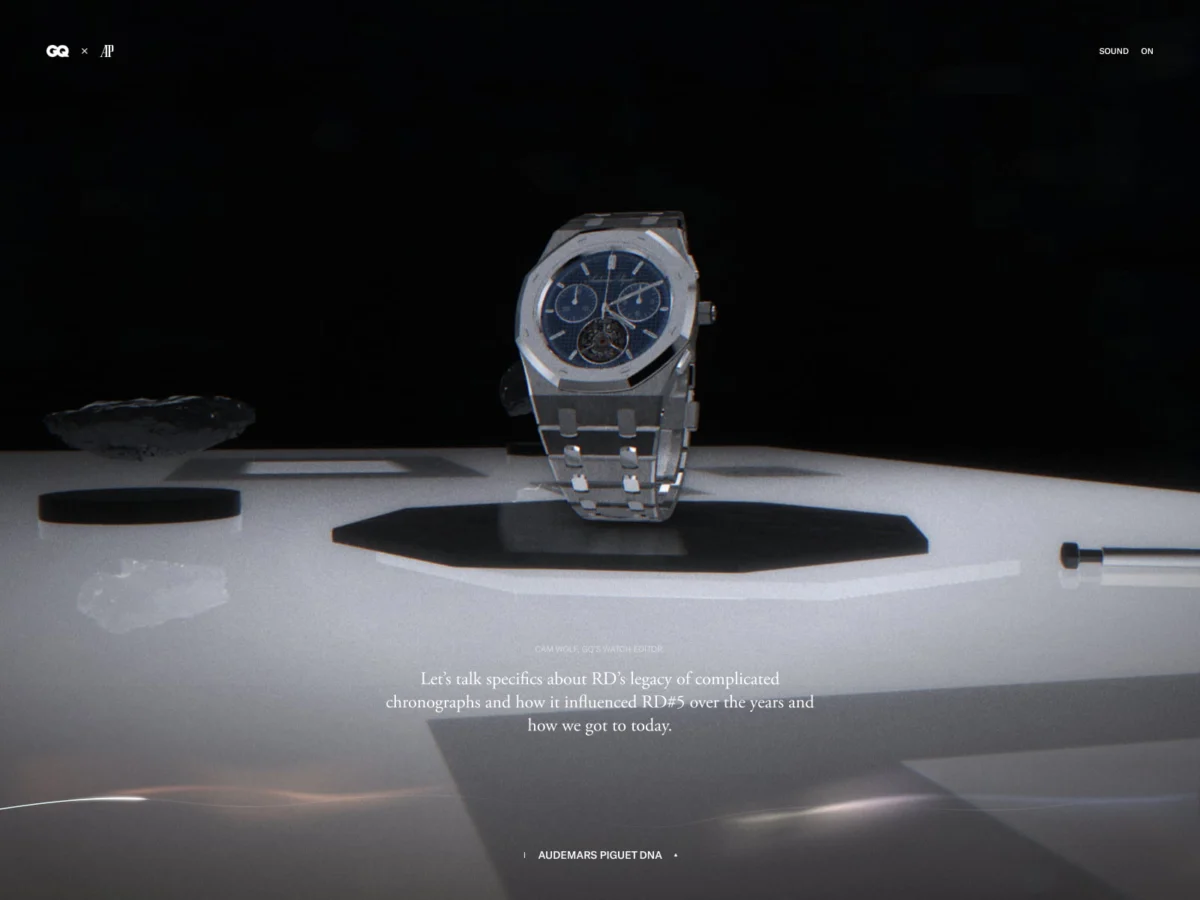
In an era where luxury brands often settle for high-definition video loops or static product catalogs, the recent collaboration between Audemars Piguet, GQ, and the creative studio Immersive Garden marks a seismic shift in digital storytelling. Their joint venture, The Extraordinary Lab, is not merely a website; it is a real-time, cinematic, and interactive experience that mirrors the mechanical precision of the Audemars Piguet RD#5.
By merging cutting-edge WebGL technology with the narrative depth of an editorial podcast, the project has set a new benchmark for how high-end maisons communicate craftsmanship in a digital-first world.
The Genesis of an Immersive Mandate
The project began with a singular, uncompromising ambition: to transcend the traditional luxury campaign. Audemars Piguet, a brand synonymous with horological excellence, required a digital vessel that reflected its own core values—precision, intensity, and an obsessive focus on detail.
For the creative team at Immersive Garden, the challenge was twofold. They had to create an interface that felt as luxurious as the watch itself, while ensuring the performance remained flawless across a vast array of hardware, from high-end desktop workstations to mobile devices.
The ambition was clear: this would not be a "product showcase." It would be a cinematic environment where storytelling, sound design, and real-time rendering converged into a single, cohesive timeline. Over a period of three and a half months, a multidisciplinary team of ten experts—ranging from technical directors to 3D artists and sound engineers—labored to ensure that every shadow, reflection, and transition felt purposeful.
Chronology of a Digital Masterpiece
Phase 1: Conceptualization and the "Continuous Track"
Early iterations of the project toyed with a "podcast-first" interface, featuring static visual companions to audio conversations. However, the team quickly realized that to achieve true immersion, the experience needed to be fluid. They moved toward a "continuous cinematic track," a design choice that treats the user experience like a film strip. By doing away with traditional page breaks and disconnected chapters, the team created a seamless environment where users move through the story with the tactile satisfaction of navigating a high-end media player.
Phase 2: The Engineering of Rhythm
The core technical hurdle was the integration of audio. Featuring conversations between Latin music icon J Balvin and GQ Watch Editor Cam Wolf, the site required the audio to serve as the heartbeat of the navigation. Unlike a standard video player, where scrubbing through content can lead to jarring audio stutters, the Immersive Garden team developed a custom system that manages fades, synchronization states, and playback continuity in real-time. This ensured that no matter how fast a user scrolled, the rhythm of the conversation remained intact, preserving the cinematic pacing.
Phase 3: Real-Time Luxury Rendering
Rendering a luxury watch in a web browser presents an inherent contradiction: the product must appear physically perfect, yet remain responsive enough to run at 60 frames per second (FPS). The team utilized a sophisticated combination of Physically Based Rendering (PBR) and custom shader techniques to simulate the RD#5’s complex textures and light-reflecting surfaces. To ensure the site remained accessible on devices like the iPhone 11 or 12, the team employed intelligent optimization, balancing visual fidelity with strict browser performance constraints.
Supporting Data: The Technical Architecture
The Extraordinary Lab functions on a complex stack designed for performance and aesthetic harmony.
- Theater.js and Motion Systems: By implementing Theater.js, the team moved away from hardcoded animations. This allowed designers to tweak motion curves, camera movements, and interface behaviors live, within the browser. This collaborative pipeline meant that technical and creative decisions were made in parallel rather than sequentially.
- Rendering Techniques: The project utilized a blend of parallax mapping, billboard reflections, and planar reflections to create a sense of depth and luxury without overloading the GPU.
- The AI Experiment: A notable aspect of the production was the integration of AI-assisted workflows. The team experimented with generative video tools to create abstract, projected silhouettes of the speakers. However, the project also served as a case study in the limitations of AI: in the high-stakes world of luxury, where brand identity is paramount, AI-generated inconsistencies were often corrected by human art direction, proving that machine learning is currently a tool for augmentation, not a replacement for human craft.
Official Perspectives: The Philosophy of the Build
"The objective was never creating ‘3D for the sake of 3D,’" noted the development team at Immersive Garden. Every visual decision was filtered through the lens of coherence. The environments—dark, electric, and futuristic—were designed to evoke the spirit of the RD#5 without descending into science fiction tropes.
The collaboration with Condé Nast and GQ provided the editorial rigor required to anchor the project. By maintaining a balance between the "electric" aesthetic of the watch and the "human" element of the podcast, the creators ensured that the technology remained invisible. As the team stated, "What appears simple on the surface is actually a tightly choreographed system balancing interaction, rendering, storytelling, motion, and sound simultaneously."
Implications: The Future of Luxury Storytelling
The success of The Extraordinary Lab—culminating in the Awwwards "Site of the Month" honor—signals a permanent shift in how luxury brands approach the internet.
1. From "Viewing" to "Inhabiting"
The industry is moving away from static assets. High-net-worth consumers now expect an experience that feels reactive and alive. By building an environment that responds to the user’s scroll speed and interaction, brands can create a deeper emotional connection to their products.
2. The Return of Invisible Craft
In an era of bloatware and heavy, slow-loading websites, this project highlights the value of technical restraint. By optimizing for mobile-first performance, the team proved that luxury is not about how much data you can push to the screen, but how efficiently you can deliver a refined, fluid experience.
3. The New Creative Workflow
The use of Theater.js and collaborative real-time development environments will likely become standard. The traditional "waterfall" method—where design is finished, then sent to developers—is being replaced by "co-design," where creative and technical teams iterate on the same digital canvas simultaneously.
4. The Human-AI Synthesis
Perhaps the most significant implication is the lesson learned regarding AI. The project demonstrates that while generative tools can speed up the production of atmospheric elements, the "luxury" in luxury goods remains tied to the human eye. The ability to discern between a "good enough" generative output and an "exceptional" artisanal output remains the primary value proposition of agencies like Immersive Garden.
Conclusion
The Extraordinary Lab serves as a masterclass in modern digital production. It is a project defined not by the technology it uses, but by the discipline with which that technology is applied. In creating a digital universe for the Audemars Piguet RD#5, Immersive Garden has provided a blueprint for how brands can preserve their legacy of craftsmanship while embracing the limitless possibilities of the web. As digital experiences become the primary touchpoint for luxury consumers, the ability to weave rhythm, sound, and interactive 3D into a coherent narrative will become the new currency of brand authority.

 Ammar Sabilarrohman
 Azzam Bilal Chamdy
 Basiran
 Neng Nana
 Nana Muazin
 Jia Lissa
 Laily UPN
 Asep Darmawan