
 Ali Ikhwan
The 2026 football tournament has proven to be more than just a series of matches; it has become a sprawling, high-stakes collision of global sports culture and American consumerism. As millions of international visitors descended upon North America, they didn’t just bring their team colors and chants—they brought a fresh, often bewildered, and deeply fascinated perspective on American life.
By analyzing 32.6 million tournament-related mentions between June 10 and June 28, 2026, researchers have mapped a unique phenomenon: a cross-cultural dialogue played out in real-time on social media, where the "fan experience" was defined as much by bottomless coffee and ranch dressing as it was by the action on the pitch.
A Chronology of Discovery: From Arrival to Obsession
The trajectory of the tournament’s cultural footprint followed a distinct pattern: initial curiosity, followed by the "shock of the new," and finally, full-blown viral integration.
June 10–15: The Arrival and Initial Culture Shock
As the tournament kicked off, the conversation was dominated by the logistical reality of travel. However, by the second day, the focus shifted sharply to the culinary landscape. International fans began posting "first-timer" reactions to staples that are mundane to Americans but revelatory to others. The "diner effect" took hold immediately, with social media feeds filling with videos of visitors marveling at the existence of all-day breakfast and, most importantly, the concept of "bottomless" hospitality.
June 16–22: The Virality of the Mundane
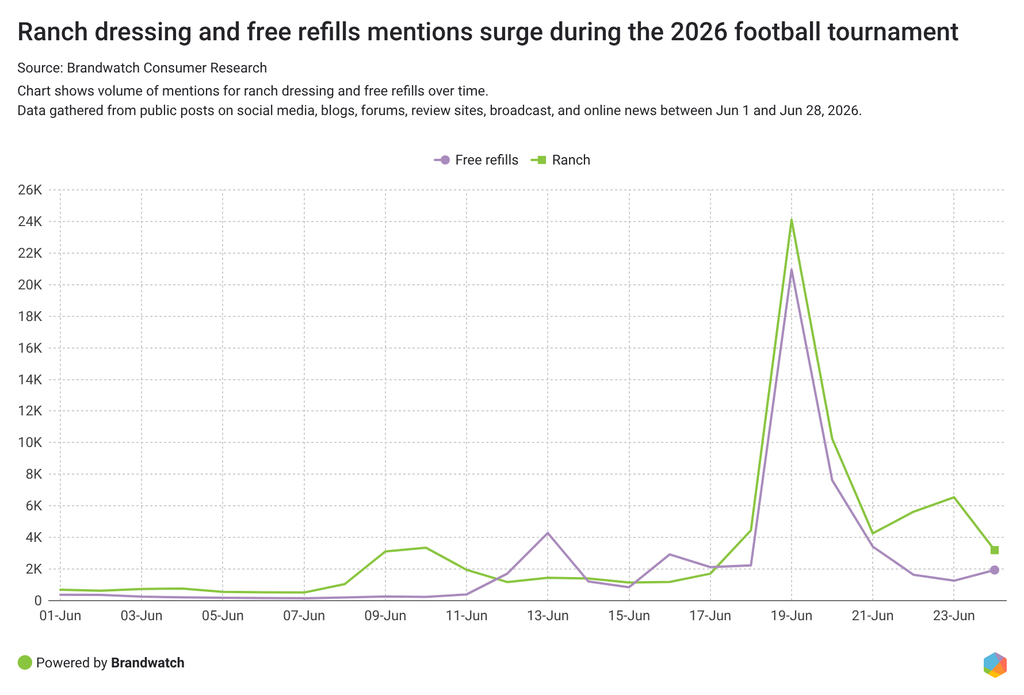
By the second week, the conversation reached a fever pitch. The "bottomless" trend—spanning soda refills, coffee, and even salsa—became a primary narrative. Simultaneously, the "Ranch Dressing" phenomenon emerged. What began as a confusing condiment encounter for European fans transformed into a full-blown culinary obsession. This period also saw the rise of the "Viking Row," as Norwegian fans brought their signature celebration to the streets of New York, sparking a global mimicry trend.
June 23–28: Brand Integration and Commercial Response
The final week of this data set marked the professionalization of these viral moments. Major corporations, having monitored the social signals, began to pivot. Kraft’s rapid deployment of "TSA-Compliant Ranch" kits serves as the definitive case study of modern brand agility, turning organic social buzz into tangible retail demand.
Supporting Data: The Anatomy of the Buzz
The numbers behind the 2026 tournament reveal that sentiment is driven by accessibility and novelty.
The Food and Beverage Metrics
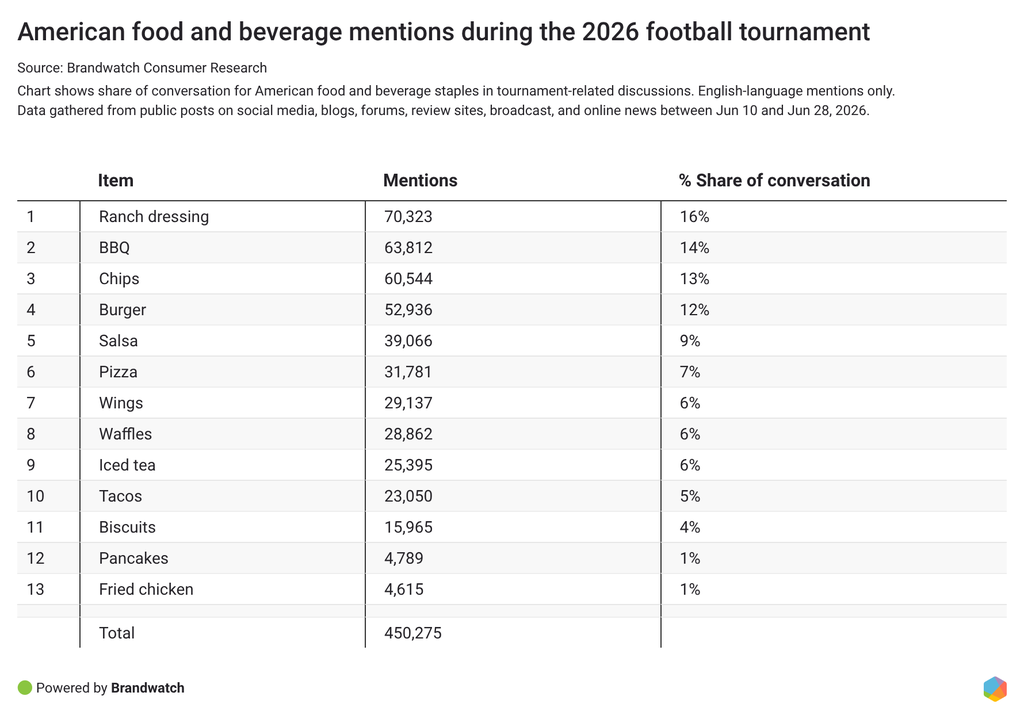
- Ranch Dressing: With over 70.3k mentions, ranch was the undisputed star of the food conversation. Google search interest for "ranch dressing" and "ranch dressing ingredients" surged by 586.4% and 600%, respectively, confirming that social chatter was driving real-world consumer behavior.
- Bottomless Hospitality: The concept of "free refills" generated 45k mentions, with a remarkable 71% positive sentiment. International fans, accustomed to paying for every individual beverage, found the American model of unlimited refills a "magical" aspect of the experience.
- The Bread Basket: Mentions of "free bread" tracked over 30k, highlighting the cultural surprise at the abundance of complimentary food items in US dining establishments.
- BBQ Supremacy: American barbecue, particularly Texas brisket and Kansas City burnt ends, generated 64k mentions. Visitors frequently described these dishes as "ruining all other meats" for them, with Texas Roadhouse emerging as a key touchpoint, gathering 13k mentions for its bread-and-butter service.
Geographic Sentiment
Host cities became the laboratories for these experiences. Kansas City and Dallas, the epicenters of the BBQ discourse, reported that over 61% of all tournament-related mentions were positive, significantly outperforming cities where commercial friction—such as high stadium pricing—dominated the narrative.
Friction Points: Where the Experience Faltered
Despite the success of local food culture, the tournament experience was not without its detractors. The data highlights a clear divide between the "authentic" fan experience and the "manufactured" stadium environment.
The Cost of Entry and Commercialization
The primary source of negative sentiment was the economic barrier to entry. Fans were vocally critical of $20+ pints of beer at stadiums, a stark departure from the more affordable fan culture common in European leagues.
Furthermore, the introduction of "hydration breaks" sparked a significant backlash. Over 79% of sentiment-categorized mentions regarding these breaks were negative. Fans perceived these as transparent attempts to force commercial breaks into the flow of the game, leading to accusations that the organizers prioritized revenue over the sanctity of the sport. This frustration pushed fans toward "watch parties" and "fan zones"—spaces that offered the communal excitement of the tournament without the perceived exploitation of stadium-grade commercialization.
The Rise of the Fan Festival
Watch parties became the democratic heart of the 2026 tournament. With over 226k mentions in the first two weeks, these events provided a decentralized alternative to the stadiums.
New York City stood out as a leader in this space, commanding a 22% share of all watch party conversations. By offering official team fan zones, such as the Portuguese hub at the Time Out Market, cities were able to capture the attention of fans who wanted to participate in the spectacle without the stadium markup. These festivals allowed brands to engage with fans in an environment that felt less like a transaction and more like a community celebration.
Implications for Future Global Events
The 2026 tournament has provided a masterclass in modern marketing and consumer engagement. The lessons for stakeholders are threefold:
1. Speed is the New Currency
The "Viking Row" and the "Ranch Obsession" both started as grassroots, organic moments. Brands that succeeded were those that did not attempt to control the narrative, but rather participated in it. When Norrona supported the Viking Row or Kraft facilitated the transport of ranch dressing, they were not just selling products; they were validating the fans’ experiences.
2. Authenticity Over Interruption
The intense negative reaction to forced commercial breaks during hydration intervals demonstrates that today’s fans have a low tolerance for intrusive advertising. Future events must integrate sponsors into the atmosphere—such as through local food activations or fan-led festivals—rather than forcing them into the broadcast flow.
3. The "Local" is the "Global"
The most successful brand activations of the 2026 tournament were those that leaned into the local culture. By highlighting regional specialties like Texas BBQ or the American diner experience, cities turned international visitors into local advocates. These fans returned home with more than just memories of a game; they returned with a refined, if somewhat indulgent, appreciation for American culture.
Conclusion: A New Era of Fan Engagement
The 2026 football tournament has demonstrated that the "fan experience" is no longer confined to the 90 minutes of play on the field. It is a 24/7 ecosystem of social media, culinary discovery, and brand-fan interaction.
For brands and organizers, the path forward is clear: success lies in the ability to listen. By monitoring the digital breadcrumbs—the 70k mentions of ranch, the 226k mentions of watch parties, and the 229k mentions of rowing fans—organizations can move from merely hosting an event to being a core participant in a global cultural moment. As the tournament continues, the brands that thrive will be those that realize the most effective marketing doesn’t interrupt the celebration; it joins it.

 Lina Irawan
 Reynand Wu

 Nana
Nana
 Rifan Muazin

 Evan Lee Salim
