
 Nana Muazin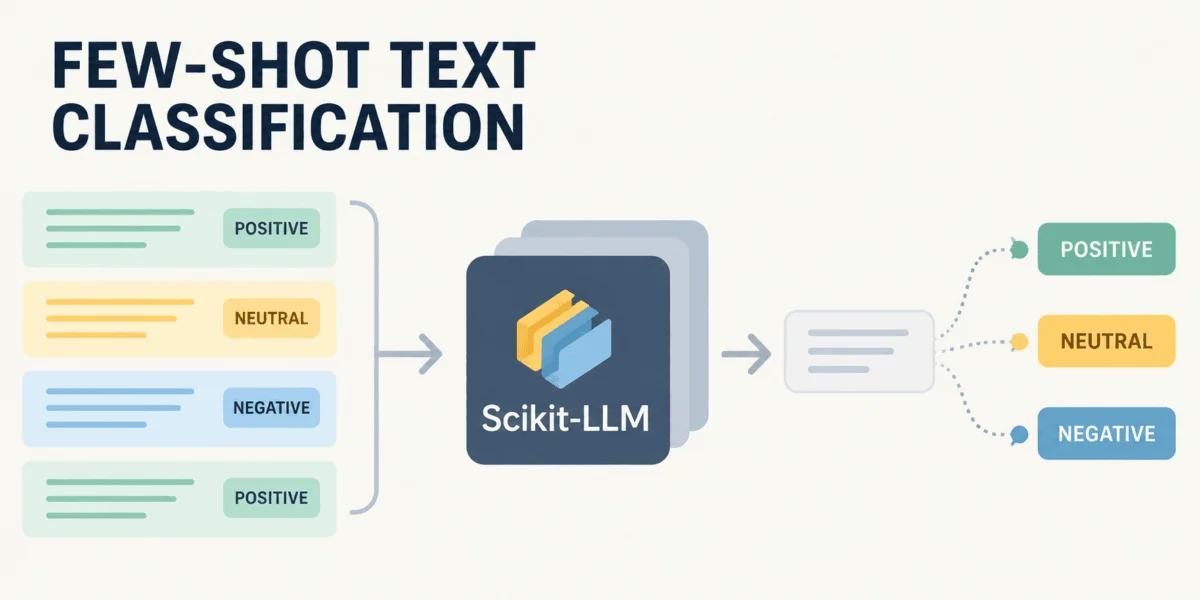
In the rapidly evolving landscape of artificial intelligence, the divide between classical machine learning and the era of Large Language Models (LLMs) has often felt like an insurmountable chasm. For years, data scientists have relied on a rigorous, time-intensive pipeline: aggregating thousands of labeled data points, performing exhaustive text preprocessing, engineering features via TF-IDF or Word2Vec, and finally training heavy-duty models like Random Forests or Support Vector Machines.
Today, that paradigm is being challenged. With the arrival of powerful LLMs, developers can perform complex classification tasks by simply prompting a model to "think." However, this shift introduces its own set of challenges—specifically, the transition from structured, programmatic pipelines to the often-unpredictable world of prompt engineering. Enter Scikit-LLM, a transformative Python library that acts as a bridge between these two worlds, wrapping the immense capabilities of LLMs within the familiar, intuitive API of scikit-learn.
Main Facts: The Intersection of Scikit-Learn and Generative AI
The core innovation of Scikit-LLM lies in its design philosophy: accessibility and familiarity. By mimicking the fit() and predict() syntax that has become the industry standard for machine learning, Scikit-LLM allows practitioners to integrate LLM-driven inference into existing workflows without rewriting their entire codebase.
The library serves as a wrapper for OpenAI-compatible endpoints, allowing users to leverage models ranging from proprietary giants to open-source alternatives hosted on high-performance inference engines like Groq. The primary advantage is the ease of implementing Few-Shot Classification. Unlike zero-shot classification—where a model attempts to categorize text without any prior context—few-shot classification provides the model with a handful of labeled examples. This "in-context learning" allows the LLM to grasp domain-specific nuances, industry jargon, and unique sentiment markers that would otherwise require fine-tuning or massive, expensive datasets.
Chronology: The Evolution of Text Classification
To understand the significance of Scikit-LLM, one must look at the historical trajectory of text classification:
- The Pre-Deep Learning Era (2000s–2015): The era of "Bag of Words" and TF-IDF. Engineers spent weeks feature-engineering to ensure a model could distinguish between sentiment or topic, often hitting a "performance ceiling" due to the limitations of simple linear classifiers.
- The Deep Learning Surge (2015–2020): The advent of BERT, RoBERTa, and other Transformer-based models. While these models yielded state-of-the-art results, they required significant computational power and thousands of high-quality, manually labeled training examples.
- The LLM Paradigm (2020–2023): Large Language Models entered the scene. While powerful, they were primarily accessed through chat interfaces or complex API calls, creating a friction point for data scientists who wanted to integrate them into automated, programmatic machine learning pipelines.
- The Bridge (2024–Present): Tools like Scikit-LLM have emerged, enabling the marriage of traditional scikit-learn workflows with the inferential power of LLMs. This allows for a modular, low-code approach to complex NLP tasks.
Supporting Data: Why Few-Shot Matters
The effectiveness of few-shot learning is supported by the inherent capabilities of modern LLMs. Research indicates that for highly specific tasks—such as classifying IT support tickets, legal documents, or medical records—providing just 3 to 5 labeled examples can yield accuracy rates that rival models trained on thousands of samples.
The "Context" Advantage
- Reduced Data Dependency: By utilizing in-context learning, developers bypass the "cold start" problem of machine learning, where a model cannot perform because it lacks a massive labeled training set.
- Domain Agility: If a company shifts its internal taxonomy, updating a few-shot prompt takes seconds, whereas retraining a traditional model could take days of GPU time and data labeling.
- Cost Efficiency: Using platforms like Groq in conjunction with Scikit-LLM allows for rapid, low-latency inference, keeping costs significantly lower than training or fine-tuning custom proprietary models.
Implementing the Solution: A Technical Walkthrough
To move from theory to practice, one can deploy Scikit-LLM within a cloud-based environment like Google Colab. The integration is seamless, requiring only an OpenAI-compatible API key.
Configuration and Setup
Using the Groq API as the engine, the configuration is straightforward:
from google.colab import userdata
from skllm.config import SKLLMConfig

# Securely retrieve credentials
groq_key = userdata.get('GROQ_API_KEY')
SKLLMConfig.set_gpt_url("https://api.groq.com/openai/v1")
SKLLMConfig.set_openai_key(groq_key)
The Workflow
The process follows a logical, step-by-step sequence:
- Preparation: Define a minimal set of
X_train(text) andy_train(labels). - Instantiation: Utilize the
FewShotGPTClassifierclass, selecting a model capable of processing the context. - Prompt-Memory Construction: The
clf.fit()method, in this context, does not update weights via backpropagation. Instead, it embeds the provided examples into the model’s prompt context, essentially creating a "memory" of how the data should be classified. - Inference: The
clf.predict()method sends new, unseen text to the LLM, which utilizes the established context to categorize the input with high precision.
Official Perspectives and Industry Implications
The rise of Scikit-LLM reflects a broader shift in the AI industry toward "Model-Agnostic Workflows." Experts in the field argue that the future of enterprise AI is not necessarily about building larger models, but about building more efficient "connective tissue" between existing models and business logic.
Iván Palomares Carrascosa, a noted leader and advisor in the AI space, emphasizes that tools like Scikit-LLM are critical for "democratizing AI." By reducing the barrier to entry, these tools allow domain experts—who may not be deep learning researchers—to harness the power of LLMs for specific, high-value tasks.
Strategic Implications
- Operational Velocity: Companies can iterate on classification taxonomies in real-time, allowing for a more agile response to changing market conditions or customer feedback.
- Interoperability: Because Scikit-LLM adheres to the scikit-learn standard, these models can be easily integrated into larger pipelines involving scikit-learn transformers, pipelines, and evaluation metrics.
- Risk Mitigation: By relying on few-shot prompting rather than fine-tuning, organizations avoid the risk of "catastrophic forgetting" or the introduction of biases that can occur during intensive model training.
Challenges and Future Outlook
While Scikit-LLM offers a powerful alternative to traditional pipelines, it is not without its limitations. Reliance on an external API means that the classification system is subject to the availability and performance of the chosen LLM provider. Furthermore, for high-volume, real-time applications where latency is measured in milliseconds, the round-trip time of an API call may necessitate a shift toward local, quantized models.
However, as the ecosystem matures, we can expect to see further integration of local inference backends, potentially allowing Scikit-LLM to operate in air-gapped or high-security environments.
Conclusion
The evolution from heavy, data-hungry machine learning models to the lean, prompt-driven architecture of Scikit-LLM represents a significant leap forward for the data science community. By abstracting the complexity of LLM interaction behind the familiar scikit-learn interface, developers are now empowered to build sophisticated, domain-aware classifiers in a fraction of the time previously required.
As we look toward the future, the ability to "teach" models with a handful of examples will remain a cornerstone of applied AI. Whether for automating support tickets, sentiment analysis, or document routing, the path forward is clear: the most effective models will be those that are easy to build, simple to maintain, and capable of adapting to the nuance of the real world.

 Sagoh
Sagoh
 Reynand Wu
 Layla Zulfa
 Nana
Nana
 Pevita Pearce
 Rifan Muazin

 Iffa Jayyana