
 Ammar Sabilarrohman
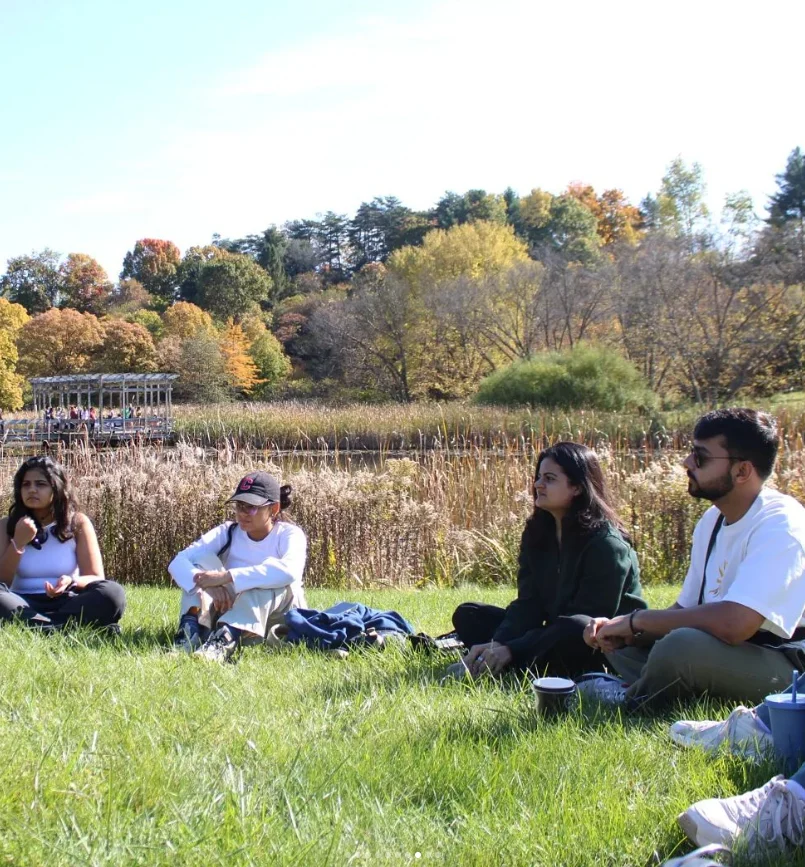
In 1984, Don Rakow was a graduate student at Cornell University, navigating the high-pressure environment of academia while struggling with his own mental health. When the weight of his responsibilities became too heavy, he found an unconventional remedy: the campus gardens.
"They were my sanctuaries," Rakow recalls. "Those gardens were essential for me to maintain balance and to survive."
Decades later, that personal sanctuary has transformed into a national movement. As a professor of plant science at Cornell, Rakow began observing a growing mental health crisis among his students. Recalling the healing power of the natural world, he questioned whether the campus itself could be part of the solution. The result was NatureRx, a pioneering program that bridges the gap between clinical mental health care and the healing power of nature.
Today, as American universities face an unprecedented surge in demand for student counseling, social prescribing—the practice of referring patients to non-medical, community-based activities—is shifting from an experimental concept to a mainstream pillar of campus wellness.
The Genesis of NatureRx: A New Paradigm
The concept of NatureRx began at Cornell as a dual-pronged approach. First, it functioned as a student-run club that organized nature-based activities. Second, and more significantly, it integrated "nature prescriptions" into the campus health system. Physicians and counselors at Cornell Health now embed formal referrals for nature activities directly into students’ electronic health records.
Dr. Jonathan Keffer, a physician at Cornell Health, views this not as a mere suggestion, but as legitimate medical treatment. "This is actually physiologically proven medical treatment," Keffer explains. The program relies on a robust body of research demonstrating that time spent in natural environments can significantly mitigate symptoms of stress, anxiety, and depression.
By "medicalizing" these referrals, clinicians are able to track outcomes, measure efficacy, and treat the root causes of stress rather than just the symptoms. It is a structured, intentional approach to well-being that validates the student experience of burnout.
A Historical Context: The Mental Health Crisis
To understand why social prescribing has gained such traction, one must look at the evolution of campus health. The first dedicated campus mental health services appeared at Princeton University in 1910, prompted by a rise in students dropping out due to emotional distress. However, it took nearly 50 years for such services to become standard practice.
The situation reached a breaking point in the 21st century. Between 2009 and 2015, the utilization of campus counseling centers outpaced enrollment growth. A comprehensive study of over 350,000 students conducted between 2013 and 2021 revealed a staggering 135% increase in depression and a 110% increase in anxiety.

Faced with these statistics and a series of tragic events at Cornell in the early 2010s, the university administration expanded its response. Beyond hiring more clinical staff, they turned to Rakow and the NatureRx initiative. This move recognized a fundamental truth: counseling and medication are essential, but they are not the only tools available for fostering resilience.
The Physiology of "Touching Grass"
The efficacy of NatureRx is rooted in biology. Research co-authored by Rakow indicates that the mental health benefits of nature can manifest in as little as 10 minutes. When a student steps into a forest or a garden, their body’s physiological response to stress—often characterized by high cortisol levels—begins to shift.
Nature exposure activates the parasympathetic nervous system, the body’s "rest and digest" mechanism. This, in turn, lowers cortisol, reduces heart rate, and modulates the anxiety response. As Dr. Keffer notes, explaining these biological mechanisms to students is a key part of the prescription. "I may medicalize it a little bit—talk about the vagal tone, how nature cools down the nervous system—to make it seem more like a treatment," he says.
For students, this often provides a sense of agency. A student seeking help for insomnia or fatigue may be surprised to receive a prescription for an outdoor walk, but when framed as a "treatment" for their nervous system, the advice is often taken more seriously.
Expanding the Network: 120 Campuses and Counting
Following his retirement from Cornell, Rakow co-founded the Campus Nature Rx Network in 2019 alongside Professor Dorothy Ibes of the College of William & Mary. Supported by the REI Cooperative Action Fund, the network provides resources, free membership, and guidance to universities looking to build their own social prescribing programs.
To date, approximately 120 institutions have joined the network. The goal is to provide a scalable model that can be adapted to any campus, whether it is an urban university with limited green space or a rural college with expansive forests. The programs vary by location, but the core objective remains the same: integrating well-being into the daily life of students in ways that are sustainable and accessible.
Social Prescribing Beyond Nature
While nature is a primary focus for many schools, the movement is expanding to include art, movement, and community service. At Stanford University, the SocialRx program (formerly Art Pharmacy) connects students to "doses" of cultural experiences, including museum visits, pottery classes, and dance workshops.
The early results at Stanford are telling: 80% of referred students reported an improvement in their mental health after engaging in these activities. This suggests that the barrier to student wellness is often not a lack of interest, but a lack of connection.
At the University of Michigan, clinical assistant professor Lindsey Mortenson discovered that the primary barrier for students wasn’t the absence of events, but a combination of time poverty and social anxiety. In response, Michigan launched Experience Rx, a comprehensive program that prescribes diverse social activities, and established the Institute for Social Prescribing to formalize research into these interventions.

Similarly, at New York University, Professor David Hollander utilizes the "HoopsRx" model, teaching students that movement and belonging through basketball can serve as a potent, non-clinical intervention for loneliness.
The Path Forward: Implications and Challenges
Despite the success of these programs, there are skeptics who question whether social prescribing is merely a band-aid for the deeper structural issues plaguing higher education—such as tuition costs, academic hyper-competition, and the sociopolitical stressors of the modern era.
Don Rakow is the first to acknowledge that NatureRx is not a panacea. "Spending time in nature is not a cure-all," he emphasizes. It is meant to complement, not replace, clinical counseling and psychiatric care. However, the data suggests that for the vast majority of students, these programs act as a vital preventive measure.
The 2024-25 Healthy Minds Study found that nearly 40% of students report moderate to severe depressive symptoms. When counseling centers are understaffed and overwhelmed, social prescribing offers a way to "triage" needs while empowering students to take ownership of their own mental health.
Measuring Success
The primary challenge for these programs remains data collection. Because the prescriptions are highly customizable, measuring the exact dosage and impact is difficult. However, the qualitative evidence is overwhelming. When students at Cornell, Stanford, or Michigan step away from their screens to walk, create art, or join a community group, the results are consistent: they feel more clear, more receptive, and more connected.
As Ani Minic, a student athlete and participant in the HoopsRx campaign, reflected after finding her old journal, the "happy place" is not a luxury—it is a necessity. "I step on the field, and all of my worries disappear," she wrote.
By formalizing these "happy places" as part of the university health experience, institutions are finally acknowledging what students have long known: that health is not just the absence of illness, but the presence of connection—to each other, to our communities, and to the natural world. As more universities adopt these models, the definition of a "medical prescription" continues to evolve, proving that sometimes, the most effective medicine is the one that brings us back to ourselves.


 Layla Zulfa

 Ali Ikhwan


 Asep Darmawan

 Asro


 Nila Kartika Wati

 Muslim
