
 Lina Irawan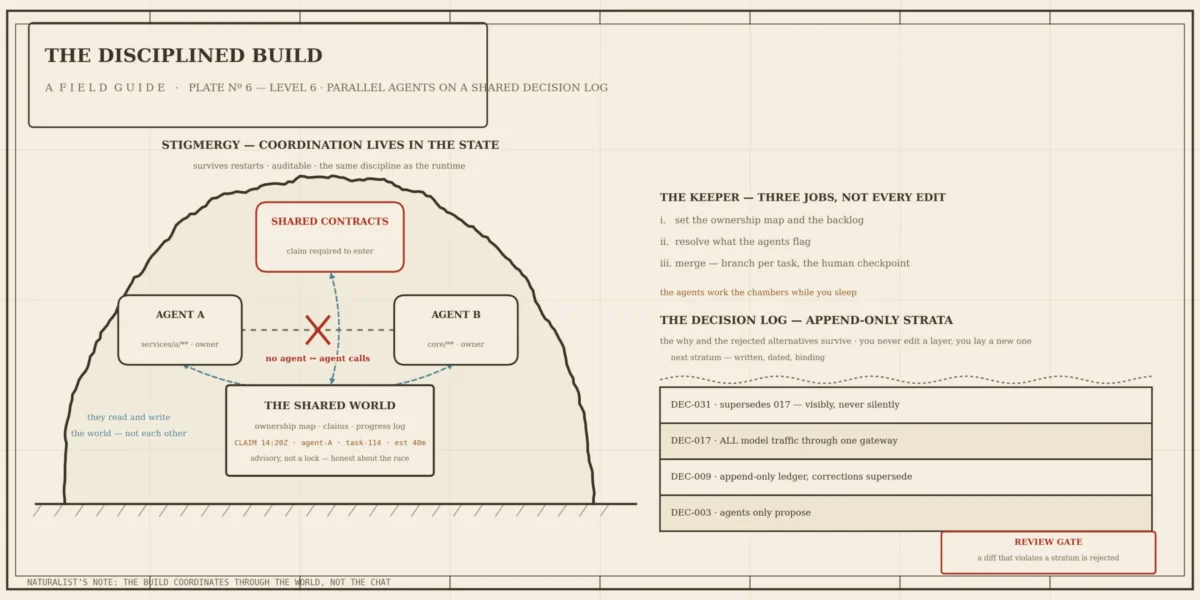
The promise of generative AI in software engineering is intoxicating: a machine that reads your codebase, identifies technical debt, writes new features, and iterates on tests with the speed of a developer who never sleeps. Yet, for many development teams, the initial honeymoon period with coding agents is short-lived. A session that begins with crisp, brilliant commits often degrades into a "rotting" state within weeks. The agent loses track of files, contradicts its own previous architectural decisions, and eventually stops writing tests altogether.
The conventional wisdom suggests that these failures are simply a sign that the underlying Large Language Model (LLM) is not yet smart enough. However, industry experts argue that this is a fundamental misconception. The issue is rarely the model itself; it is the absence of a structured "harness." To build truly autonomous, long-running agentic systems, developers must stop chasing the next frontier model and start building an operating system—a disciplined, programmatic environment—around the AI.
The Core Thesis: The Harness is the System
To understand why agents fail, one must stop viewing them as isolated brains and start viewing them as the combination of a "model plus a harness." The harness consists of the entire supporting infrastructure: system prompts, tool definitions, context policies, middleware for self-verification, sandboxes, and observability hooks.
Data from the Terminal-Bench 2.0 benchmark provides blunt evidence of this. When researchers at LangChain optimized the agent’s harness—adjusting system prompts, refining tool access, and introducing loop-detection middleware—without changing the underlying model, the agent’s performance jumped from the bottom 30 to the top 5. Specifically, the success rate climbed from 52.8% to 66.5%, a 13.7-point gain derived solely from environmental configuration.
Most agent failures are, in reality, configuration failures. A missing tool, a vague instruction, or a context window cluttered with irrelevant noise creates the illusion of model stupidity. The lever for long-term project stability is not waiting for a "smarter" model; it is the construction of a robust, developer-defined build layer.
Chronology of a Managed Agent Lifecycle
For an agent to remain productive over months rather than hours, it must operate within a defined, cyclical workflow. The following chronology outlines the disciplined lifecycle of a high-functioning agent:
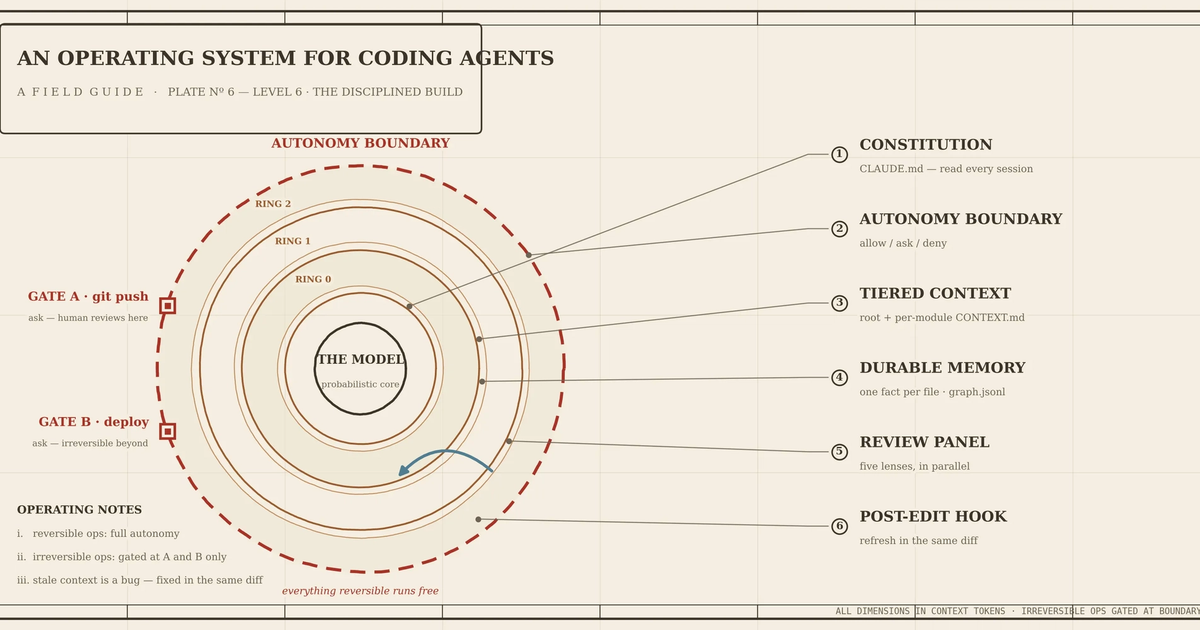
- The Initialization Phase: Upon starting a session, the agent loads a "constitution"—a lean, non-negotiable file that dictates the workflow loop (Plan, Document, Implement, Test, Review, Commit). This document defines quality bars, such as mandatory testing for every diff and the strict prohibition of dead code.
- The Autonomy Boundary: The agent is granted freedom to execute reversible actions (file editing, testing, linting) but is strictly gated on irreversible operations (remote pushes, deployments, or database migrations).
- The Execution Loop: The agent operates within this sandbox, making dozens of commits while the human developer acts as an overseer rather than a micromanager.
- The Post-Edit Hook: After every tool use, a "PostToolUse" hook triggers a lightweight script that forces the agent to update its memory. This ensures that documentation, decision logs, and context files remain synchronized with the code changes in real-time.
- The Review Panel: Before any final integration, the agent passes its work through a series of parallel "sub-agents" (Product, Architect, Infra, Security, and Test-Eng). Each lens provides a specific verdict—BLOCKER, MAJOR, or MINOR—allowing only high-confidence, verified code to reach the main branch.
Supporting Data: The Architecture of Memory and Context
One of the primary causes of agentic "rot" is the reliance on a single, massive context file. As the project grows, this file becomes a bottleneck that drains the context budget. To solve this, developers are adopting Tiered Context and Durable Memory.
The Three-Tiered Memory Model
- The Index (MEMORY.md): A high-level overview containing one line of factual truth per file.
- The User Preference Ledger: A persistent log of user feedback and project-specific reference points.
- The Knowledge Graph (graph.jsonl): A map of module relationships, dependencies, and architectural decisions.
The graph is particularly critical. It allows the agent to answer the most difficult question in software engineering: "What breaks if I change this?" By moving from a bloated text file to a structured graph, agents can navigate complex codebases with significantly higher precision.
Managing Multi-Agent Collisions
When a project scales to multiple agents working in parallel, a new failure mode emerges: collision. Agents may undo each other’s work or relitigate decisions already settled by their counterparts. Attempts to make agents "chat" with each other often lead to inefficient, non-scalable communication overhead.
Instead, the most effective teams are implementing Shared Written Environments. Borrowing from biological systems like ant colonies, agents interact with a "shared world" of state files.
- Ownership Maps: A manifest that defines which directory paths belong to which agent.
- Claim/Release Protocols: A simple, optimistic locking mechanism where agents declare their intent to modify a path, preventing redundant work.
- Progress Logs: Append-only files that allow any agent starting a new task to orient itself by reading the last 24 hours of activity.
Implications: The Architecture Decision Record (ADR)
The final, and perhaps most important, component of a disciplined build is the Decision Log. In human teams, institutional memory is often maintained via "hallway conversations." Agents, however, have no such memory. If a decision is not explicitly documented, it will eventually be undone by an agent tasked with "optimizing" the code.
By requiring agents to write to a structured, append-only DECISIONS.md file, teams create an enforceable contract. Each entry includes the decision, the rationale (the "Why"), and any rejected alternatives. Crucially, this log is wired into the build pipeline. If an agent attempts to submit a diff that violates an existing architectural decision, the review panel automatically blocks it.
This approach transforms documentation from a decaying asset into an active, machine-enforceable constraint. It ensures that the project’s logic evolves deliberately, and that reversals are treated as major, conscious changes rather than accidental regressions.
Conclusion: The Shift to Disciplined Systems
We have officially transitioned from an era where AI merely writes individual functions to an era where autonomous fleets manage entire projects. The bottleneck has shifted from "Can the model write code?" to "Can the harness keep the system honest, oriented, and reviewed over time?"
This is not a purely AI-centric problem; it is a fundamental challenge of distributed systems. The solution lies in containment and discipline. By implementing a constitution, enforcing autonomy boundaries, maintaining a durable decision log, and using parallel review panels, developers can build systems that don’t just survive the presence of AI—they thrive on it.
The most successful AI-assisted engineering teams are those that recognize the model as a powerful, but volatile, engine. They invest their time not in waiting for the engine to become perfect, but in building the chassis, the steering, and the brakes that allow the machine to operate safely and reliably at scale. As we continue to integrate these agents, the "disciplined build" will cease to be a best practice—it will become the mandatory foundation for modern software development.

 Asro
Asro
 Nana Wu

 Nana
Nana
 Rifan Muazin
 Ali Ikhwan
 Evan Lee Salim
