
 Neng Nana
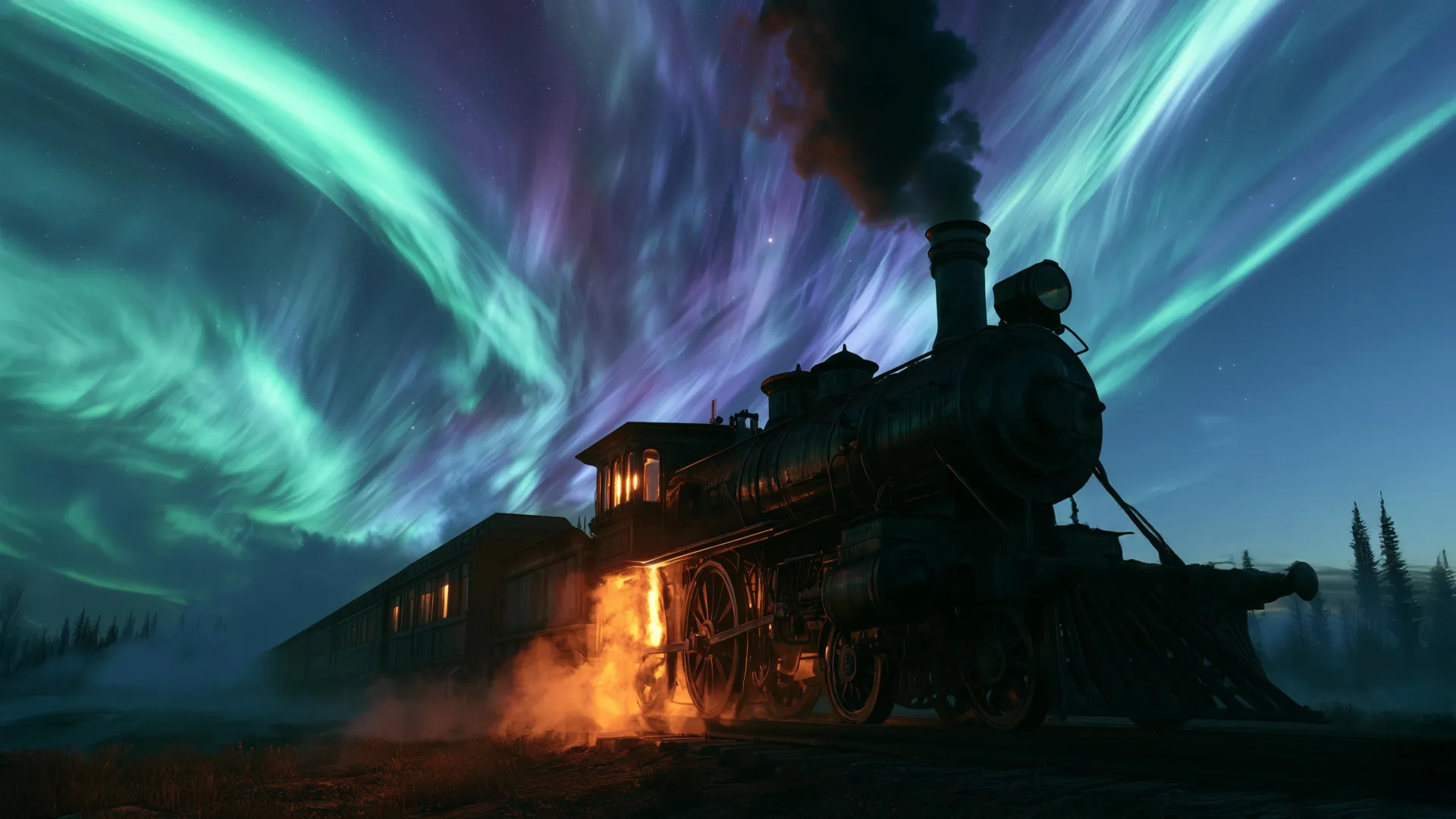
In the annals of scientific discovery, breakthroughs are often forged in high-tech laboratories with particle accelerators or supercomputers. Occasionally, however, the most profound revelations are found gathering dust in archival vaults. A multidisciplinary team of international researchers has recently unearthed a historical "glitch" in the timeline of space weather, correcting a 178-year-old error that fundamentally shifts our understanding of how the Sun’s temperamental behavior first collided with human innovation.
The investigation, spearheaded by Lancaster University and featuring experts from RMIT University, the British Geological Survey, and RAL Space, centered on a mysterious 16-minute delay of a train in Exeter, England. For nearly two centuries, this incident was cited as the earliest recorded instance of a solar storm disrupting human technology. But as the researchers discovered, the history books—and a 19th-century typo—were leading us astray.
The Mystery of the 1841 Exeter Delay
The narrative began with a 1871 report published in the prestigious scientific journal Nature. An anonymous author recounted a “very intense magnetic disturbance” that allegedly occurred on October 18, 1841. According to the account, this geomagnetic surge wreaked havoc on railway telegraph signals in Exeter, causing a 10:05 p.m. train to grind to a halt for 16 minutes.
For generations, historians and space scientists viewed this report as the "Patient Zero" of technological vulnerability to space weather. It was a compelling tale: the dawn of the electrical age meeting the fury of the Sun. However, when Associate Professor Brett Carter of RMIT University and his colleagues began to cross-reference the report with modern digitized archives, they encountered a chronological impossibility.
The Exeter-to-Starcross railway line, the very tracks where this spectral delay supposedly occurred, did not open to the public until 1846. The discrepancy was glaring: the event could not have taken place in 1841, as the infrastructure required for the incident had not yet been built.
"In this study, we effectively investigated what had to be a typo in a Nature paper from 1871," said Professor Carter. "We know it was a typo because the Exeter-to-Starcross train line mentioned in that paper didn’t exist until 1846, which is five years afterwards."
A Chronological Reconstruction: Solving the Puzzle
With the 1841 date invalidated, the team embarked on a detective mission that spanned several continents and disciplines. They turned to the only tools available for an era before satellites and digital sensors: historical newspapers, railway timetables, and, crucially, the magnetic field observations recorded by Victorian-era observatories.
By aligning the records of geomagnetic disturbances—which were meticulously tracked by magnetic observatories in the mid-19th century—with the operational history of the Exeter railway, the team identified a new, definitive date: October 18, 1848.
Exactly seven years after the erroneously reported date, a massive solar event occurred that perfectly matched the conditions described in the 1871 account. This revision not only corrected a persistent historical error but also placed the event within a more accurate context of industrial development. The 1840s represented a "technological intersection," a period where the rapid expansion of telegraphy and rail networks suddenly made human society susceptible to the unseen forces of the solar wind.
The Carrington Event: The Gold Standard of Solar Fury
To understand why the Exeter incident is so vital to modern science, one must consider the benchmark of solar storms: the Carrington Event of 1859. This cataclysmic solar flare and subsequent coronal mass ejection (CME) remains the most powerful geomagnetic storm in recorded history.
The Carrington Event did not merely delay trains; it brought the world to a standstill. Auroras were reported as far south as the Caribbean and Hawaii, glowing with such intensity that miners in the Rocky Mountains awoke at midnight, convinced that the sun had risen, and began preparing breakfast. Telegraph systems, the "internet" of the Victorian era, were overwhelmed. Operators reported sparks showering from their equipment, some receiving severe electrical shocks, and in several instances, telegraph lines continued to function even after their batteries had been disconnected, powered entirely by the raw electricity surging through the atmosphere from the Sun.
While the Carrington Event is the most famous, the Exeter research highlights that our infrastructure was being tested by the Sun even before the Victorian public was aware of the phenomenon.
Official Perspectives: The Scientific Significance
The study, published in the American Geophysical Union’s journal Space Weather, emphasizes the importance of archival preservation. Dr. Mike Hapgood, a visiting scientist at the UK’s RAL Space, noted that the research process mirrors a classic forensic investigation.
"It highlights the importance of preserving these older records, which give us the evidence base we need to interpret past events and strengthen future predictions," Dr. Hapgood explained. By synthesizing the "analog" data of the 1840s with modern meteorological modeling, the team proved that we can reconstruct historical space weather patterns with surprising accuracy.
Professor Jim Wild, who led the Lancaster University team, underscored that the findings strip away the myth that space weather is a modern, satellite-age problem. "What this research highlights is that space weather is not a new threat but a long-standing natural hazard," Wild stated. "Society has been experiencing the effects of space weather on technology for almost as long as electrical technologies have existed."
The team also clarified that while the Exeter event is no longer the "earliest" recorded instance, it remains a critical case study. The distinction of the first confirmed technological disruption by space weather now officially belongs to an incident on Britain’s Midland Railway in March 1847.
Implications for a Vulnerable Future
The transition from the 19th to the 21st century has seen our reliance on electricity grow from simple telegraph keys to global power grids, GPS navigation, and satellite-based communication. Yet, the physical mechanism behind the danger remains identical.
When a coronal mass ejection hits the Earth’s magnetosphere, it induces electrical currents in long, conductive structures. In 1848, these were railway lines and telegraph wires. Today, they are multi-billion-dollar power transformers and deep-sea fiber optic cables. The threat has not changed; it has only scaled.
"Understanding this historical event is important because the 1840s mark the intersection between the rise of our technological age and space weather," Professor Carter remarked. "Since this line was crossed, humans have not looked back."
Preparing for the 2030s
As we look toward the next decade, the urgency of this research becomes clear. We are entering a new cycle of solar activity, and our global infrastructure is more interconnected than ever. The lessons learned from the Exeter train delay are not merely academic curiosities—they are warnings.
By analyzing how 19th-century operators handled—or failed to handle—these surges, scientists are developing better mitigation strategies for modern electrical grids. The goal is to ensure that when the next "Carrington-class" event occurs, we are not left in the dark.
The 178-year-old mystery of a delayed train in Exeter has served a final, vital purpose: it has reminded us that the Sun is a constant, powerful force in our environment. By correcting the past, we are better equipped to protect the future, ensuring that the next time the Sun flares, our technology remains resilient in the face of the celestial storm.


 Raul Delapena Setiawan

 Laily UPN

 Reynand Wu

 Sagoh


 Azzam Bilal Chamdy

 Ali Ikhwan
