
 Reynand Wu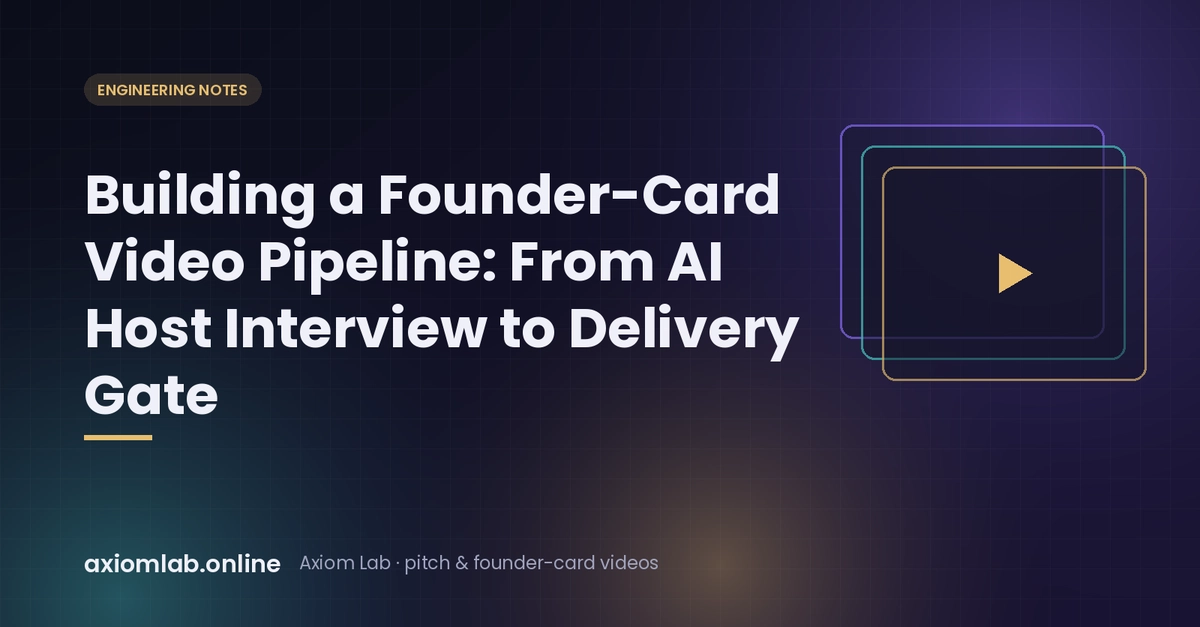
TL;DR: Generating a two-minute startup video using artificial intelligence is not a single prompt-to-result operation. It is a complex, multi-stage chain—encompassing scriptwriting, storyboarding, shot generation, voice synthesis, and final editing—where every link is a potential point of failure. This article deconstructs the pipeline, explores how to implement automated or human-in-the-loop checks at each gate, and explains why final quality assurance (QA) is the ultimate arbiter of professional delivery.
The Myth of the "Few-Minute" Render
Ask a software engineer how long it takes to "make an AI video," and you will likely hear a response centered on the speed of GPU inference: "A few minutes." Ask a producer who has successfully delivered high-stakes pitch videos, product launch films, or accelerator application clips to demanding founders, and you will hear a different story.
While the raw generation of pixels and audio is indeed rapid, the process of arriving at a deliverable, professional-grade video takes significantly longer. The primary friction point is quality control. A modern video pipeline chains together several probabilistic generative systems. Because these systems do not inherently understand the "truth" or the "intent" of a project, errors do not remain isolated in the stage where they occurred; they compound. A minor factual inaccuracy in an initial script becomes a confident, synthesized voiceover, which then manifests as an incorrect on-screen caption—eventually becoming the specific misinformation an investor remembers during a pitch.
The Pipeline: A Chronology of Creation
To minimize the compounding of errors, production must be viewed as a series of distinct stages. The guiding design principle here is simple: Check at the boundary, not just at the end. A failure caught at the scriptwriting phase is a minor, inexpensive adjustment; a failure caught at the final render stage is a catastrophic loss of time and compute resources.
Gate 1: Ingest—The Foundation of Intent
The most expensive failures occur before a single frame is generated. Startups often provide decks that are highly compressed documents, relying on human presenters to fill in the context. An AI, lacking this tacit knowledge, will struggle with ambiguity.
- What breaks: The AI interprets "3x faster" without knowing the benchmark, leading to vague, unconvincing marketing copy.
- The Gate: This stage requires a "context-validation" layer. Before the script is generated, the system (or a human editor) must extract core claims and verify them against source documentation. If the source material is ambiguous, the ingest gate should trigger a query back to the founder for clarification. It is the cheapest gate to maintain and the one most frequently skipped.
Gate 2: Scripting—Structure vs. Fluency
Large Language Models (LLMs) are masterful at writing fluent, grammatically perfect text. However, "fluent" is often the enemy of "accurate."
- What breaks: Scripts often drift from source facts, suffer from "startup buzzword fatigue," or fail to hit strict timing requirements.
- The Gate: Implementation of a "fact-checker" agent that compares the script against the source deck is essential. Furthermore, a timing-check algorithm should measure the projected audio duration against the visual beats of the video. If the script is too long, the gate stops the process before any animation is generated.
Gate 3: Storyboarding—Words into Visual Claims
The storyboard is where the script becomes concrete. This is where many "turn-key" AI video products fail because they treat visuals as mere decoration rather than evidence.
- What breaks: The visual element does not support the specific claim being made in the audio, creating a cognitive dissonance for the viewer.
- The Gate: A "relevance-check" layer is required here. Every script beat must be cross-referenced with a visual prompt. If the prompt lacks a clear connection to the narrative, it must be flagged for manual refinement or re-prompting.
Gate 4: Asset Generation—The Consistency Crisis
This is the phase most users associate with "AI Video." The primary hurdle is temporal and spatial consistency. Characters, color palettes, and stylistic elements often shift from shot to shot.
- What breaks: A "CEO" character may change hair color or facial structure between frames. The lighting in a scene might shift drastically, breaking the immersion of the film.
- The Gate: Automated systems must implement a "style-anchor" database. By keeping a consistent set of character and environment LoRAs (Low-Rank Adaptation models), the pipeline ensures that assets generated at the beginning of the video match those generated at the end. Any asset that deviates from the established style vector must be automatically rejected and re-queued.
Gate 5: Assembly—Pacing and Readability
Even with perfect assets, a video can fail if the pacing is off. Assembly errors are often subtle, as no individual frame is technically "broken," yet the final product feels disjointed.
- What breaks: Subtitles might overlap with on-screen action, or the transition between two shots might create a "jump-cut" that feels jarring rather than intentional.
- The Gate: A programmatic check for "visual density." If a scene is too cluttered or the text-to-image ratio is off-balance, the assembly engine should trigger an automated adjustment of layout or duration.
Gate 6: Final QA—The Gate of Delivery
Every previous gate exists to make this one boring. Final QA is a full, granular watch-through performed by a human who was not involved in the actual production of the video. This separation of duties is vital because producers often develop "blind spots" to their own mistakes.
Implications for the Industry
The shift toward AI-assisted production changes the business model of creative services. Companies like Axiom Lab, for example, have adopted a model where the customer pays only upon the successful completion of a film that passes rigorous QA. This creates a powerful incentive: a video that fails Gate 6 yields no revenue.
This financial structure forces the production pipeline to be robust. It discourages the practice of "shipping to iterate" and instead rewards the construction of a pipeline where errors are visible early. If you are building or purchasing generative tools, the question is not "How fast can this generate?" but rather "Where are the gates, and who is held accountable when a gate is skipped?"
Supporting Data and Metrics
To effectively manage a multi-stage pipeline, managers should track specific "leakage" metrics:
- Gate-Level Reject Rate: What percentage of scripts fail the truth-check? This indicates if the ingest process is capturing enough data.
- Re-render Frequency: How often does an asset need to be re-generated at the assembly stage? A high rate here indicates poor prompts at the storyboarding level.
- Human-Intervention Time: The time spent manually correcting output after the automated pipeline has finished. The goal is to drive this toward zero.
The Broader Lesson: From "Generation" to "Visibility"
Multi-stage generative systems do not fail in the way traditional software fails. There is rarely a "crash" or a "404 error." Instead, you receive a perfectly valid, fluent, and high-resolution video that is fundamentally wrong in its claims or inconsistent in its logic.
The engineering challenge has shifted from "improving the model’s output quality" to "making errors visible." By creating a system of gates, we turn an opaque, probabilistic process into a transparent, predictable pipeline. Whether you are a founder looking to polish a pitch or a developer building the next generation of video tools, the solution remains the same: stop focusing on the speed of the render and start focusing on the rigor of the review.
In the current landscape, the value of an AI video is not found in the AI itself, but in the human-led gates that ensure the output is fit for professional consumption. If a tool cannot clearly define where its gates are, its output is likely too risky to put in front of an investor.


 Jia Lissa
 Layla Zulfa
 Basiran
 Neng Nana
 Nana Muazin

 Laily UPN
 Asep Darmawan