
 Layla Zulfa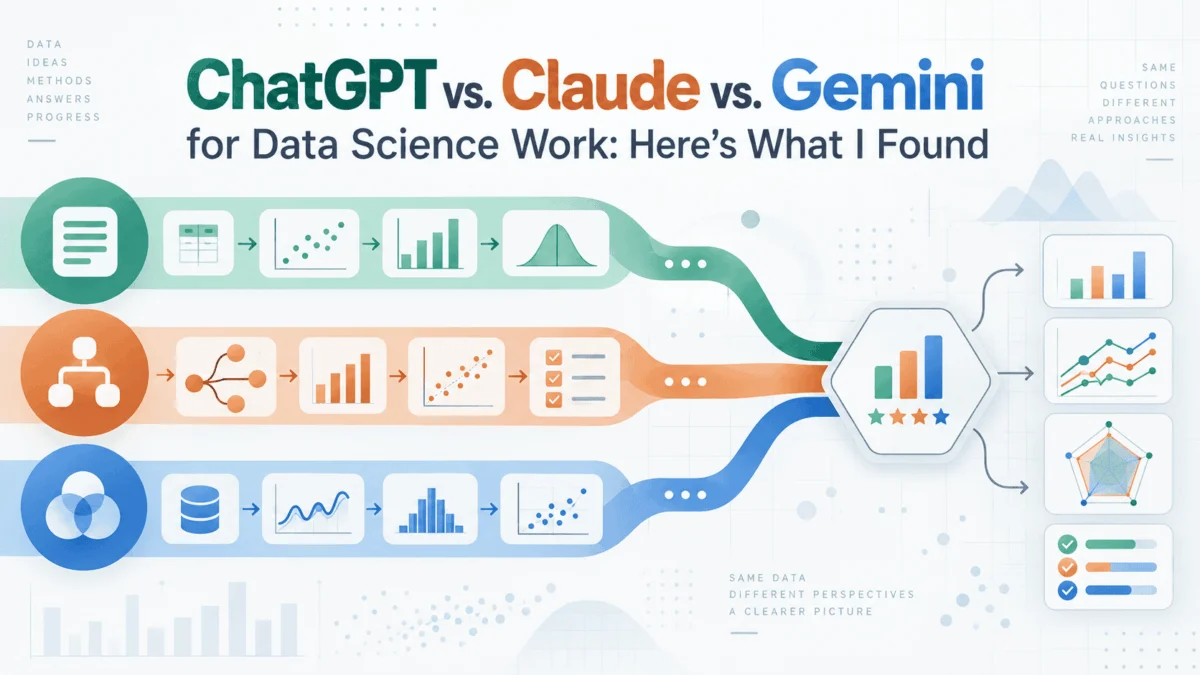
The landscape of data science is currently undergoing a radical transformation. For decades, the profession was defined by the mastery of IDEs, syntax-heavy libraries, and manual debugging. Today, that barrier to entry is being dismantled—or at least heavily modified—by a new generation of Large Language Models (LLMs). As AI assistants become embedded into the daily workflows of data scientists, the question is no longer whether to use them, but which one to deploy for specific analytical challenges.
This article provides an in-depth analysis of the current "Big Three" in the AI space: OpenAI’s ChatGPT, Anthropic’s Claude, and Google’s Gemini. By examining their strengths in statistical reasoning, code generation, and context management, we can determine how to leverage these tools to enhance, rather than replace, human expertise.
The Rise of the AI Analytical Assistant
In the span of just two years, the industry has shifted from manual coding to "AI-assisted programming." Whether the task is explaining a p-value, debugging a complex regression script, or performing exploratory data analysis (EDA) on a messy CSV, data scientists are increasingly relying on LLMs.
However, these tools are not interchangeable. While they all utilize advanced transformer architectures, their underlying training objectives and "personalities" differ significantly. A recent 2025 peer-reviewed study, which evaluated six AI assistants across 20 distinct statistical test selection scenarios, found a universal 100% accuracy rate for basic selection. Yet, the nuance lies in the methodology of the output: while all models reached the correct conclusion, the path to that conclusion varied in clarity, pedagogical value, and logical structure.
Comparative Anatomy: How the Big Three Function
1. ChatGPT: The Polished Generalist
ChatGPT (specifically via its GPT-4o iteration) remains the industry benchmark for data exploration. Its most compelling feature is its integrated "Data Analysis" environment. Unlike models that merely suggest code, ChatGPT can ingest raw data files, write Python scripts in a sandboxed environment, execute them, and return visualizations or summary statistics.
- Best For: Rapid iteration. If you have a CSV and need to visualize distributions or remove outliers on the fly, ChatGPT’s conversational feedback loop is unmatched.
- Workflow: It acts as an interactive notebook. You can instruct it to "recalculate with a log transformation" mid-session, and it handles the backend logic seamlessly.
2. Claude: The Methodical Architect
Anthropic’s Claude has earned a reputation for being the most "thoughtful" of the bunch. It excels at adhering to complex instructions and maintaining logical consistency over long-form conversations.
- Best For: Complex code architecture. When tasked with building data pipelines or object-oriented preprocessing classes, Claude tends to produce cleaner, more modular, and better-documented code than its peers.
- Strengths: It is less prone to "shortcut-taking." While ChatGPT might jump to a quick solution, Claude tends to provide a more methodical walkthrough, making it an excellent choice for peer-reviewing your own logic.
3. Gemini: The Ecosystem Powerhouse
Google’s Gemini is built for the professional who lives within the Google Cloud and Workspace ecosystem. Its ability to pull data directly from Google Sheets, BigQuery, and Google Drive reduces the friction of data ingestion.
- Best For: Research and large-scale synthesis. With its expansive context window and real-time access to Google Search, Gemini is the superior tool for synthesizing information from multiple external sources or analyzing massive documentation sets.
- Strengths: It excels at pedagogical tasks, frequently cross-referencing related concepts to provide a holistic view of a statistical problem.
Statistical Reasoning: A Deep Dive
While LLMs have become proficient at coding, statistical reasoning remains the "final boss" of AI reliability. When asked to explain the application of a Welch’s t-test versus a standard independent samples t-test, all three models provide technically correct answers. However, the divergence appears in the explanation of assumptions.
- The Claude Advantage: Claude provides the most structured reasoning. It explicitly lists the assumptions—normality, homogeneity of variance, and independence—and explains the consequences of violating them.
- The ChatGPT Approach: ChatGPT focuses on the "practical application." It is more likely to provide a snippet of code alongside the explanation, connecting the theory to the business case.
- The Gemini Pedagogy: Gemini excels at the "why." It often provides broader context, such as how a specific test relates to other non-parametric alternatives, making it an excellent tool for learners or researchers.
A Critical Note on Accuracy: While these models perform well on textbook problems, they can struggle with "statistical hallucinations." They may suggest a procedure that is mathematically sound but inappropriate for the specific dataset at hand, failing to account for nuances like influential observations or non-independent residuals.
The Evolution of Workflow Integration
The transition from simple code generation to "agentic" data science is evident in how these tools handle context.
Chronology of Features
- 2023: The era of "copy-paste." Users would ask for code, copy it to their IDE, and fix the errors manually.
- 2024: The era of "sandboxed execution." ChatGPT and Claude introduced built-in code interpreters, allowing for end-to-end analysis within the chat interface.
- 2025: The era of "contextual integration." Models are now being trained to understand long-form documentation and massive datasets, with Gemini leading in window size and Claude leading in reliability over long contexts.
Implications for the Data Science Profession
The adoption of these tools forces a shift in the data scientist’s skill set. The value is migrating away from syntax memorization and toward statistical literacy and verification.
The Need for Skepticism
Regardless of the model, the "human in the loop" is more important than ever. AI assistants are prone to:
- Outdated Syntax: Particularly in Gemini, users may occasionally encounter deprecated functions for niche Python libraries.
- Assumption Blindness: Models often overlook the structural properties of data. If your data is heavily skewed or contains significant measurement errors, the AI will likely process it using the default settings of the chosen library, potentially leading to biased results.
- Security Risks: Data privacy is a paramount concern. Enterprises must ensure that uploading sensitive, proprietary data into a public-facing AI model does not violate internal compliance policies. Many organizations are now opting for enterprise-tier API access, which typically guarantees that data is not used for model training.
Strategic Recommendations: Matching Tool to Task
To optimize your workflow, consider a multi-tool strategy:
| Task | Recommended Tool |
|---|---|
| Exploratory Data Analysis (EDA) | ChatGPT (for its rapid-fire sandboxed environment) |
| Complex Code/Pipeline Building | Claude (for superior code structure and instruction adherence) |
| Research & Multi-Source Synthesis | Gemini (for search integration and large context windows) |
| Learning/Pedagogy | Gemini (for its cross-referencing and teaching style) |
| Refactoring/Debugging | Claude (for high-fidelity code maintenance) |
Conclusion: The Future of the AI-Augmented Scientist
We are moving toward a future where the AI assistant acts as a "second brain" for the data scientist. The goal is not to outsource the thinking, but to outsource the repetitive, low-value cognitive labor—such as writing boilerplate code or looking up documentation syntax.
The most successful data professionals today are those who treat these models as junior partners. They provide the hypothesis, the high-level logic, and the final verification, while leaving the execution to the AI. As the technology continues to iterate, the ability to prompt effectively and verify results critically will become the defining characteristics of the next generation of data science leaders.
Final Warning: Treat these tools as a source of potential insight, not ground truth. Always verify the output, check the assumptions of your statistical models, and ensure your data handling meets your organization’s privacy standards. In the age of AI, your expertise in the why is your most valuable asset.
Vinod Chugani is an AI and data science educator who bridges the gap between emerging AI technologies and practical application for working professionals. His work focuses on agentic AI, machine learning workflows, and the strategic implementation of automation in quantitative fields.

 Basiran
 Siti Muinah

 Neng Nana
 Nana Muazin
 Jia Lissa
 Laily UPN
 Asep Darmawan