Lina Hope
Every website experiences a distinct, inevitable lifecycle. On launch day, it is a masterpiece—a pristine collection of code, design, and messaging that perfectly aligns with the company’s vision. But as the clock ticks forward, the site begins a slow, silent drift. It doesn’t break, and it doesn’t go offline. Instead, it becomes a "period piece." As the market shifts, competitors innovate, and internal design systems evolve, the static website becomes an anchor of technical and messaging debt.
For years, the web development industry has treated this decay as a law of nature. However, a new paradigm is emerging: the autonomous website. Led by pioneers like Pierre Burgy and the team behind the platform Fimo, the industry is beginning to ask if websites can move beyond the "set it and forget it" model to become living, self-optimizing entities.
Yet, as Burgy discovered, the challenge of building an autonomous web is not technological; it is deeply human.
The Philosophy of Persistent Improvement
The traditional web development cycle is inherently front-loaded. Teams spend months in discovery, design, and development, culminating in a high-stakes "go-live" moment. From that point forward, the site is technically in a state of entropy. Small issues accumulate: an uncompressed image here, a broken meta tag there, or a design token that fails to propagate to the pricing page.
Autonomous websites aim to reverse this decay. Imagine a site that, while its human curators sleep, proactively updates its own design system, fixes accessibility regressions, and optimizes assets. The result is a website that is objectively better on its 300th day than on its first.
The Core Problem: The Autonomy Paradox
When developers and stakeholders are first presented with the concept of an "autonomous website," the initial reaction is often visceral resistance. The fear is not that the technology will fail, but that it will succeed too well—removing the human element from a digital space that defines a company’s identity.
"Almost nobody actually wants a website that changes entirely on its own," notes Burgy. This realization—that total automation is undesirable—became the foundational insight for the next generation of web management tools.
Chronology: From Total Automation to Curated Agency
The journey toward autonomous web management has evolved through three distinct phases:
- The Era of Static Decay (Pre-2020): Websites were manually updated. Once the initial build budget was exhausted, the site would remain frozen until the next major redesign.
- The "Black Box" Experiment (2022–2024): Developers experimented with fully autonomous agents. These agents were given broad permissions to write, edit, and publish content. This phase proved that while agents were capable, they lacked the contextual nuance required for high-level brand management.
- The Collaborative Intelligence Era (2025–Present): The current shift focuses on "composable autonomy." Instead of a binary "on/off" switch for automation, users now define specific agents with granular permissions, creating a partnership between human judgment and machine efficiency.
The Taxonomy of Web Tasks: Where Value Lives
To make autonomy palatable, one must first categorize the work involved in maintaining a website. According to the research conducted by Fimo, this work falls into three clear tiers:
1. The Rule-Bound "Joyless" Pile (80% of Work)
This is the domain of technical maintenance: accessibility compliance, asset compression, link integrity, and design system propagation. This work is defined by strict rules, not artistic taste. It is repetitive, predictable, and frankly, a poor use of human talent. Automating this layer is not a threat to professional roles; it is a liberation from the drudgery of digital janitorial work.
2. The Domain of Human Taste (The Core 5%)
At the other end of the spectrum is the work that requires human intuition. No agent can determine if a landing page "feels" right or if a brand voice is emotionally resonant. This is the strategic judgment that justifies the existence of creative teams. Protecting this space is essential; if an agent encroaches on this, it is not an improvement—it is an error in design.
3. The Grey Zone: The Contextual Line (15% of Work)
This is the most critical area where the "line" between human and machine becomes personal. Consider the task of setting "Dark Mode" as the default theme. To a developer, this might be a trivial configuration change. To a brand designer, it is a fundamental statement about the company’s identity. The "right" answer depends entirely on the stakeholder’s role.
Supporting Data: The Cost of Stagnation
While "autonomy" sounds like a luxury, data suggests that the "frozen site" is actually a high-risk liability.
- Accessibility Decay: Studies show that 70% of websites that are accessible at launch develop compliance issues within six months due to unmonitored content updates.
- Performance Degradation: Without automated asset optimization, the average website’s "Time to Interactive" (TTI) increases by 15–20% annually as legacy code and unoptimized media accumulate.
- Market Misalignment: A site that is even one year behind its current marketing messaging suffers a 25% drop in lead conversion rates compared to sites updated quarterly.
These metrics highlight that "doing nothing" is an active choice that carries a significant fiscal cost.
Implications: The New Role of the Web Professional
If the machine takes over the 80% of rule-bound maintenance, what happens to the web designer or developer? The answer is that their role shifts from "Builder" to "Architect of Systems."
Instead of spending weeks updating meta tags, the modern web professional builds the agents that do it for them. They move from writing individual lines of code to defining the boundaries of what an agent is permitted to do.
Establishing Trust Through Transparency
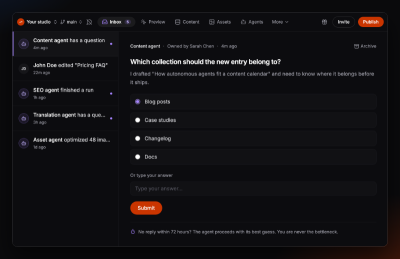
For this system to function, trust is paramount. The current generation of autonomous platforms, such as Fimo, relies on "Explainable Autonomy." Every action taken by an agent is logged. Users can review "before-and-after" states, allowing them to see exactly how an agent optimized a component. Trust is not a gift given at the start; it is earned through thousands of successful, transparent micro-tasks.
Official Perspective: The Future of the Living Web
The goal of autonomy is not to remove humans from the loop; it is to remove the bottlenecks that prevent progress.
"The point of autonomy was never to remove you from your website," states the Fimo editorial team. "It was to remove the decay."
By delegating the tedious, rule-heavy tasks to specialized agents, companies can ensure their digital presence remains a reflection of their current reality, not their past. This allows human teams to focus on the 5% of work that truly drives value—the creative, the strategic, and the empathetic.
Conclusion
The "launch day" version of a website should no longer be its peak. By embracing autonomous systems, we can create websites that breathe, evolve, and improve alongside the organizations they represent. The transition to this model requires a fundamental shift in mindset: moving from a static "final build" mentality to a dynamic "continuous improvement" framework.
As we look toward the future of the web, the most successful sites will not be those built by the most talented coders working in isolation, but by those who have successfully mastered the art of delegation—building agents that respect the human touch while keeping the digital rust at bay. The future of the web is not just code; it is a partnership between human intent and autonomous execution.


 Nila Kartika Wati
 Sagoh
Sagoh
 Siti Muinah
 Jia Lissa
 Asep Darmawan