
 Sagoh
Sagoh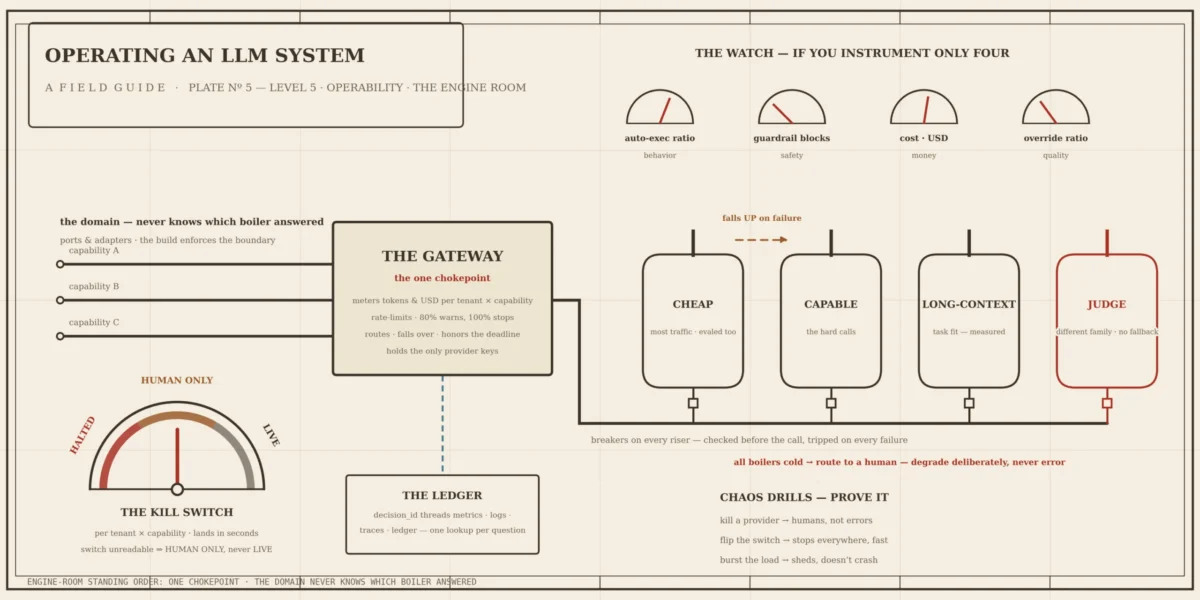
In the rapidly evolving landscape of generative AI, the focus for most engineering teams has historically been on the "getting it to work" phase—fine-tuning prompts, selecting models, and ensuring basic correctness. However, as organizations transition from prototypes to high-stakes production environments, a new, critical maturity level emerges: Level 5, Operability.
This stage of the six-level maturity model for LLM systems is not about model performance; it is about infrastructure sustainability. Operability defines the difference between a system that functions and a system that can be reliably managed, monitored, and scaled. As AI agents move from simple chatbots to autonomous decision-makers, the stakes shift. A traditional service error results in a 500 status code, but an LLM agent that fails can make "wrong actions at scale, fast." This asymmetry makes operability not just a best practice, but a prerequisite for business survival.
Main Facts: The Anatomy of Operability
At its core, Level 5 operability is built upon a singular, unifying concept: the chokepoint. By routing all model traffic through a centralized gateway, engineering teams gain a single vantage point to observe, control, and secure their AI systems. This architecture facilitates the use of a unified decision_id, which threads together every metric, log entry, and trace, allowing developers to reconstruct any single decision—end-to-end—within seconds.
The operability layer consists of several pillars:
- Decision-Layer Observability: Standard metrics like CPU usage and request rates are insufficient. AI systems require "decision-layer" metrics that treat every agent interaction as a first-class, measurable event.
- Structural Cost Control: LLM costs are often invisible until the invoice arrives. By measuring tokens and costs at the gateway, teams can attribute spend to specific tenants, capabilities, or models.
- Granular Control Levers: Implementing routing, fallbacks, and a runtime "kill switch" ensures that if a model provider experiences an outage or a specific agent begins to misbehave, the system can self-correct or be halted in real-time.
Chronology: From Prototype to Reliable Agent
The evolution of an LLM system usually follows a predictable path. Initially, teams rely on vendor SDKs integrated directly into their business logic. As the system grows, this becomes an unmanageable liability.
- The Ad-hoc Phase: The model is called directly from various locations in the codebase. Costs are opaque, and latency spikes are difficult to diagnose.
- The Standardization Phase: Teams introduce a "Gateway" layer. This is the transition to operability. Business logic begins to interact only with internal interfaces (ports and adapters), decoupling the application from specific AI vendors.
- The Resilience Phase: With a gateway in place, teams implement circuit breakers and fallback chains. They start measuring the "Golden Baseline"—a fixed dataset used to verify that optimizations or model swaps do not degrade quality.
- The Maturity Phase (Level 5): The system is fully instrumented. Automated alerting is based on "symptoms" (e.g., judge disagreement rates or cost ceilings) rather than "causes." Chaos testing becomes a standard part of the CI/CD pipeline, where engineers intentionally kill model providers to ensure the system gracefully degrades.
Supporting Data: Metrics that Matter
Standardizing observability requires moving beyond basic service health. To gain true visibility, organizations should implement a "RED + Decision" monitoring model.
Key Performance Metrics
| Metric | Purpose |
|---|---|
agent_decisions_total |
Tracks volume and the split between automated vs. human-in-the-loop decisions. |
agent_decision_confidence |
Measures the distribution of the agent’s self-reported confidence. |
guardrail_blocks_total |
Highlights the efficacy and frequency of safety interventions. |
llm_cost_usd_total |
Provides real-time visibility into spending per tenant and capability. |
shadow_eval_pass_ratio |
Monitors the quality of production traffic against a baseline. |
If a team can only instrument four signals, the most critical are the auto-execution ratio, guardrail block rate, total cost, and human override rate. These four metrics cover the primary vectors of behavior, safety, money, and quality.
Cost and Latency Optimization
Cost and latency are not merely consequences of "using too much AI"; they are often products of architectural inefficiencies. Teams should prioritize these levers in order:
- Deterministic Logic: Use code instead of an LLM for simple rules.
- Batching: Reduce round-trips by processing multiple items in a single call.
- Caching: Memoize repetitive queries or embedding lookups.
- Right-sizing: Use a smaller, cheaper model for simple tasks and reserve high-capability models for complex, high-stakes decisions.
Official Perspectives and Industry Standards
In the context of architectural design, the "Hexagonal Architecture" (Ports and Adapters) has become the gold standard for LLM-powered applications. By ensuring the "domain" code never imports a vendor SDK, teams insulate themselves from provider lock-in and vendor-specific request objects.
When asked about the role of the "Judge" in these systems, lead architects emphasize that the judge must be a different model family than the primary agent. This independence is crucial for identifying blind spots. If the primary model and the judge share the same training bias, they will likely make the same mistakes, rendering the evaluation layer useless.
Furthermore, identity management in agentic workflows has emerged as a major security frontier. Because agents often perform actions long after a user has disconnected, teams must mint short-lived, delegated grants. This ensures that every action is strictly scoped to the tenant and the specific task, effectively mitigating the risk of the "confused deputy" problem.
Implications for Production Environments
The implementation of a Level 5 operability layer has profound implications for how organizations operate:
1. The Death of the "Black Box"
By using structured, tiered logging—where Tier 1 and 2 are searchable for engineers and Tier 3 is treated as a secure, regulated vault—teams remove the mystery of "why" a model made a specific decision. Every action is traceable via the decision_id, turning investigation from an archaeological dig into a simple database lookup.
2. Resilience Through Degradation
The ultimate goal of operability is to ensure that "failing" does not mean "crashing." By designing for graceful degradation—where the system shifts from autonomous execution to human-in-the-loop or uses a fallback model—the business remains operational even during provider outages. This is proven through chaos testing, which forces engineers to confront reality rather than relying on theoretical robustness.
3. The Shift from Vigilance to Automation
Perhaps the most significant implication is the shift in team culture. When infrastructure, identity, and cost are governed by code, engineers spend less time "watching the dashboards" and more time improving the product. Linting rules that prevent vendor-specific imports, for instance, turn the build process into an enforcer of architectural purity, ensuring the system remains clean and portable as it scales.
Conclusion
Achieving Level 5 operability is not a one-time project; it is a permanent change in how a system is constructed. By consolidating all AI traffic through a single, well-instrumented chokepoint, organizations transform their LLM systems from volatile, unpredictable experiments into stable, reliable business assets. The path to production-grade AI is not paved with more models or faster chips—it is paved with the boring, essential work of observability, strict identity boundaries, and the disciplined, deliberate design of failure modes.


 Rifan Muazin
 Raul Delapena Setiawan
 Laily UPN
 Iffa Jayyana
 Suro Senen
 Lina Hope
 Lina Irawan