
 Reynand Wu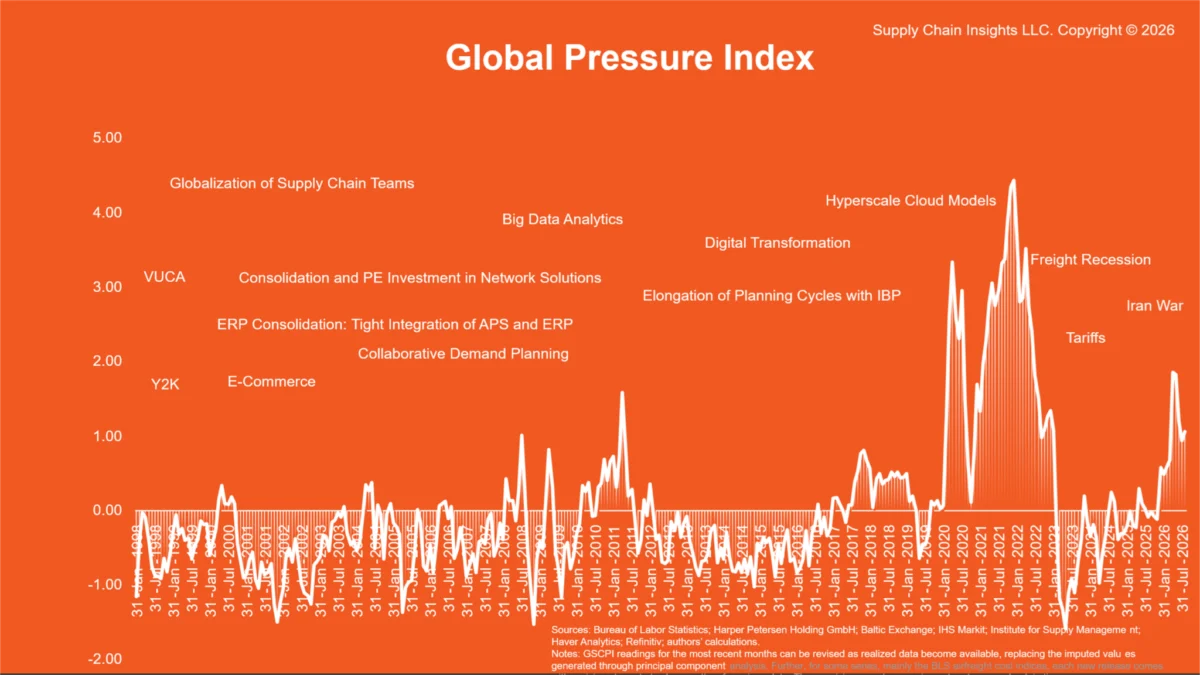
In the mid-19th century, a parable emerged that would eventually become a staple of corporate management discourse: the frog in the pot of water. The premise is simple yet chilling—if you place a frog in boiling water, it immediately leaps out to save itself. However, if you place it in lukewarm water and slowly turn up the heat, the frog, failing to perceive the incremental change, remains in the pot until it is too late.
Today, this analogy serves as a diagnostic tool for the modern supply chain. Companies are currently absorbing unprecedented levels of volatility, geopolitical risk, and technological complexity, yet they remain tethered to outdated core processes. By confusing "historic practices" with "best practices," organizations are inadvertently cooking themselves, attempting to automate broken systems with the latest AI agents without stopping to ask if the underlying processes should exist at all.
The State of Global Supply Chain Volatility
The Global Pressure Index, a barometer for supply chain health, paints a picture of a system under duress. As global markets fluctuate, supply chain leaders are facing a three-fold challenge: the erosion of lead-time reliability, the fragmentation of supplier networks, and the widening gap between digital capability and operational execution.
Rather than fundamentally redesigning their architecture to be resilient, many firms are doubling down on legacy ERP-centric models. They are applying "agentics"—the use of autonomous software agents—to processes that were designed for a more stable, predictable era. This, experts argue, is a fundamental misstep. Automating a sub-optimal process only results in a faster, more efficient failure.
Driving Change: A Strategic Framework
To avoid the fate of the frog, organizations must pivot from incremental adaptation to radical transformation. This requires a rigorous five-step approach:
- Process Deconstruction: Audit every core supply chain process. If a process was designed over a decade ago, it is likely obsolete. Strip it back to the business objective and rebuild it for today’s reality.
- Semantic Synchronization: Standardize the language of the supply chain. If regional teams define "on-time delivery" differently, your data will never yield actionable insights.
- Governance Realignment: Move away from the "SCRUM" mentality—where departments engage in frantic, disorganized competition for resources—and toward a model of clear decision rights.
- Data-First Architecture: Shift from siloed spreadsheets to a unified semantic layer that allows for the integration of structured and unstructured data.
- Human-Machine Symbiosis: Redefine the role of the worker. The objective is not to replace humans with AI, but to use AI to handle the "transactional noise," freeing human talent for strategic decision-making.
Redefining the Relationship with Data
The buzzword of the decade is "orchestration." However, many technology leaders confuse the mechanics of data movement with true process orchestration. Data orchestration is a prerequisite, but it is not the solution.
Currently, approximately 80% of data generated within the supply chain remains unused. This is primarily because this data is unstructured, siloed, or poorly contextualized. To unlock this value, companies must build a semantic layer—a conceptual model that defines how data relates to real-world objects, processes, and business outcomes.

Breaking the Organizational Paradigm
To successfully integrate data, leaders must challenge traditional structures:
- Move beyond the ERP: Stop viewing the ERP as the single source of truth for all things. It is a transactional ledger, not a strategic planning engine.
- Adopt Cross-Functional Ownership: Data should be owned by the business processes it serves, not by IT departments.
- Embrace Unstructured Data: Negotiated contracts, email communications, and supplier sentiment are as important as purchase orders. Connecting these to transactional data is the new frontier of supply chain visibility.
The Governance Crisis: Addressing the "Major SCRUM"
Reflecting on the early development of youth soccer, one cannot help but notice the resemblance to modern corporate decision-making. Just as young players cluster around the ball in a chaotic "SCRUM," supply chain teams often engage in brief, disorderly struggles to define priorities during planning cycles.
The larger the organization, the more acute the problem. Without clear governance, planning meetings become exercises in attrition. Effective governance requires a clear definition of the "Who, What, and When":
- Who: Which individual or team has the final authority for this specific planning window?
- What: What constitutes a "good" decision in this context?
- When: What is the cadence of the review process, and how does it escalate when KPIs deviate from the norm?
Most companies fail because they lack the "Who"—the clear assignment of responsibility versus influence. Without this, even the most sophisticated AI tools will merely provide better data to a broken decision-making body.
Upskilling: The Lost Fundamentals
There is a growing concern that as technological sophistication increases, the industry’s grasp of foundational supply chain principles is eroding. We are witnessing a "precipitous drop" in the understanding of basic concepts:
- Inventory Theory: Many planners no longer understand the mathematical relationship between lead time, safety stock, and service levels.
- Cost-to-Serve: The ability to trace the true cost of a product from raw material to the final consumer is being lost in the abstraction of modern software interfaces.
- Economic Order Quantities: The fundamental physics of supply and demand are being ignored in favor of "black box" algorithmic suggestions.
The AI Strategy: Moving Beyond Agents
When executives speak of "AI," they are almost exclusively speaking about agents. However, agents are only as good as the instructions they are given. Implementing agents on top of traditional, flawed supply chain architectures is a recipe for disaster.
Instead, companies should look at AI as a portfolio of capabilities:

- Deep Learning/Reinforcement Learning: For better engine performance in forecasting and replenishment.
- LLMs: For the synthesis of unstructured data and the democratization of insights.
- Data Transformation: Using Gen AI to build the semantic layers that bridge the gap between transactional and contractual data.
The goal is not to automate the "how," but to enhance the "why."
Rethinking "Connection" and the Bullwhip Effect
In 2012, the concept of the "connected supply chain" was hailed as the successor to the "integrated supply chain." However, years of testing have revealed a hidden cost: hyper-integration with ERP systems often exacerbates the bullwhip effect. By creating rigid, real-time connections between transactional systems, companies often amplify small market signals into massive, destabilizing shocks.
The true definition of a "connected" supply chain lies in the bridge between structured and unstructured data. Take the discrepancy between a Purchase Order (PO) and a Customer Order. While they look similar on paper, they are governed by vastly different legal and contractual frameworks. Most of these contracts remain buried in static files, completely disconnected from the execution of the order.
True connectivity means enabling "touchless" management that understands the terms and conditions of a contract, not just the price and quantity. Currently, order management is the "Wild West," plagued by compliance issues, credit disputes, and master data failures. Until we bridge the gap between the contract (unstructured) and the transaction (structured), true end-to-end efficiency will remain elusive.
Looking Ahead: The Future of Supply Chain Intelligence
As we look toward industry events like CSCMP Edge, the conversation is shifting from simple automation to intelligence and strategic maturity. Through new initiatives—such as the partnership between ISCEA and platforms like AskLora.AI—the focus is moving toward equipping leaders with the tools to benchmark their maturity, evaluate risk, and gain strategic clarity.
The "boiling frog" is an apt metaphor, but it does not have to be a prophecy. By acknowledging the limits of our current systems, redefining our relationship with data, and returning to the foundational principles of supply chain management, organizations can stop absorbing the heat and start managing the temperature.
The path forward requires courage: the courage to stop "doing what we’ve always done" and the discipline to build a supply chain that is not just connected, but truly intelligent.

 Nila Kartika Wati
 Lina Hope

 Jia Lissa
 Basiran
 Sagoh
Sagoh